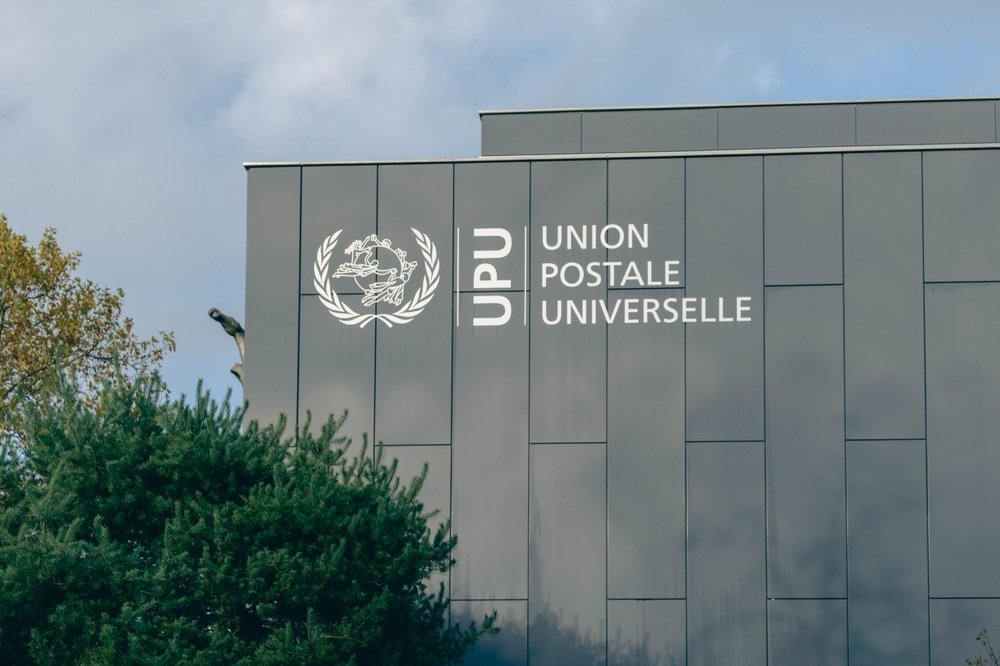
In a landmark vote at the 28th Universal Postal Congress, Universal Postal Union (UPU) member countries approved new measures granting the State of Palestine expanded observer rights within the union’s decision-making structure.
The 28th Universal Postal Congress, held in Dubai on Sept. 8-19, offered a rare opportunity to address a long-standing inequity. In a symbolic yet significant development, the State of Palestine – long confined to the margins of participation within the union – was granted expanded observer rights, allowing a deeper, though still limited, engagement in the UPU’s decision-making processes.
The UPU resolution, passed by a majority of 107 votes, allows Palestine to sit alphabetically among member states, to raise points of order, to co-sponsor proposals, to request items on the agenda, and to see its flag flutter-albeit after those of “full members.” The measure is historic in the UPU’s limited universe. A cautious expansion of rights first granted in 1999, when Palestine was permitted to exchange mail and speak in sessions concerning itself. This new resolution opens the microphone a little wider and lets the Palestinian flag climb a little bit higher. But it still stops at the one act that would truly signal justice: a vote, a voice equal to others.
There is something painfully familiar about this dance of incremental dignity. For decades, Palestine has been granted the same ritual crumbs across the United Nations system: recognition without consequence, membership without agency. The flag is raised, but the people beneath it remain occupied, their mail censored, their homes demolished, their very names erased from registries that once bore their ancestors.
When Huda Alwahidi, vice minister of the Palestinian Ministry of Telecommunications and Digital Economy, welcomed the resolution, she said it would help “uphold the dignity of Palestinian citizens.” Her words were simple, even humble. But they also hinted at the tragedy of low expectations – how dignity itself has been reduced to the symbolic right of a flag at a U.N. building, while millions of lives remain trapped under siege.
Robert Fisk might have called this “the theater of recognition.” What use is a postal right when no state exists to deliver letters from Gaza? What meaning does a raised flag have when the post offices beneath it lie in rubble?
For decades, the Palestinian postal system has been both a victim and a metaphor of occupation. Envelopes opened by foreign hands. Parcels delayed, censored, or “lost.” In the silence of mailrooms, the politics of control revealed itself: who is allowed to send, who is allowed to receive, who is allowed to exist in the ledger of nations. To write “State of Palestine” on a stamp was once an act of defiance; today, it is still an act of courage.
The UPU’s decision, therefore, is not without meaning. Symbols matter, and in diplomacy, even the smallest clause can signify the slow thaw of injustice. But symbols can also be a means of evading responsibility. They allow those who hold power to pretend to be generous without being just. To offer half a seat, half a right, half a recognition, while the world outside the conference hall continues to burn.
It is easy to forget that the UPU was founded in 1874 as one of the earliest instruments of international cooperation–an embodiment of trust between nations. That the same institution, 150 years later, still hesitates to acknowledge Palestine as an equal member tells us much about the progress of the global moral compass. The UPU, after all, is not a political body; it is about letters, not land. And yet, even here, politics infiltrates like ink through paper.
The resistance to Palestinian membership in international organizations is not procedural; it is ideological. It is the continuation of a long tradition of silencing under the guise of neutrality. Those who voted “no” or “abstained” at the UPU did not fear chaos in the mail system; they feared what every symbol of equality threatens to expose–that Palestine is real, enduring, and deserving of the same rights as any sovereign nation.
The tragedy is that this recognition comes at a time when the Palestinian postal service itself lies in ruins.
Still, one cannot dismiss the quiet power of such gestures. History has a strange way of collecting these fragments – the flag here, the seat there, a line in a resolution – and one day turning them into sovereignty. Perhaps one day, a child in Gaza will send a letter stamped with “State of Palestine,” and it will arrive unimpeded, unopened, unjudged. Perhaps one day, the mail will no longer carry the weight of occupation.
So yes, let the flag rise in Bern. Let the diplomats applaud and record their votes. But history will remember not the number of abstentions, nor the polite smiles in the assembly hall. It will remember the silence – the decades of silence that preceded this moment – and ask how many resolutions it takes before justice is finally delivered.
Because the true test of a universal postal union is not in the number of letters it routes, but in whether it still believes in the humanity of those who write them.
The UPU’s new resolution grants Palestine a seat, a voice and a flag – but not equality. It is the latest act in a long theatre of symbolic justice that delivers gestures instead of rights.