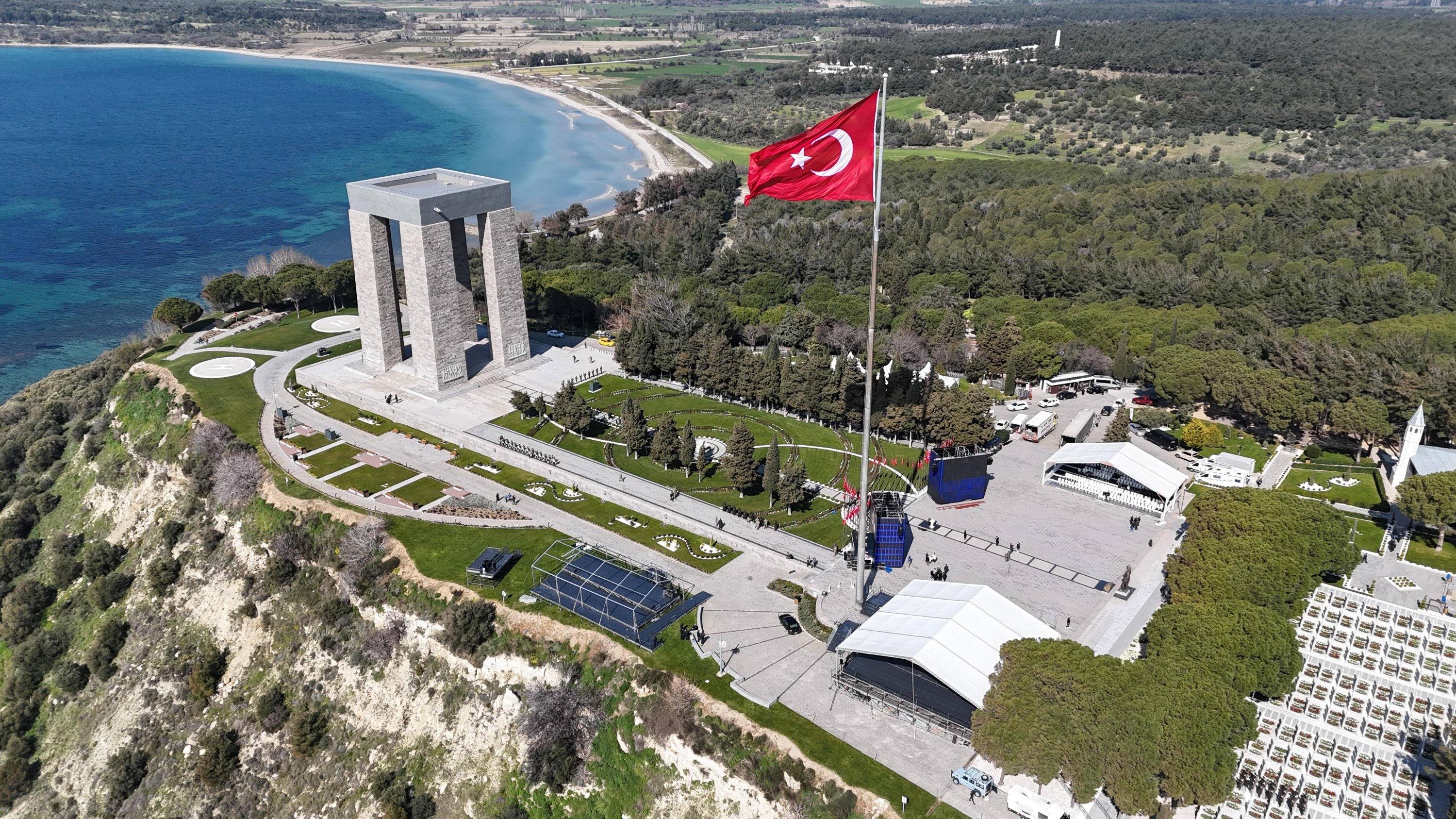
When World War I erupted in 1914, the Ottoman Empire stood at a crossroads. For over a century, the empire had suffered heavy losses across its territories stretching from the Balkans to North Africa in the face of growing European pressure. Facing an existential threat to its sovereignty, the empire aligned with the Central Powers alongside Germany and entered a war that would determine not only its borders but also its very survival against Britain, France and Russia.
It was within this context that the Gallipoli victory of 1915 became one of the most consequential engagements of the entire war.
The strategic logic was straightforward: by forcing the Ottoman Empire to open the Dardanelles Strait, the narrow waterway connecting the Aegean Sea to the Sea of Marmara and ultimately Istanbul, the Allied powers hoped to knock the empire out of the war entirely, open a supply route to their Russian ally, and potentially swing the war's momentum in their favor.
Winston Churchill, then first lord of the Admiralty, was among the campaign's most ardent architects. The plan called for a combined naval and land assault. If successful, it could have reshaped the entire course of the war. If it failed, the consequences for the Allies would be severe, and for the Ottomans, survival itself was at stake.
What the Allied planners had not accounted for was the soldiers standing on the other side of that calculation. The Ottoman forces were bound by an ideological cohesion rooted in faith, homeland and an unshakeable conviction that the ground they held was inseparable from their identity as a people. No naval superiority, no industrial advantage could model that variable.
When British, French and Anzac forces tried to take the strait and failed, Gallipoli proved one thing beyond argument: "Çanakkale is impassable."
No imperial power can break the people fighting for their own survival. 111 years on, three stories tell us how that line was held.
On 18 March 1915, the Allied fleet suffered a crushing defeat: three battleships were sunk, the HMS Ocean, the HMS Irresistible, and the French Bouvet; three more were heavily damaged, and over 700 sailors died in a single day. Yet within that time, one moment stood apart.
When the loading crane at the Rumeli Mecidiye Battery failed, the battery's combat capability collapsed with it. The position, by any military calculus, was neutralized. Corporal Seyit Onbaşı rejected that equation. He lifted a 276-kilogram shell, carried it to the cannon, and loaded it himself. It struck the HMS Ocean, which sank.
Seyit replaced a mechanical system with a human one. That act defines how the entire battle of Gallipoli was fought: wherever the Ottomans lacked material capability, individual willpower filled the gap. Not just as inspiration, but as a functioning military power.
The way he described his achievement reflects the feelings shared by numerous soldiers: “I did not carry the shell. I carried my homeland."
When a soldier's identity is bound to a collective cause, his behavior can no longer be predicted by standard rational-actor models. This is precisely how willingness to sacrifice shapes military outcomes and why Gallipoli defied imperial calculation.
If Seyit's act illustrates how dedication expands physical capacity, Sergeant Yahya demonstrates what happens when every conventional means of resistance has been removed. During close-quarter fighting on the Gallipoli ridges, he found himself without ammunition, without reinforcements and in direct contact with advancing enemy forces.
The ridges of Gallipoli were narrow, blood-soaked strips of earth where opposing trenches often stood no more than a few meters apart, well within auditory range of enemy movement. Standard doctrine would classify this as the threshold for withdrawal. Sergeant Yahya picked up a shovel.
He led a hand-to-hand counterattack that pushed enemy forces back from positions they had already occupied. With a small unit of men under his command, he managed to resist three British regiments for hours at Ertuğrul Bay, effectively delaying the Allied forces’ landing.
This outcome cannot be explained solely by material factors. What explains it is a variable that conventional military analysis tends to underweight: deeply internalized values such as devotion to the homeland that shape battlefield behavior.
On April 25, Anzac forces landed at Arıburnu with the strategic objective of securing the Conkbayırı ridge before Ottoman defenses could consolidate. What they encountered was not a prepared fortification but the 57th Infantry Regiment, a unit of largely inexperienced soldiers, and a commander who acted before his orders arrived. Lieutenant Colonel Mustafa Kemal deployed the regiment on his own authority, understanding that losing the ridge would compromise the entire Ottoman defensive line.
By 9:40 that morning, the situation was critical. The regiment's ammunition was nearly exhausted, and soldiers were already pushed to their physical limits. It was at this point that Mustafa Kemal issued what has since become one of the most cited commands in military history:
"I am not ordering you to attack. I am ordering you to die. In the time that passes until we die, other troops and commanders can come forward and take our places."
The regiment held. Of its roughly 3,000 soldiers, only a handful survived the battle. Fighting without reinforcement or relief from April 25 to May 17, the 57th absorbed the full weight of the Anzac assault at its most critical phase, securing the time the broader Ottoman defense required. The 57th was not merely a military unit. It was the decisive proof that collective will, when absolute, outweighs any material advantage.
For the Ottoman Empire, Gallipoli was one of the few bright moments in a war otherwise defined by defeat and devastating loss. A smaller force held one of the most powerful and modern armies in the world at bay, not through material superiority, but through the unbreakable bond between a nation and its homeland, a force that would lay the foundation for the Republic of Türkiye in 1923.
The consequences of Gallipoli extended far beyond the Ottoman front. Without Allied support, Russia broke from within, and the revolution of 1917 changed far more than the war itself. For Britain and France, it was one of the costliest miscalculations of the war, a campaign that consumed vast resources, damaged reputations, and forced a fundamental rethinking of Allied strategy. For Australia and New Zealand, Gallipoli not only cost the lives of their soldiers, but it also shaped who they became as nations.
What Gallipoli established, beyond any military calculation, is that collective will is not a soft variable but a strategic force capable of overriding material advantage. That remains its most consequential legacy, extending well beyond Türkiye's borders.
May the souls of all who held that line, named and unnamed, rest in peace on the 111th anniversary of the Gallipoli Victory.