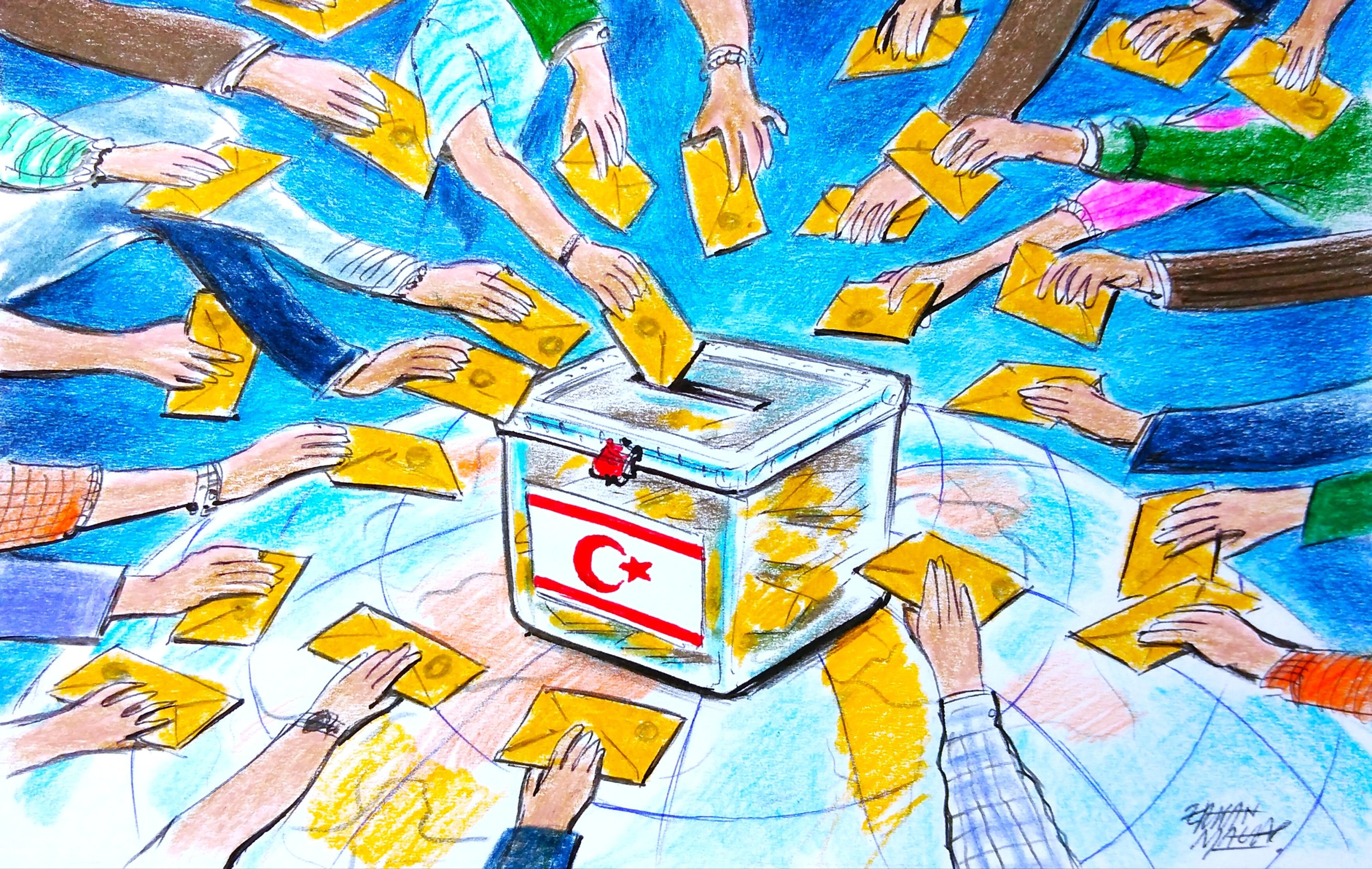
One fact should trouble every Turkish Cypriot who has wondered why 50 years of struggle for recognition have yielded so little: Hundreds of thousands of Turkish Cypriots abroad who fought for their independence back then had no vote in a decision shaping their homeland's future, and few were even consulted.
That has to change and the moment is now. Whenever the next parliamentary election is called, candidates will fan out to London, Berlin and Istanbul, the cities they have most consistently courted in the past, chasing the diaspora's financial support, its volunteers and its blessing, while withholding the one thing that would make that courtship a two-way transaction: a vote. Diaspora organizations should treat that imbalance as leverage, not an insult to shrug off: no hall booked, no photograph taken and no cheque signed without a public answer on the demands below. This is the best leverage the community has, and it should not be spent for free.
The prize is specific. An organized diaspora is the only force that can unwind an embargo that still bars direct flights, trade, sporting fixtures and international recognition. Moreover, it is the only group that can advocate for making the Turkish Republic of Northern Cyprus (TRNC) a known place rather than a rumor on a map, and build the international goodwill any future recognition of Turkish Cypriot self-determination will need. None of that gets built at home in Lefkoşa (Nicosia). It gets built in Westminster, the Bundestag (which blocked two German lawmakers, Achim Köhler and Maximilian Krah's request to visit the TRNC most recently), and increasingly, Brussels.
Nobody in authority has ever agreed on the diaspora's real size. Diaspora organizations, led by the Overseas Turkish Cypriots Union Platform, put the global total at roughly 650,000. Government-linked estimates run higher: Britain's Home Affairs Committee was told in 2011 that "about 300,000" Turkish Cypriots lived in the United Kingdom. A government-linked estimate in Türkiye puts the figure there at 500,000, while Australian estimates reach 120,000.
Add those three alone, and the total exceeds the diaspora's own figure, proof of how badly this population needs an honest count. What is not in dispute is that more Turkish Cypriots live abroad than are even registered to vote at home. At the last count, ahead of a 2023 by-election, 210,121 people were on the electoral roll in the TRNC, fewer than the low estimate for Britain alone. This is not a scattering of exiles. It is a nation in waiting, and it has done astonishingly little with the fact.
Compare that with the Greek Cypriot diaspora, worth studying closely. Roughly comparable in size, it organized decades ago under umbrella bodies – POMAK, the World Federation of Overseas Cypriots, PSEKA in the United States, NEPOMAK for younger generations. It is coordinated with the Presidential Commissioner's office and, since 2023, has become a formal national diaspora strategy. It meets annually, lobbies in unison, and has kept the Cyprus problem alive in Washington, Brussels and Canberra for half a century.
Turkish Cypriots abroad haven't built anything comparable so far. Attempts to unite the diaspora date to 1975, under the late Prime Minister Nejat Konuk, and have been revived by half a dozen governments since, including a 2020 presidential committee, without ever producing a functioning organization. What exists instead is a patchwork of cultural associations and rival platforms, mostly unknown to their host governments, let alone to the authorities in Lefkoşa.
The remedy is not complicated, even if executing it will take discipline.
What we need is, firstly, one voice, not 50. Turkish Cypriots abroad need a single, professional diaspora council with a paid staff, a public-affairs operation, offices starting with London, formally linked to Lefkoşa's ministries so priorities are set in consultation with the state, not shouted at it.
The same body should run language and culture programs for younger generations, investment vehicles for the north, and support for those who want to return. It should place Turkish Cypriots in positions of influence across host-country politics, civil service, media and business, coordinated as assets rather than celebrated at galas. Additionally, it should be funded the way rival diasporas fund themselves, through a standing network of major donors and business figures, not one-off collections.
Second is the vote, and the diaspora needs a receipt, not a hypothesis. Currently, only Turkish Cypriots formally registered as residents in the north and staff at official missions abroad can vote, not diaspora members merely visiting on election day. There is no postal or embassy ballot for the wider diaspora.
In January 2025 in London, Prime Minister Ünal Üstel promised "serious work" on new electoral legislation "in the near future." Nine months later, the October 2025 election that chose President Tufan Erhürman ran under the same old rules.
A "seventh constituency" for Turkish Cypriots abroad has been drafted in outline by diaspora organizations for years. Every candidate courting diaspora support before the next parliamentary election should be made to say when they will deliver it. Article 21 of the Universal Declaration of Human Rights guarantees every citizen a voice in their government. Over a hundred states already extend external voting, including Türkiye, which has enfranchised its own diaspora since the 1950s and now counts more than 3.4 million registered voters abroad. If Ankara can do it, Lefkoşa can too.
There is also a harder argument for urgency. First, Turkish Cypriots abroad tend to make quietly among themselves rather than in public, that the diaspora may be the community's most reliable constituency for sovereignty itself. Having spent decades as a minority in Britain, Germany, Australia or Canada many say they understand something the island can afford to forget, which is Turkish Cypriot identity carries little weight anywhere without Türkiye's protection behind it, and that a shared "Cypriot" identity, however appealing to federalists on both sides of the Green Line, has never in 50 years actually erased the line between the two communities. Whether or not one agrees, that view deserves a vote alongside every other one, which is exactly why this fight belongs at the top of the list.
Another issue is holding both citizenships and registering, not just applying. Many Turkish Cypriots whose roots predate 1974 already qualify for citizenship in the Greek Cypriot administration, and with it, an EU passport. Every eligible Turkish Cypriot abroad should claim it. Unlike a TRNC passport recognized almost nowhere on Earth, a Southern Cyprus one offers full consular protection and visa-free travel, and, for those who resettle elsewhere in the EU, an actual ballot for the European Parliament, a foothold in the very institutions now inserting themselves into Cyprus's future. That should not be oversold.
Like most states, the Greek Cypriot administration only lets citizens vote from outside the EU if they lived there and registered before moving abroad, so most diaspora-born applicants won't qualify automatically. What it guarantees everyone, though, is standing if the island ever votes again. History offers a warning here. When Cyprus last voted, on the Annan Plan in 2004, eligibility ran through the electoral roll on the island, not citizenship held abroad. If the island votes again, registration will matter as much as status, which is why securing a permanent right to external referendum voting should be a diaspora council's first-order task.
Fourth, concentrating lobbying efforts where they can do the most good, and that place is Britain. The U.K. is a guarantor power under the 1960 Treaty of Guarantee and home to the largest Turkish Cypriot community outside Türkiye, with a Parliament that has proven receptive – dozens of lawmakers have backed ending the ban on direct flights to Ercan. Turkish Cypriots sit in the House of Lords and the City of London Corporation; one has served as a British ambassador. The U.K. is where this model can be proven before it is exported to Germany, the United States, Australia and beyond. What has taken root there over the past decade should be the template, not the ceiling.
Fifth is taking Brussels seriously. For two decades Cyprus was, for the European Union, someone else's problem, managed through the United Nations and the Green Line trade regulation. That has changed with the commission's appointment of Johannes Hahn as Special Envoy for Cyprus in May 2025. After Hahn's resignation in March 2026, it moved not merely to replace him but to upgrade the post, naming Executive Vice-President Raffaele Fitto, one of the most senior figures in Brussels, as special representative in July 2026, tasked with reunification diplomacy and the EU's aid programme for Turkish Cypriots. A diaspora with no presence there, and no organized voice among the many Turkish Cypriots who already hold EU passports, will watch this happen to it. One that builds those relationships now will help shape it.
None of this requires pretending the dispute is settled, or denying that Turkish Cypriots hold genuinely different views on their island's future. It requires only that Turkish Cypriots abroad stop being spectators to decisions made in their name and start making the TRNC's isolation harder to justify and its people's right to be heard harder to dismiss. Whichever path the island takes, it should reflect the settled will of the whole Turkish Cypriot people, not only of those who never had to leave. A divided, invisible diaspora will keep losing by default. An organised one has, for the first time in decades, an audience that is listening.
The choice, unusually for a disorganized people, is entirely in their own hands.