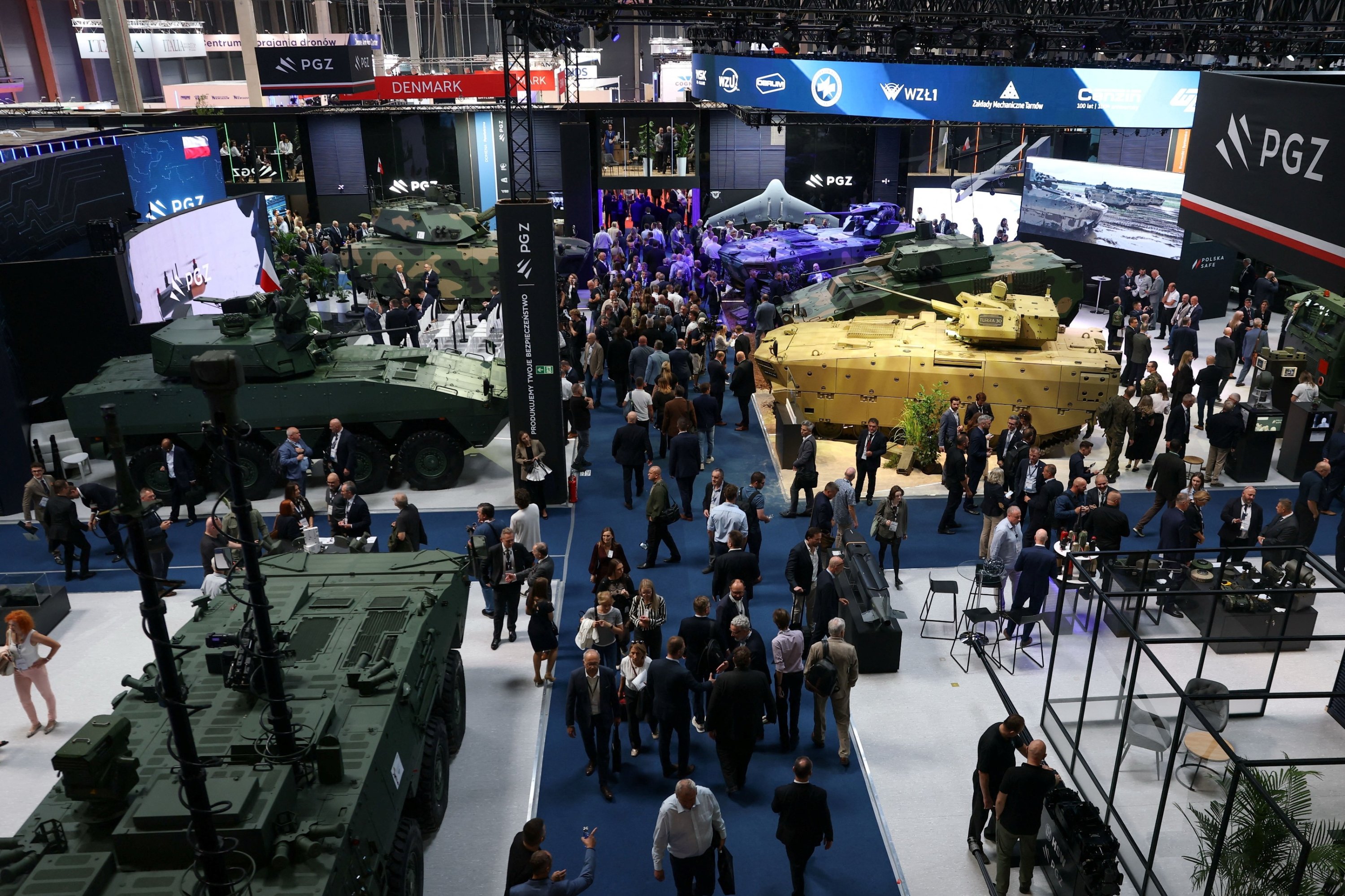
Last week, I traveled to Kielce, Poland, to attend the 34th International Defense Industry Fair (MSPO 2026). What I witnessed there was a source of great pride. With its political will, military strength, diplomatic reach and technological capabilities, Türkiye is playing a central role in shaping Europe’s evolving security architecture.
The discussions I had at the fair with Türkiye’s Ambassador to Warsaw, Rauf Alp Denktaş, President of the Defense Industries professor Haluk Görgün and Aselsan's General Manager Ahmet Akyol conveyed important and complementary messages.
Furthermore, the national missile and ammunition systems I examined at the MKE and Roketsan booths offered a tangible demonstration of how these messages are being translated into capabilities on the ground.
Denktaş, whom I met in front of the MKE booth, described the importance of Türkiye-Poland relations with a particularly striking statement.
“Türkiye and Poland are not just any two countries," he said.
As he pointed out, Türkiye and Poland possess the two largest land forces in NATO’s European command. Türkiye ranks first, while Poland ranks second. At the same time, both countries are among the world’s leading economies. While the history of diplomatic relations between Türkiye and Poland spans over 600 years, the two countries have maintained a strategic partnership since 2009.
Denktaş also noted that he is the 114th Turkish ambassador to Poland. This is a figure that alone speaks to the historical depth of the relationship between the two countries.
However, the real driving force behind this historic friendship today is the defense industry. As Denktaş put it, “Security is now the world’s primary concern.” Poland is the NATO member that allocates the largest share of its national income to defense. With its advanced technologies, production capacity and operational experience, Türkiye is one of the strong partners Poland needs.
Indeed, Polish officials have openly stated that they are taking Türkiye’s defense industry model as an example.
The figures presented by Görgün clearly illustrate the level Türkiye has reached.
Last year, Türkiye exported more than 230 defense products to 185 countries and rose to become the world’s 11th-largest defense exporter. Defense exports since the beginning of 2026 have reached $6.4 billion.
It is also important to correct a common misconception here. It is often assumed that the Turkish defense industry’s exports are primarily directed toward African and Asian countries. However, according to the data disclosed by Görgün, 56% of last year’s exports were made to European and NATO countries.
The fact that the defense industry’s localization rate, which stood at approximately 20%, has reached 80% over the past 20 years is the key factor behind this success. Türkiye is no longer merely a seller of products. It has become a country that shares its production expertise, technology and the defense industry model it has developed with other nations.
Akyol explained Türkiye's rising strategic weight through three elements: effective diplomacy, a strong military and a strong defense industry.
When these three elements come together, a significant power multiplier emerges. Diplomacy creates opportunities at the negotiating table, the Turkish Armed Forces (TSK) provide deterrence on the ground and the defense industry ensures this power remains independent and sustainable.
Aselsan’s collaboration with Poland, which began in the field of border security, has expanded to include radar and electro-optical systems. Following the success of the first package, a contract was signed at MSPO regarding the project’s next phase.
Akyol’s remarks on electronic warfare were also extremely significant. Akyol stated that Aselsan ranks among the top three companies in the world in the field of electronic warfare. Work on the electronic warfare systems developed for Poland, and the payloads to be integrated into unmanned vehicles, is proceeding as planned.
The Roketsan booth served as a summary of Türkiye’s leap forward in missile and munitions technology.
The Teber guidance kit transforms conventional bombs into high-precision smart munitions. With a range of up to 8 kilometers (5 miles), Sungur eliminates reliance on foreign sources for low-altitude air defense. While the Khan missile, with a range of 300 kilometers, provides strategic deterrence, the IHA-230, with a range of approximately 150 kilometers, enables unmanned aerial vehicles such as the Akıncı to strike targets without entering the enemy’s air defense range.
The version of the MAM-T equipped with an imaging infrared seeker enhances target identification in intense electronic warfare environments. The Pusu system, meanwhile, creates a mobile and low-cost line of defense against drones and helicopters using Cirit missiles.
What I witnessed in Poland is more than just a trade show success.
Denktaş’s diplomatic perspective, Görgün's export figures, Akyol’s emphasis on technology and the strike systems showcased by MKE and Roketsan all point to a single conclusion: Türkiye is no longer just selling weapons. It is exporting technology, trust, deterrence and long-term strategic partnerships. This is the message Türkiye sent to the world from Poland.