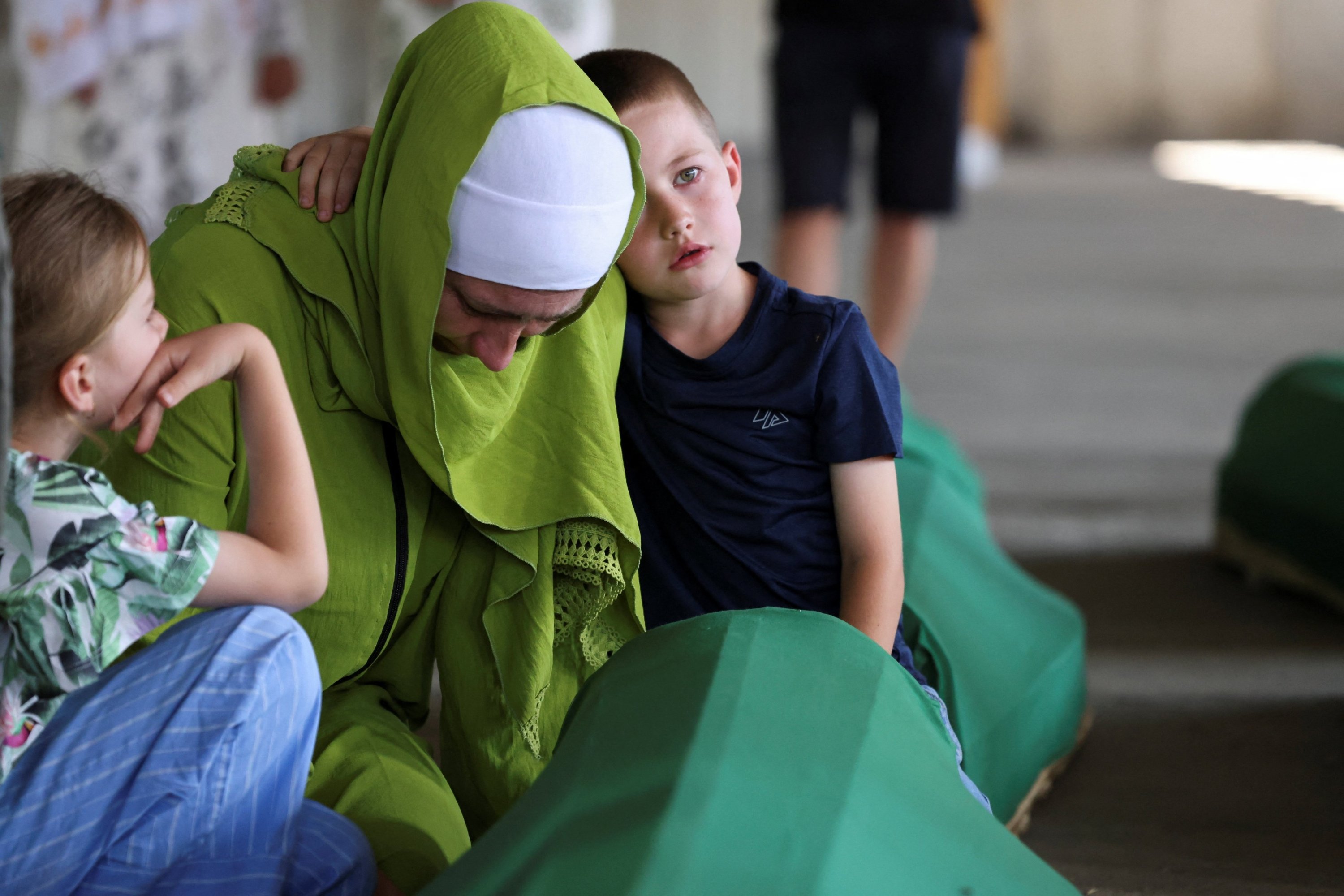
On July 11, as thousands gather beneath the white marble headstones of the Srebrenica-Potocari Memorial Centre, 10 more victims of Europe’s worst atrocity since World War II will be laid to rest. Most were young men in their 20s and 30s. They had mothers waiting for them, wives expecting them, children who would grow up without fathers. In July 1995, they fled through the forests of eastern Bosnia after the United Nations “safe area” of Srebrenica collapsed before the eyes of the international community. They believed they might still reach free territory.
Instead, they walked into history’s largest mass execution on European soil in half a century. Thirty-one years later, only fragments of their bodies have been recovered. Some families will bury only a few bones. The rest may never be found. That is why Srebrenica is not history. It remains an unfinished crime.
So many years later, around 80 families are still waiting for enough remains of their loved ones to conduct a burial. Many have recovered only a handful of bones. Others refuse burial altogether, hoping that one day another excavation will uncover enough to bury a son, husband or brother with dignity.
For these families, time itself has become another form of violence. Over the years, I have spoken with countless mothers and widows who have waited decades for a phone call from investigators. Again and again, they tell me the same thing: there can be no closure without a grave. Without a place for prayer. They feel forgotten.
Some parents died before they could bury their children. They died alone, in their pain, without ever having closure. Others continue waiting, growing older with every July anniversary.
Imagine living for 31 years without knowing where your child’s body lies. Imagine having nowhere to place flowers, nowhere to mourn.
This remains the reality for dozens of families in Bosnia-Herzegovina. And Bosnia’s tragedy continues because justice stopped halfway.
The international tribunals prosecuted those most responsible for genocide. The International Criminal Tribunal for the former Yugoslavia and later international courts established beyond legal doubt that genocide occurred in Srebrenica. But courts alone cannot complete justice.
Justice also means finding the missing and uncovering every mass grave. Justice means compelling those who know where bodies were hidden to reveal the truth.
Instead, international attention has faded. As The Hague closed its doors and international investigations slowed, so too did the search for the missing. Fewer international investigators remain involved. Meanwhile, those who participated in concealing bodies, or know where secondary and tertiary mass graves are located, are themselves growing old.
Every year increases the possibility that someone dies carrying the location of another grave. With them dies another family’s chance of ever finding the truth.
This unfinished justice creates fertile ground for something equally dangerous: historical revisionism. Despite multiple international judgments confirming that genocide occurred in Srebrenica, denial remains a central feature of political life in the Bosnian entity of Republika Srpska. Convicted war criminals Ratko Mladic and Radovan Karadzic continue to be celebrated by sections of society. Bosnia criminalised genocide denial, yet enforcement has been inconsistent, allowing denial and glorification to continue with little consequence.
The danger today is no longer only denial; it is also the deliberate rewriting of history. Bosnian Serb political leaders, including Milorad Dodik and Zeljka Cvijanovic, increasingly present themselves internationally as victims while promoting alternative narratives that directly contradict established judicial facts. These narratives have found audiences abroad, including in Tel Aviv and Washington, where lobbying efforts seek to reshape international perceptions of the Bosnian war. History shows that reconciliation cannot coexist with competing realities. No society can build peace while simultaneously debating whether genocide occurred. That is why the fight over memory matters.
Srebrenica story is not only about the past; it is about preventing the future.
The Balkans have repeatedly demonstrated what happens when nationalist myths replace historical facts. Every generation that grows up believing fabricated versions of history becomes more vulnerable to political manipulation and ethnic mobilization. The warning signs should concern Europe as much as Bosnia.
The United Nations General Assembly recognized this reality in May 2024 when it adopted the Resolution establishing July 11 as the International Day of Reflection and Commemoration of the 1995 Genocide in Srebrenica. The resolution also calls upon states to preserve the judicially established facts about the genocide through education and to combat genocide denial and the glorification of convicted war criminals. Yet the resolution’s adoption represented something larger than diplomacy.
It affirmed that Srebrenica belongs not only to Bosnia but to humanity’s shared historical conscience. Because Srebrenica is not only Bosnia’s story. It is a story about what happens when the international community mistakes diplomacy for protection, neutrality for justice, and hesitation for prudence. It reshaped humanity’s understanding of what genocide is and what indifference costs.
Just as Gaza is not solely a Palestinian story or tragedy, Srebrenica is a warning to the entire international community about the consequences of dehumanization, ethnic hatred and political indifference.
If the world truly wants to honor the victims, remembrance alone is no longer enough. The final chapter of Srebrenica will not be closed when another funeral is held. It will close only when every missing victim is found. When those hiding information about mass graves finally speak. When genocide denial carries real legal consequences. When schoolchildren around the world learn about Srebrenica alongside the Holocaust and the genocide against the Tutsi in Rwanda. And when historical truth becomes stronger than political propaganda.
If Srebrenica remains only Bosnia’s memory, we have misunderstood its purpose. If Gaza remains only the Middle East’s tragedy, we are making the same mistake again. The victims of mass atrocities do not ask us to inherit their grief. They ask us to inherit their lesson and hear their screams.