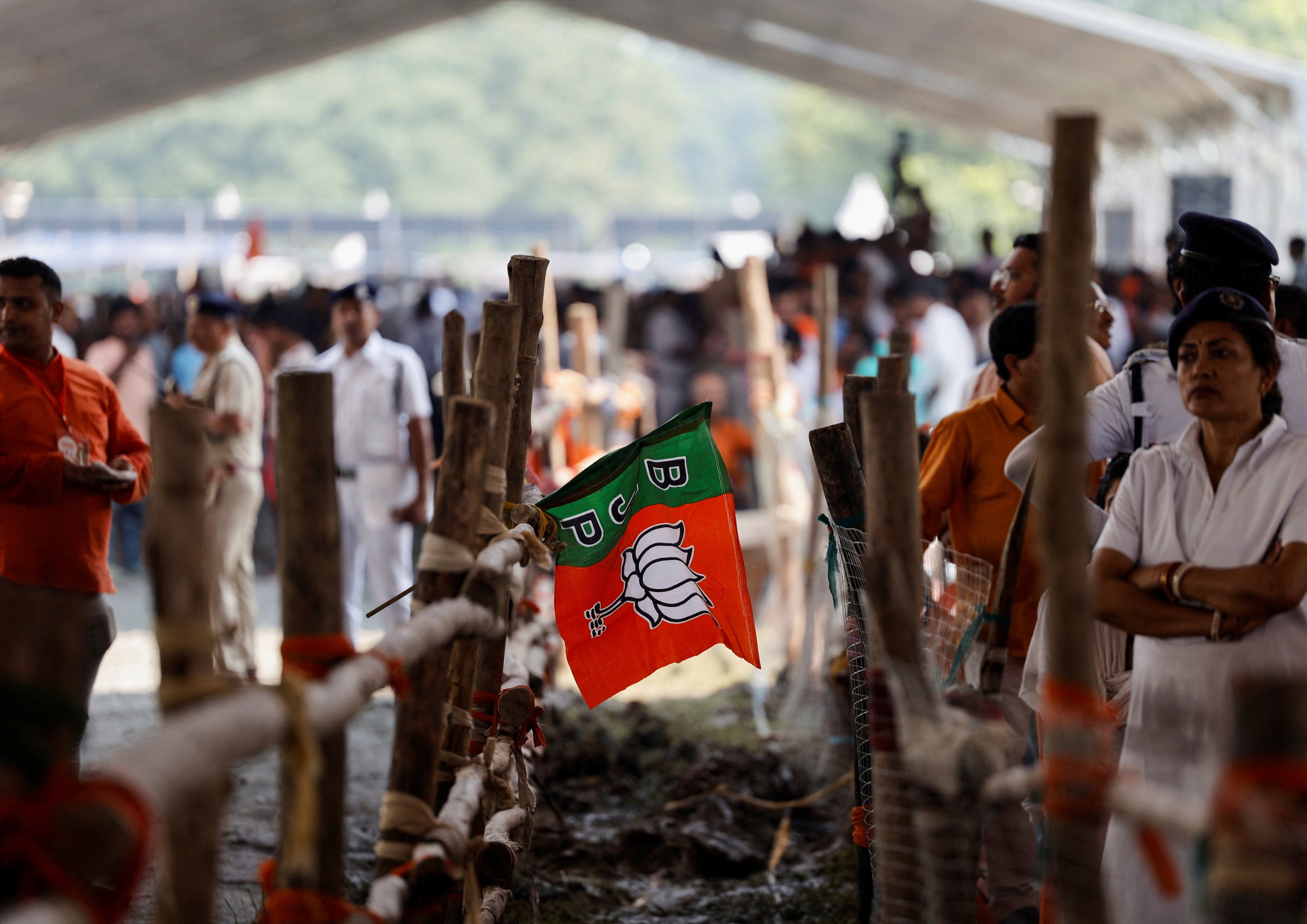
India’s recent provincial elections across five major states produced more than routine political change. The results reflected shifting alliances, rising polarization and the continuing dominance of identity politics in the country’s democratic landscape. In several states, the Bharatiya Janata Party (BJP) strengthened its position through a combination of welfare politics, organizational discipline, Hindu nationalist mobilization and opposition fragmentation. Elsewhere, regional parties managed to retain influence but often with reduced confidence and increasing political pressure.
Yet among all the election results, West Bengal carried a significance that cannot be fully understood through conventional political analysis alone. Unlike states where Hindu nationalist politics had already become normalized, Bengal long projected itself as the intellectual and secular exception within Indian politics. BJP’s breakthrough there therefore appeared not merely as an electoral shift, but as the exposure of deeper cultural tensions that had existed beneath Bengal’s secular self-image for decades.
Bengal was historically one cultural region before the partition of British India in 1947, which divided it into India’s West Bengal and present-day Bangladesh. Despite becoming separate political entities, the two sides continue to share language, literary traditions, media influence and one of the longest and most politically sensitive borders in South Asia. West Bengal alone shares more than 2,200 kilometers (1,370 miles) of border with Bangladesh. For this reason, political and cultural developments in Bengal rarely remain confined within one state or one country.
The real significance of Bengal’s political shift lies not only in the rise of the BJP. It lies in the exposure of a deeper cultural structure that long existed beneath the language of Bengali secularism. The election did not suddenly create polarization from nowhere. Rather, it made visible tensions that had often been softened, hidden or described as merely “cultural.”
For decades, Bengal occupied a special place in the South Asian liberal imagination. It was presented as the land of syncretism, poetry, intellectualism and secular coexistence. The Bengali bhadralok (Western-educated upper-caste middle-class elite) tradition, shaped by colonial modernity and elite Hindu reform movements, produced an image of Bengal as morally different from the supposedly more communal politics of North India. Yet this self-image often depended on a silent assumption: That Bengali culture itself was neutral, universal and naturally inclusive. But that culture had never been entirely neutral.
Anthropologist Irfan Ahmad recently argued that the West Bengal election result should not be understood merely through electoral arithmetic or short-term political strategy. Rather, it reflects a deeper historical pattern in which Indian liberal and intellectual traditions often present Hindu social experience as culturally universal and secular, while millions of Indian Muslims, including the large Muslim population of West Bengal, remain marginal within the broader imagination of “India.” In this reading, the BJP’s rise in Bengal is not simply a sudden political shift, but the more explicit political expression of a long-standing cultural grammar that had already shaped ideas of identity, nation and belonging.
The issue is not whether Bengali secularism protected minorities better than openly majoritarian politics in some periods. In many ways, it did. The problem is that the structure of recognition often remained unequal. Muslims were frequently accepted more easily when their Muslim identity became less publicly visible or politically assertive. The “good Muslim” in much of the Bengali secular imagination was often the Muslim who could comfortably fit into a Hindu-coded cultural vocabulary.
This is why debates around culture and religion in Bengal have always carried deeper political meaning. Certain practices become celebrated as “heritage” or “culture,” while others remain marked as “religion.” Durga Puja, a major annual Hindu festival, may appear as public culture and Bengali civilization, but visible Islamic practices often remain confined to the category of religion, conservatism or communal identity. Once this distinction becomes normalized, secularism stops functioning as neutrality and begins functioning as a cultural hierarchy.
The recent political language surrounding West Bengal reflects this transformation, becoming more explicit. Statements from BJP leaders about representing Hindu interests are not emerging in a vacuum. They are building upon a longer history where demographic anxiety, Muslim visibility and Bengali identity had already become intertwined in subtle ways. The BJP did not invent all these anxieties. It reorganized and openly politicized them.
Ironically, many Muslims who strongly identified with secular or left politics in Bengal often describe experiences of exclusion not mainly from the Hindu right, but from liberal and progressive social spaces themselves. Their Muslim identity remained acceptable only as long as it did not become too visible, too political or too culturally assertive. This produced a quiet but important contradiction within Bengali secularism: Muslims were included symbolically, yet often expected to minimize visible forms of Muslimness to become fully “cultural” Bengalis.
Bangladesh inherited much of its secular vocabulary from the same colonial and postcolonial Bengali intellectual history. Although Bangladesh is a Muslim-majority society, tensions between “culture” and “religion” continue to shape public discourse there as well. Certain cultural expressions are treated as markers of enlightened Bengali identity, while visible Islamic practices are sometimes viewed with suspicion, backwardness or political anxiety. In this framework, secularism does not always function at an equal distance from religions. Instead, it can operate through selective cultural legitimacy.
Cross-border migration debates, border killings and citizenship politics have repeatedly affected relations between India and Bangladesh, making developments in West Bengal politically significant far beyond local electoral competition.
This does not mean Bangladesh and West Bengal are identical. Their political histories, demographic realities and state structures differ significantly. But the intellectual grammar connecting culture, religion and national identity often overlaps across the border.
For this reason, the BJP’s victory in West Bengal should not be understood simply as the collapse of a secular state into communal politics. The deeper story is more uncomfortable. Bengal’s secularism was never entirely free from majoritarian cultural assumptions. What the BJP achieved was not the invention of a new grammar, but the electoral opening of an older one.
The future of secularism in South Asia may therefore depend less on repeating abstract slogans of tolerance and more on confronting a difficult question: Can secular culture truly remain neutral when one community’s practices are absorbed into “civilization,” while another’s continue to remain visibly marked as religion?