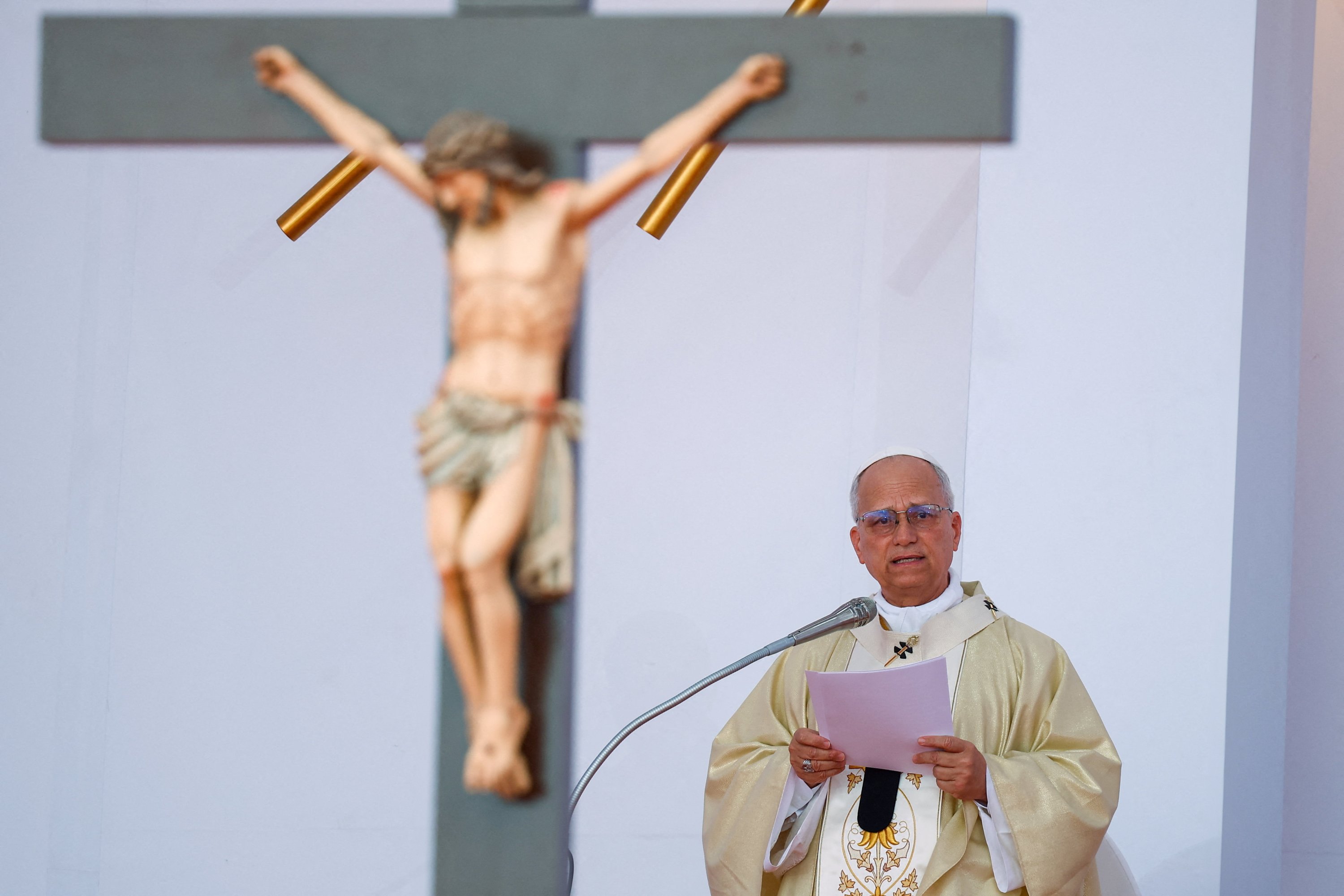
Throughout the ongoing exchange of words between U.S. President Donald Trump and Pope Leo XIV, the pope has continued to call for peace with increasingly forceful language each day, emphasizing compassion and justice and stating that the war must end. In contrast, Trump and the political line he represents instrumentalize religious references to generate power while explicitly targeting this moral discourse.
Yet despite the pope's opposition, the reality has not changed: Israel continues its aggressive stance, the U.S. refuses to back down, and humanity is being dragged toward an ever-greater catastrophe. This situation raises an unavoidable question: If the pope, who is also a political leader, is truly against the war, why doesn’t he take an active role to stop it?
There is no doubt that giving a clear answer to this question is not easy. However, as a scholar of the history of religions and a researcher specializing in the papacy, I would like to focus on two probabilities.
According to the first scenario, there may be a controlled, designed conflict between the papacy and the United States. In this scenario, while Trump represents power, the pope represents morality. One hardens, the other softens. One legitimizes, the other criticizes. However, in the end, the system and plans continue as originally intended. In such a situation, moral discourse works as "a balancing force" rather than a driver for change. Public opinion is soothed, consciences are appeased, but the war will not end.
The second one is far more optimistic. Maybe the pope is genuinely against the war. The problem, however, is that this moral discourse lacks the power to change anything. In other words, there may be sincerity, but that is ineffective. The truth is spoken, but it cannot write history.
Whatever the case may be, one thing remains certain: Moral discourse is doomed to remain ineffective unless it is translated into concrete power. This is precisely the situation the pope faces today. He speaks, warns and calls for action; yet he cannot alter the course of the war.
This inevitably shifts the focus to a different issue: not what the pope says, but what he can change. And this problem is not limited to the papacy. The same situation is clearly evident among leaders in the Islamic world and other religious traditions. Strong anti-war rhetoric is voiced in sermons, statements and international meetings, and prayers are offered to God for the end of war and oppression. But, in the end, none of this produces a transformative impact in the field. This is precisely the crisis facing all religious leaders, including the papacy. The issue is no longer what is said, but how much can actually be changed. This situation stands in clear contradiction to the historical mission of religious leadership.
When we look at the lives of the prophets upon whom Christianity, Islam and Judaism are founded, we see that they never hesitated for a single moment to stand up against the status quo and oppression.
The Prophet Abraham opposed the idolatrous order of his time not only with words but also through action. By shattering the idols that represented the status quo, he made the truth visible. The Prophet Moses was not merely a figure who delivered a message; he waged a political and social struggle by directly opposing the pharaoh’s oppressive regime. Jesus Christ openly criticized the hypocrisy of the religious authorities of his time and was consequently viewed as a threat by the system. The Prophet Muhammad, meanwhile, fought against the power and interest-driven order in Mecca both in word and deed. In Medina, he reinforced this struggle not only through moral principles but also through the state authority he established.
The common thread in these samples is clear: Leadership that represents the truth has never been merely a speaking authority. The prophets took risks, confronted power, stood alone when necessary, and, most importantly, transformed ethics into action. Therefore, their authority stemmed not from their words but from their transformative interventions.
Today, however, the picture that emerges is exactly the opposite. Religious leadership has largely retreated into a safer, more cautious and consequently more ineffective position. For this reason, the crisis we are experiencing is clearly a crisis of will, going beyond a mere crisis of faith or morality. Religious leaders know what is right, but they hesitate when it comes to what they must be willing to risk.
At this point, an even more critical question arises: In a world where religious sentiments and beliefs are instrumentalized to legitimize conflict and violence, why are leaders of Muslim, Jewish and other religious traditions, not least the pope, unable to come together to adopt a strong, united and binding anti-war stance? Yet for religions to cease being part of the problem and become a fundamental element of the solution, this is only possible through such collective and sincere cooperation.
If such unity were to be realized, could we not prevent religions from being used as a tool to legitimize violence? Would this not create a powerful moral pressure on the global public? Would the scope for political actors not be narrowed and the legitimacy of war not be seriously undermined? More importantly, could religions and the religious leaders who represent them not, for the first time, steer humanity’s shared future not merely as producers of rhetoric, but as a force capable of bringing about transformative change on the ground?
The answers to these questions are hidden in several structural issues. Religious leadership is fragmented globally, institutionally disorganized, and often has direct or indirect ties to political systems. This situation forces them into a cautious, hesitant and limited position. More importantly, the mechanisms for translating moral discourse into concrete power have not been sufficiently developed. The resulting picture is one of rhetoric and discourse, but no tangible results are at hand.
However, by its very nature, the role that religious leadership must assume is far greater than this. Religion must not remain merely a sphere of discourse that calls for good intentions. Rather, it must be a structure that balances power when necessary and generates strength against injustice. For this reason, the imperative for religious leaders to act in open solidarity is more evident today than ever before.
Genuine coordination among religious leaders on a global scale must be established, practical mediation processes initiated in conflict zones and effective moral pressure mechanisms put in place to influence political actors. For the issue is no longer merely about desiring peace, it is about demonstrating the will to make peace possible.
Humanity stands at an existential crossroads today: Either we will build a common living space together, or we will be dragged toward collective extinction. This imperative is both a moral duty and a strategic necessity. If religious leaders do not undertake this responsibility, moral authority will become purely symbolic, power politics will fill the resulting vacuum and humanity will be dragged into deeper chaos amid the crises it has created.
Last but not least, the question we must ask today is not, “What do religious leaders say?” but “What do they dare to change?” As history has clearly shown us, through the example of the prophet, “History can be written only if truth is put into action.”