On Oct. 27, 2026, Israel will head to the polls for what may be the most critical election in its history. In this election, the Israeli people will decide not only who will lead the country for the next four years, but also whether the current racist, expansionist, anti-democratic and genocidal policies will continue. They will also be deciding the political future of a criminal against whom corruption cases are ongoing and for whom the International Criminal Court (ICC) has issued an arrest warrant for crimes against humanity and war crimes committed in Gaza. In other words, this election will be a fateful one for Israel.
One of the most significant factors distinguishing this election from previous ones is that Israel is holding it while embroiled in such a prolonged war. The war, which began on Oct. 7, 2023, has not been limited to the destruction of Gaza and the killing of 73,000 Palestinians. The war front has expanded with attacks first on Lebanon and now on Iran. Consequently, this election is viewed as a referendum on both the events of the Gaza genocide and the ongoing war with Lebanon and Iran.
Therefore, to better understand the election process in Israel and make predictions about the post-election period, it would be helpful to take a close look at developments in Israeli politics and assess how these developments might affect the new government and parliament that could emerge after the election, as well as whether the current status quo in Israel will change.
It appears that the primary determinants of the election results in Israel will inevitably be the ongoing wars, their effects and the steps taken to emerge from the state of war. After all, the primary demand of a securitized society like Israel is the elimination of threats and the provision of an environment where people can continue their lives in safety. The war has also resulted in high economic costs due to disruptions in education, production, trade and tourism. How these issues, which have been swept under the rug until now, will be addressed moving forward is one of the most pressing questions.
After Oct. 7, settlements both around Gaza and near the Lebanese border were evacuated for security reasons, and despite the three years that have passed, residents of these areas have not been able to return to their homes. Not only have Prime Minister Benjamin Netanyahu’s promises to restore normal life in these areas gone unfulfilled, but as the war has spread to more fronts over the intervening period, the public’s security concerns and economic hardships have only intensified.
Due to the attacks, homes have been evacuated, schools and factories have also been closed, and industrial and agricultural production has come to a standstill. Consequently, all political parties and their leaders running in the election are promising to first ensure security and then revive the economy. However, they are unable to fully explain how they intend to do this. Therefore, when the Israeli public goes to the polls, it will become clear whether they will vote based on these promises or on their ideological positions.
Regardless of whether Israel is in the midst of an election campaign, think tanks and media outlets are constantly conducting polls to gauge public support for government policies, the search for alternatives, public sentiment toward opposition figures, and potential changes in the Knesset. According to polls conducted after the election process began, it appears that Netanyahu, who formed a government after the 2022 elections by securing 64 seats alongside far-right and ultra-Orthodox coalition partners, will not be able to secure the sufficient number of seats required to achieve a simple majority in the 120-seat Knesset at this stage.
Looking at the losses on the government side, the most significant decline appears to have occurred within Likud, which is projected to drop from 32 seats to the 25-28 range. While a relative decline is also observed in ultra-Orthodox parties such as Shas and United Torah Judaism (UTJ), it appears that the far-right Religious Zionist Party, led by Minister of Finance Bezalel Smotrich, will struggle to clear the electoral threshold. Although National Security Minister Itamar Ben Gvir's far-right Jewish Power party has also lost some ground, it is evident that far-right votes are consolidating within this party.
According to polls, it appears that the opposition figures have also failed to offer the public any hope, as it has become clear that the bloc that defined itself as the anti-Netanyahu front in the 2022 election will not be able to secure the majority needed to form a government with the current players in the Oct. 27 election. However, the Israeli opposition has begun to believe that Netanyahu could be defeated if the opposition unites around a figure capable of drawing votes from Netanyahu’s own voter base.
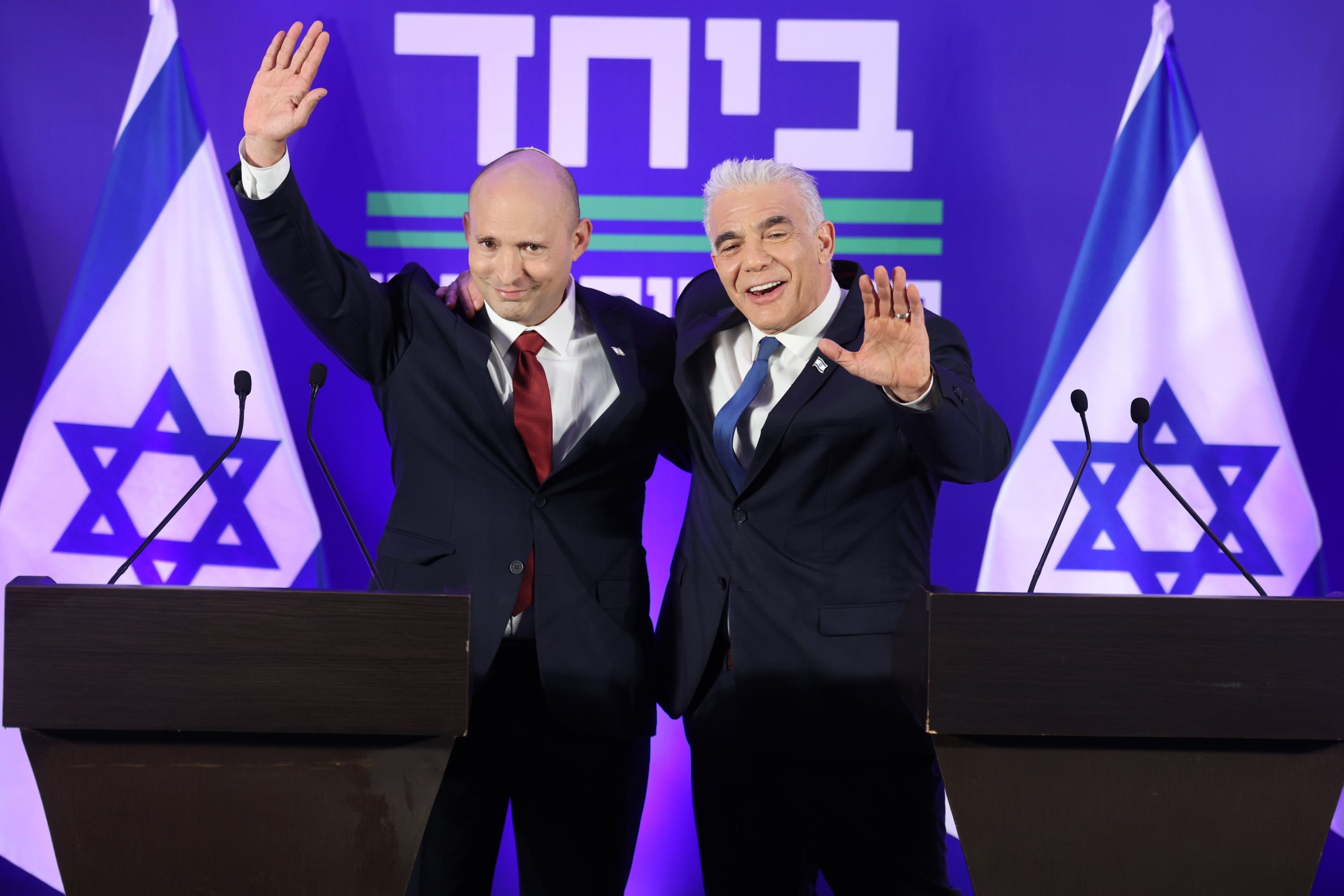
In polls on this topic, the name of Naftali Bennett, the prime minister of the 18-month-long unity government who stepped down before the 2022 election, has emerged as a frontrunner. Following this, Bennett announced his return to politics and, shortly after founding the party “Bennett 2026,” announced that he would join forces with his former partner, Yesh Atid's centrist leader Yair Lapid, to run in the election under the new coalition named “Beyachad" (Together).
According to polls conducted following this announcement, the Together party is expected to win nearly the same number of seats as Likud, around 25 to 26. The Bennett-Lapid duo is once again attempting to form an anti-Netanyahu bloc, just as they did in 2021. It is estimated that with the support of political figures like the former chief of the general staff, Gadi Eisenkot, who is joining Together, as well as backing from centrist and left-wing parties, they could secure 60 seats in the Knesset, and with external support from Arab parties, a government could be formed.
Although Bennett and Lapid’s “Together” party is being presented as the sole actor capable of finding solutions to the problems Israel has faced recently and, in particular, of repairing its global image, which has been tarnished since Oct. 7, it remains debatable how successful they will be, given the differences in their views and Bennett’s political background, which is not all that different from Netanyahu’s. Although the Bennett-Lapid duo performed well during their brief stint in the "change government," it should not be forgotten that, ultimately, the two represent opposing political poles.
While Lapid prides himself on being a liberal who identifies as centrist, Bennett is a politician with a conservative right-wing background who rose through the ranks of the Likud and served as a minister in Netanyahu’s governments. While Lapid supports a two-state solution, Bennett advocates for the annexation of the West Bank and argues that a Palestinian state must never be allowed to exist. Similarly, while Bennett opposes any partnership or tacit support for Arab parties, Lapid appears more flexible on this issue. Perhaps the only common ground between the two is their opposition to Netanyahu.
Under these circumstances, even if the Together Party emerges victorious from the election and forms a government, it will likely face numerous challenges, and it remains to be seen whether it will be able to successfully overcome them. Furthermore, given that Bennett holds an ideology not too far removed from Netanyahu’s, it is difficult to predict what stance he will take regarding the attacks on Gaza and Lebanon, as well as the ongoing war with Iran. All these uncertainties suggest that the Bennett-Lapid formula is merely a stopgap measure and that there will be no radical change in Israeli politics.
In conclusion, the election to be held in Israel will not only determine the ruling party and the prime minister; it will also require a decision on whether to continue down the path Netanyahu has led Israel on, that of a rogue state that is isolated by the international community due to its policies based solely on power. In other words, the issue is not whether Israel will be led by Netanyahu or Bennett over the next four years, but whether the Israeli people will demonstrate the will to break free from the current situation.
Depending on the election results, Israel will either continue down Netanyahu’s racist and genocidal path, becoming increasingly isolated and ultimately fading into history, or it will choose a more reasonable path and reintegrate with the international community. While Bennett may not be the ideal choice in this regard, he is at least a necessary actor for bringing the Netanyahu era to an end. Once Netanyahu is permanently removed from Israeli politics, it will be possible to move forward with more suitable candidates. The decision on this matter rests with the Israeli people, and ultimately, they will be the ones who must bear the consequences of their choices.