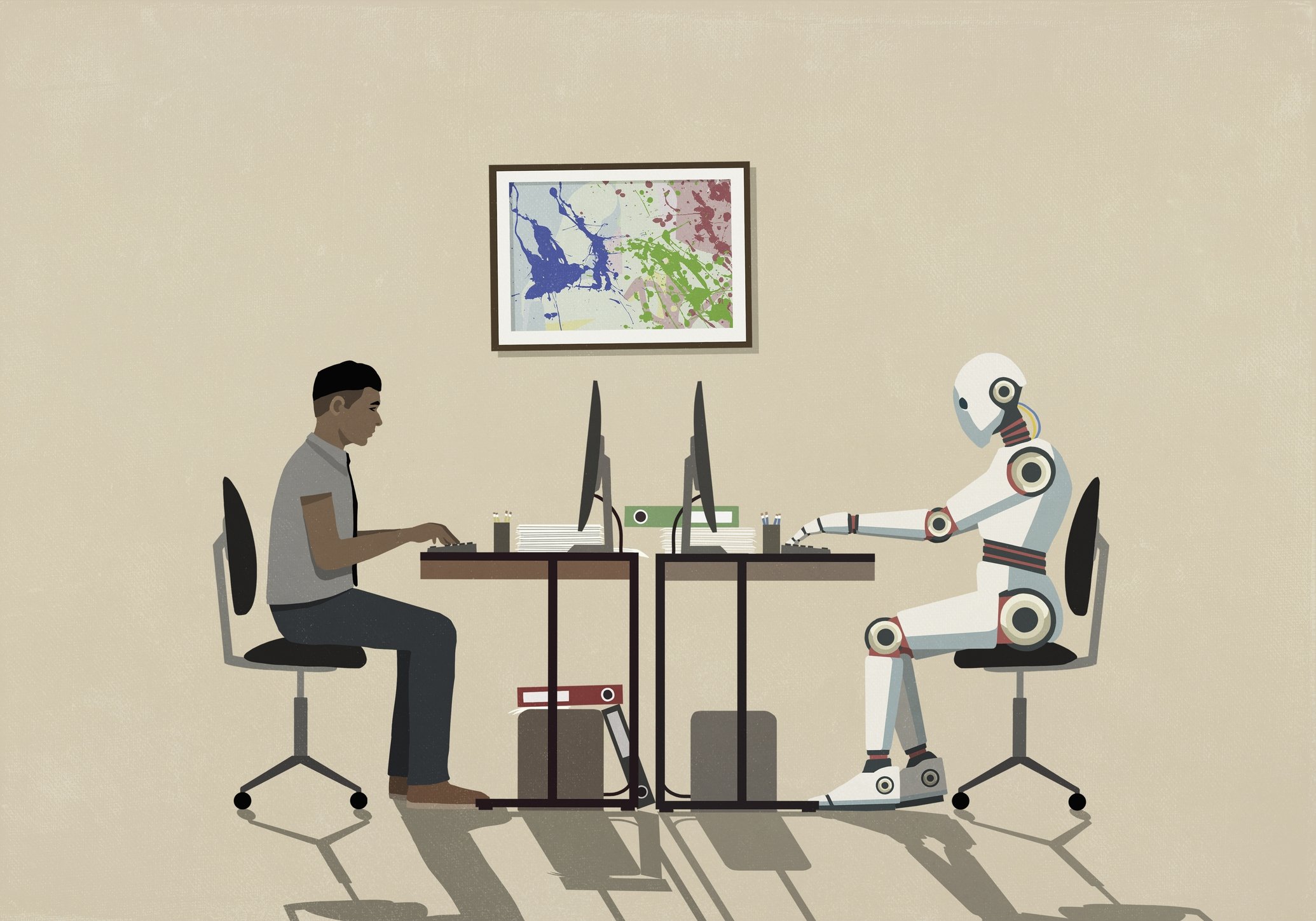
In this era when Artificial Intelligence and automation are reshaping the business world, ongoing debates about the future workforce often rest on a false dilemma: either we embrace the efficiency of machines and lay people off, or we invest in people while sidelining technology. However, this adversarial perspective between technology and humanity severely limits our potential for sustainable growth and innovation.
While aggressive automation strategies driven by pressure to increase profits and investor demands may yield short-term cost reductions, they risk depleting organizational knowledge and eroding employee trust in the long run. The record-breaking wave of automation-triggered layoffs in the U.S. in October 2025 clearly demonstrates the dramatic short-term effects of this shift.
However, we need to view AI not as a threat, but as a partner. As a technology developer who has developed and managed algorithms throughout my career, I have observed the potential of AI firsthand. The winning formula is not to eliminate humans or exclude machines; it is to allow machines to liberate humans to do the things only humans can do. This is a strategic imperative known as Augmented Intelligence.
Working in the Human Resources technology space, this is no longer an abstract principle for me; it directly shapes how we hire. When we bring new colleagues into the team, we now care less about which programming languages they know and more about which AI tools they use and how effectively they use them. Instead of simply asking which tech stack they are familiar with, we increasingly ask them to show us how they would solve a real task by working with AI.
AI is concerned with the nature of the tasks we perform, not our job titles. For a job to be at risk of automation, it must meet three criteria: it must be repetitive and predictable, involve rule-based decision-making processes and be of high volume and low complexity.
According to research conducted by the job platform Indeed for 2025, professional skills are set to undergo a significant transformation. For example, 81% of software development skills can be transformed by AI. Tasks such as routine coding, debugging, and test case generation are open to automation. 79% of data and analytics skills face AI transformation through processes like data extraction and basic pattern recognition. 74% of accounting and finance skills are subject to change due to rule-based and transactional processes.
Research from Stanford University shows that the vast majority of employees desire a "co-pilot model" where humans and AI collaborate equally, rather than full automation.
This Augmented Intelligence model implies that AI systems are designed to support human effort, with critical, high-risk decisions ultimately left to humans. Our mindset today must shift from the delusion of “AI can’t do what I do” to a more honest framing: “With AI, I can get my work done many times faster and reclaim that extra capacity for learning, creativity and being more human.” In other words, AI should not turn us into people who simply do 10 times more tasks, but into people who feel 10 times stronger, as if we were working with a quiet superpower in the background.
In our own recruitment processes, we see this mindset shift very clearly. We increasingly prefer candidates who can confidently say, “I let AI do the first pass,” over those who only use AI at the end to double-check work they have already done. The people who thrive in our teams are the ones who design the problem, orchestrate the tools, and then apply their judgment on top of what AI produces.
As technology takes over routine tasks, the most valuable human skills come to the forefront. These are the soft skills that are hardest for AI to mimic: Judgment and critical thinking, the ability to evaluate complex situations based on ambiguous data where no clear rules or precedents exist, are vital for ethical governance and strategic planning. Emotional intelligence and empathy, the capacity to understand, manage and use emotions in high-stakes human interactions, such as leadership, sales, or patient care, are critical for conflict resolution and transformational leadership. Creativity and innovation, the ability to generate new solutions and frame new problems, are also essential since while machines can perform generative tasks, it is the human who invents new possibilities. Complex communication, mastery of cross-cultural context, and non-verbal cues are necessary for managing global teams and negotiating contracts. For companies to achieve a successful transformation, they require employees to focus on these fundamental human skills, delegate routine work to machines, and embrace the vision of an Augmented Workforce.
While technology and product development are my areas of expertise, any serious discussion of AI inevitably involves ethics; every meaningful innovation in this field has to be developed hand in hand with ethical principles. If companies act solely in pursuit of efficiency, income inequality could increase significantly; automation has been identified by the U.S. National Bureau of Economic Research as the primary factor explaining 60% of the wage gap between skilled and unskilled labor since 1980.
In this context, it is clear that ethical and legal boundaries are needed for innovation to advance in harmony with human dignity.
Successful AI adoption is not just about buying technology; it is a matter of organizational adaptation. To compete in a rapidly changing environment, companies must increase employees' AI literacy and address the need for reskilling due to the adoption of new technologies. This involves communicating clearly to employees how AI will affect their careers and giving them a greater sense of responsibility and purpose by reducing manual workloads. However, while most employees are open to reskilling, failures in this process usually stem from inadequate training, resistance to adaptation, and hasty implementation.
The future of work is not a choice, but a synergy. Companies must view investment in human capital not as a mandatory expense, but as the most critical infrastructure investment for long-term strategic resilience, innovation and competitive advantage. The future belongs not to those who replace people with machines, but to those who learn to maximize human potential with technology.