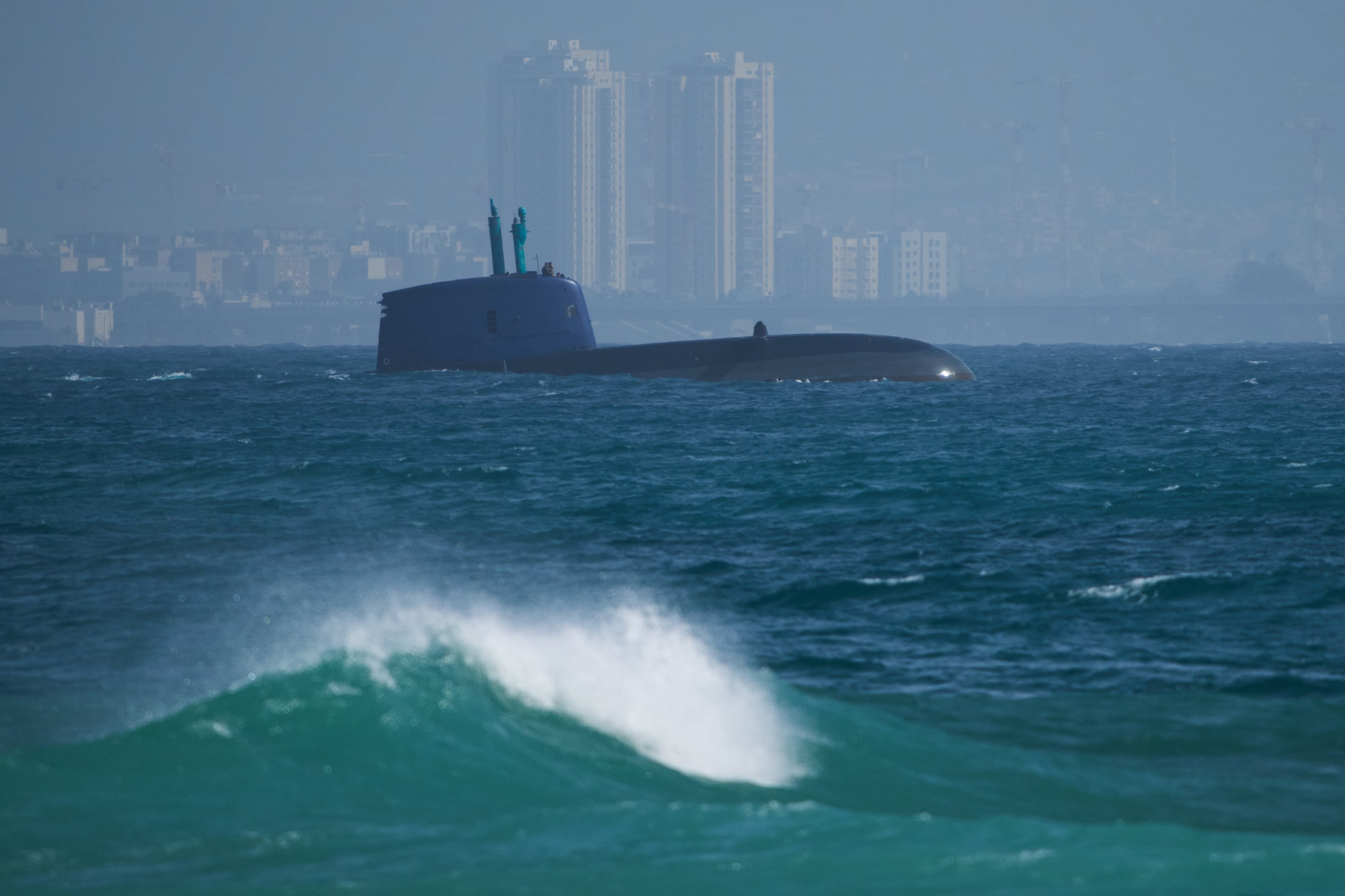
As part of Israel’s plan to modernize and expand its navy, and, consequently, its submarine fleet, in response to changing circumstances and new threat assessments, the INS Drakon, the third Dolphin II-class submarine ordered under an agreement with Germany’s ThyssenKrupp shipyards, arrived at the Port of Haifa on Sept. 24.
Actually, the INS Drakon was expected to be delivered in 2025, but due to delays in some deep-sea tests that the ThyssenKrupp shipyard wanted to conduct specifically for this vessel, its tests were not completed until August, and it was only able to set sail for Israel following a ceremony held in Kiel on Sept. 1.
With the addition of the INS Drakon to the fleet, the number of submarines in the Israeli Navy has reached six – three of the Dolphin I class and three of the Dolphin II class. However, it is also known that the Israeli Navy has placed an order with ThyssenKrupp shipyards for three Dakar-class submarines, which are larger and have more advanced technological capabilities than the Dolphin II submarines. While it is known that the first submarine of the class, the INS Dakar, is currently under construction, its delivery may not occur until 2030 or later, and it is unclear exactly when the remaining two will join the Israeli Navy.
So what does a new submarine that Israel has added to its navy have to do with Türkiye? Because these submarines are linked to an effort to eliminate Türkiye’s submarine superiority in the region.
During the speeches at the commissioning ceremony for the INS Drakon, it was stated that Türkiye currently possesses 14 submarines and that this number will rise to 18 with the four submarines currently under construction, thereby positioning Türkiye as the country with the largest and most effective submarine fleet in the region, and that this situation runs counter to Israel’s national security and interests. Some analysts and former military officials have even gone so far as to argue that if Türkiye’s submarine fleet reaches 18, Israel would need to possess not six, but at least eight submarines.
Therefore, it is anticipated that the Eastern Mediterranean will become a new front in the ongoing tension between Türkiye and Israel, a tension that has persisted for some time due to developments in Gaza, the West Bank, Lebanon and Syria. For this very reason, it is considered beneficial to shed light on the background of Israel’s efforts to increase both the number and capabilities of its submarines, following the Israeli Navy’s modernization initiatives targeting its surface vessels.
To this end, we will first discuss the technical specifications of the INS Drakon and touch on the advantages that Dolfin II-class submarines would offer Israel. Then, we will attempt to explain why Israel has entered into a naval, and specifically a submarine, race with Türkiye.
Although the INS Drakon is generally similar to the other two Dolphin II-class submarines in the Israeli Navy (INS Tanin and INA Rahav), it is 4.5 meters (nearly 15 feet) longer than them, with a length of 73 meters. It is believed that this difference stems from the Popeye cruise missiles, which are thought to be housed in the torpedo tubes located in the submarine’s bow. Furthermore, while the torpedo tubes on the earlier submarines had a diameter of 533 millimeters, those on the INS Drakon measure 650 millimeters. It is speculated that this increase in the diameter of the torpedo tubes is also related to the deployment of Popeye or Tomahawk cruise missiles.
Although the INS Drakon’s air-independent propulsion system is similar to that of previous submarines, it is reported that the INS Drakon can dive deeper and remain submerged for longer periods than its counterparts. Furthermore, it is said that the new-generation, high-tech systems on board make it difficult to detect, which is expected to provide Israel with a significant advantage.
Thanks to the INS Drakon, Israel will be able to conduct longer-range submarine operations and will gain a significant intelligence advantage due to the submarine’s stealth and invisibility capabilities. Thanks to the long-range cruise missile, which may be equipped with nuclear warheads, on board the submarine, Israel will provide a deterrent on the one hand, while on the other hand, it will have the advantage of launching a second strike in the event of a nuclear attack.
In other words, the INS Drakon, together with the Saar 6-class corvettes that were recently added to the fleet, will significantly enhance the Israeli Navy’s combat and intelligence capabilities. Thanks to its ability to carry out both independent and joint missions, it will contribute to the security of gas fields in the Eastern Mediterranean and, if necessary, enable operations in distant seas. As a result, the Israeli Navy will undergo a transformation, shifting from its identity as a coastal navy to the role of a blue-water, and even ocean-going, navy.
For a country like Israel, which has 190 kilometers (118 miles) of coastline in the Eastern Mediterranean and 14 kilometers in the Red Sea, its current naval capacity is sufficient. In fact, it is known that during its early years, the need for a navy to prevent and counter threats from neighboring Arab countries was even greater than it is today. This is because Israel has neutralized the potential threat from Egypt by signing a peace treaty with that country, and since Lebanon currently has no naval force, there is no situation that would warrant perceiving a threat from that direction. Furthermore, Israel has largely neutralized Syria’s naval capabilities, both during the civil war and in the aftermath of the revolution.
However, according to Israel, the only exception to this is Türkiye. Particularly following the Mavi Marmara incident in 2010, relations between Israel and Türkiye have continued to be volatile. Furthermore, due to the significant strengthening of Türkiye's navy through its recent defense industry advances, the country has begun to be perceived as a potential threat.
In addition, the fact that the Eastern Mediterranean Gas Forum and the EastMed Pipeline project, both established through Israeli initiatives, became defunct due to the agreement on the delimitation of maritime zones and the exclusive economic zone that Türkiye signed with Libya in 2019 has also caused Israel to view Türkiye not merely as a rival but as a potential enemy. Since then, an unspoken state of competition and tension has persisted between Türkiye and Israel in the Eastern Mediterranean.
In addition to all this, the dynamic of relations between the two countries has gone beyond mere competition due to Türkiye’s firm and resolute stance against the genocide committed by Israel in Gaza. Of course, recent developments in Syria have also fueled tensions between Türkiye and Israel, bringing the two countries to the brink of armed conflict. Since there is no direct land border between Türkiye and Israel, it is assessed that if a confrontation were to occur between the two countries, the Eastern Mediterranean would naturally be the most significant front. Indeed, Israel’s ongoing engagement with Greece and the Greek Cypriot administration is the most concrete indication of this.
However, under current circumstances, it does not appear possible for Israel to cope with Türkiye’s naval power, either in terms of quality or quantity. In this context, Israel is working to expand its navy by adding new warships, submarines, and unmanned aerial and maritime vehicles to its inventory. Following the Saar 6 corvettes, Israel is also working to balance the asymmetry with Türkiye by equipping submarine platforms such as the INS Drakon with the capability to launch ballistic and cruise missiles, and even by demonstrating its nuclear warhead capacity to turn the situation in its favor.
On the other hand, Israel, which is attempting to encircle Türkiye by developing defense partnerships with Greece and the Greek Cypriot administration, is striving to limit Türkiye’s operational capabilities through the air defense systems and radars it has deployed on islands in the Sea of Islands that are supposed to have a non-military status. Similarly, through the air defense systems it has deployed in the Greek Cypriot administration, Israel is both monitoring the movements of Türkiye’s naval and air assets in the south and attempting to prevent Türkiye from accessing hydrocarbon resources in the Eastern Mediterranean by imposing various obstacles through the EU and the U.S.
However, there is no rational basis for Israel to set its sights on Türkiye’s navy. After all, no matter how technologically advanced they may be, both the Sa’ar 6-class warships and the Dolphin- or Dakar-class submarines were built by Germany and they ultimately make Israel dependent on another country.
Moreover, Türkiye is a maritime nation surrounded by seas on three sides, and thanks to recent advancements in its defense industry, it has expanded and strengthened its navy by equipping it with domestically produced and national systems, making it the largest fleet in the region. Consequently, even if Israel views Türkiye as a regional rival or enemy, it has no chance of matching Türkiye at sea.