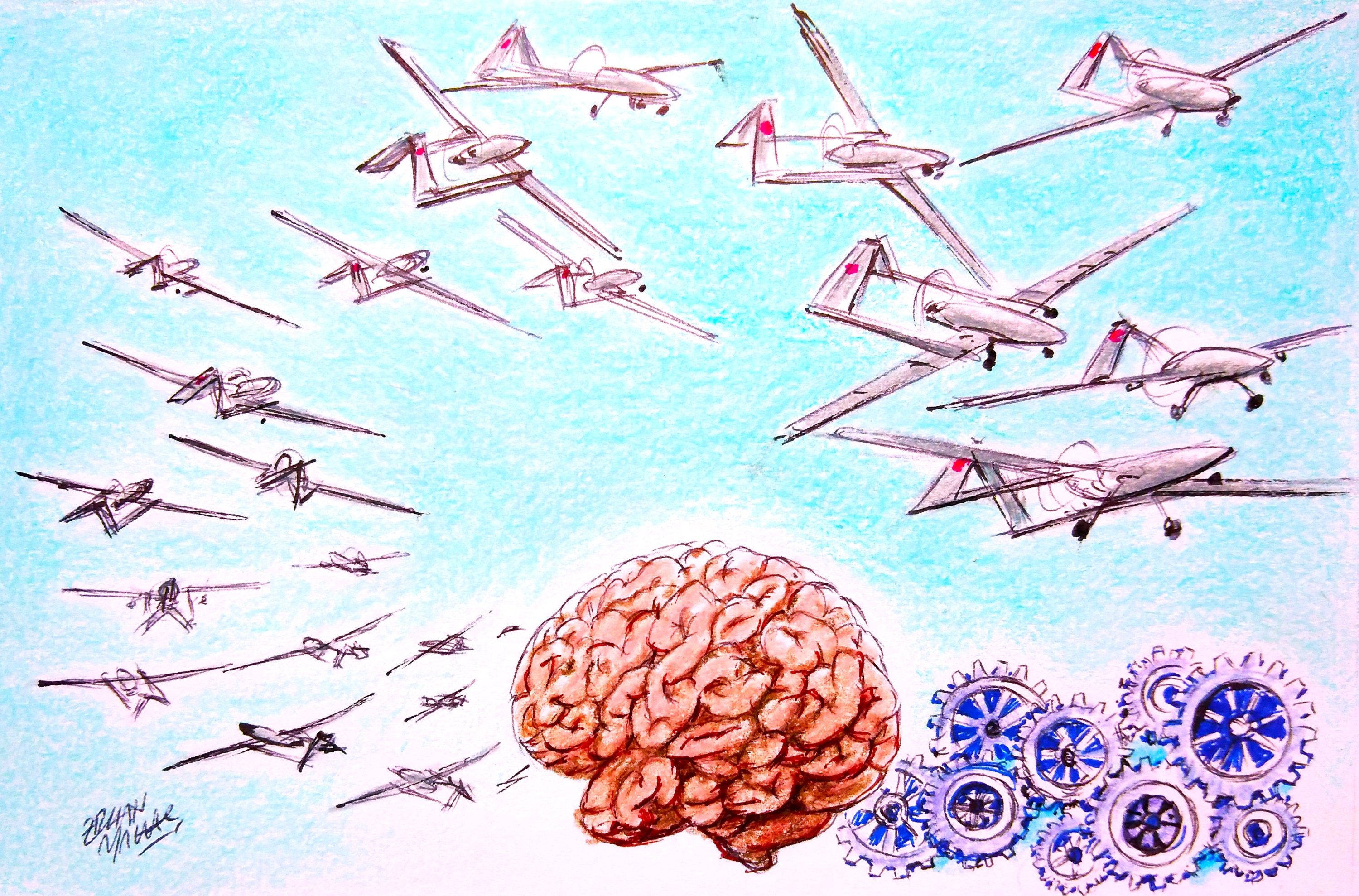
Watching recent conflicts unfold, one thing is becoming impossible to ignore: the real limits of military power are no longer set on the battlefield, but on factory floors and within supply chains.
In the opening phase of the recent U.S.-Israeli strikes against Iran, thousands of precision-guided munitions and interceptor missiles were reportedly used in a matter of hours. The scale is staggering. Yet the more important question is not how much was fired, but how long such a pace can be sustained.
This is where the illusion of modern warfare begins to crack.
We tend to imagine contemporary conflict as a contest of cutting-edge technologies. Artificial intelligence (AI), stealth platforms, precision systems and advanced sensors dominate discussions about the future of war. In this narrative, victory belongs to those who innovate faster.
Reality is more unforgiving.
High-tech warfare consumes resources at a pace that even advanced economies struggle to sustain. Precision-guided munitions, interceptor missiles and advanced systems are effective, but they are also expensive, complex and slow to replace. A single interceptor can cost millions, while the drone it destroys may cost a fraction of that. When such exchanges repeat at scale, the imbalance becomes structural.
Technological superiority without industrial depth is not an advantage. It is a liability waiting to be exposed.
The war in Ukraine has already demonstrated this with brutal clarity. Artillery shells, air defense missiles and precision munitions have been consumed at rates that exceeded prewar production assumptions across NATO and beyond. Defense industries designed for efficiency in peacetime suddenly faced a different reality: survival in war depends on volume, not elegance.
What was marketed for years as a contest of smart weapons has turned into something far more basic: which side can keep supplying the front.
Modern air defense illustrates this paradox most clearly. Cheap drones assembled from commercial components can force states to expend missiles worth exponentially more. When attacks come in swarms, even the most advanced systems are drawn into an economically losing equation. Over time, this is not just a budgetary concern. It becomes a strategic trap.
As this dynamic deepens, the definition of military power is quietly being rewritten.
For decades, national strength was associated with research capacity, innovation ecosystems and technological breakthroughs. Defense expos showcased prototypes as symbols of strategic superiority. But recent conflicts are delivering a harsher verdict: innovation that cannot be industrialized is strategically incomplete.
The real divide is no longer between those who can design advanced systems and those who cannot. It is between those who can mass-produce them and those who cannot.
This shift is pushing manufacturing ecosystems back to the center of geopolitical competition. Countries that can integrate research, design and scalable production now hold a decisive advantage in any conflict that extends beyond short-term engagements.
History offers a clear precedent. During World War II, the United States’ industrial capacity did not just support its war effort; it overwhelmed its adversaries. Today’s weapons are more sophisticated, but the underlying logic remains unchanged.
For middle powers such as Türkiye, this transformation presents both a warning and an opportunity.
Over the past two decades, Türkiye has invested heavily in its defense industrial base. From Baykar to Turkish Aerospace Industries, from Aselsan to Roketsan, the country has developed indigenous capabilities across drones, precision munitions, electronic warfare and air defense systems. These systems have been tested in multiple operational environments, from Syria and Libya to Karabakh and Ukraine.
Their significance lies not only in their technological performance, but in the ability to produce, sustain and export them at scale.
In an era of industrialized precision warfare, “good enough, available and scalable” can be more decisive than “perfect but scarce.”
For Ankara and other emerging powers, this implies several priorities. Securing domestic supply chains for critical components is essential to avoid strategic vulnerability. Designing systems with manufacturability, modularity and repairability in mind is equally critical. And perhaps most importantly, leveraging civilian industry and advanced manufacturing techniques will determine how quickly production can surge in times of crisis.
The central question facing policymakers is no longer who has the most advanced systems.
It is who can keep producing when stockpiles run dry.
Factories, logistics networks and supply chains are returning to the core of national security strategy. AI, autonomous systems, space capabilities and cyber power will shape the character of future conflicts. But none of these will matter if they cannot be sustained.
In the harsh arithmetic of modern war, dominance in the first 36 hours means little if it cannot be extended into the 36th month.
Wars are not won by prototypes, presentations or promises. They are won by production lines, logistics and industrial endurance. Laboratories may design the future of warfare. But in the 21st century, it is the factory floor that will decide who prevails.