The energy geopolitics of the Eastern Mediterranean demonstrates that sharing the same geological basin does not necessarily produce the same economic outcomes for all actors. Although the Turkish Republic of Northern Cyprus (TRNC) and the Greek Cypriot administration share the hydrocarbon potential of the Levant basin, they operate under markedly different political and legal conditions. On one side stand political isolation and limited investment opportunities. On the other side stand international recognition and agreements with major energy companies. Yet both sides share one common reality: Neither has succeeded in fully transforming the Eastern Mediterranean’s abundant natural gas resources into economic prosperity.
The reason is that in the Levant basin, the key factor shaping the development of the natural gas sector is not the existence of reserves, but the legal, regulatory and institutional framework that enables those reserves to be developed.
The Greek Cypriot administration, as an EU member, operates within a market structure integrated into the EU energy acquis, natural gas market regulations and international investment law. Within this framework, 13 offshore exploration blocks have been opened to investors through international licensing rounds, allowing global energy companies including Chevron, ExxonMobil, Shell, Eni, TotalEnergies and QatarEnergy to undertake exploration and development.
Despite this, the Greek Cypriot administration does not currently have an operational international natural gas pipeline or a commercially operating liquefied natural gas (LNG) import terminal. Construction of the Vasilikos LNG Terminal continues, and the country has not yet become a producer that uses its own natural gas domestically or exports it to international markets. Its regulatory framework, aligned with EU legislation, provides the legal predictability that enables investors to allocate long-term capital. However, these advantages alone do not guarantee commercial success, as the ability to make investment decisions or select investors is constrained by EU rules.
The situation in the TRNC has evolved for different reasons. Although it is part of the hydrocarbon potential surrounding the island, the TRNC cannot conclude direct licensing agreements with international energy companies, access global financing, or secure its maritime jurisdiction claims because of its lack of international recognition. This significantly limits its ability to convert potential energy resources into economic value.
Over the past decade and a half, the Eastern Mediterranean has become a focal point of global energy discussions following natural gas discoveries in Israel’s Tamar and Leviathan fields, Egypt’s Zohr field and the Greek Cypriot administration's Aphrodite field. Türkiye, however, was excluded from this equation for many years. The clearest example was the EastMed Pipeline Project, signed in 2020. The project was developed by Israel, Greece and the Greek Cypriot administration, with Italy later joining the list of European countries supporting the initiative.
Backed by the EU as a Project of Common Interest (PCI), the EastMed was designed to transport natural gas from offshore Israel and Cyprus to Greece via Crete and then onward to Europe. The project never gained momentum. Its approximately 1,900-kilometer (1,180-mile) length, deep-water sections exceeding 3,000 meters (nearly 10,000 feet), high investment costs and limited commercial viability prevented it from moving forward. The withdrawal of United States political support in 2022 brought the project to a halt. Today, it is clear that the EastMed project, conceived without Türkiye, has failed to achieve its intended objectives.
During this period, the Greek Cypriot administration awarded the development of the Aphrodite field in Block 12 to a consortium led by Chevron, together with Shell and NewMed Energy. On Feb. 17, 2025, agreements signed by the Greek Cypriot administration, Egypt and the consortium established the legal and commercial framework for transporting natural gas from the field to Egypt through a newly constructed subsea pipeline. Under the agreement, the gas to be transported to the Egyptian coast via the newly constructed subsea pipeline will be fed into Egypt’s existing natural gas transmission network, liquefied at LNG facilities and exported to international markets, primarily Europe.
Pipeline construction has not yet begun, and the project remains in the stages of seabed surveys, engineering studies and preparations for the final investment decision. Although this model is presented as a more practical export alternative than the EastMed project, transporting the gas first to Egypt and then exporting it to Europe as LNG introduces additional infrastructure requirements, along with liquefaction, regasification and maritime transportation costs.
Türkiye pursued a different strategy throughout this period. While strengthening its maritime jurisdiction claims in the Eastern Mediterranean through the 2019 Maritime Jurisdiction Delimitation Memorandum with Libya, it has also continued expanding its energy infrastructure. The Trans Anatolian Natural Gas Pipeline (TANAP), TurkAkım, LNG terminals and Floating Storage and Regasification Unit (FSRU) investments have significantly strengthened Türkiye’s ambition to become a regional natural gas hub.
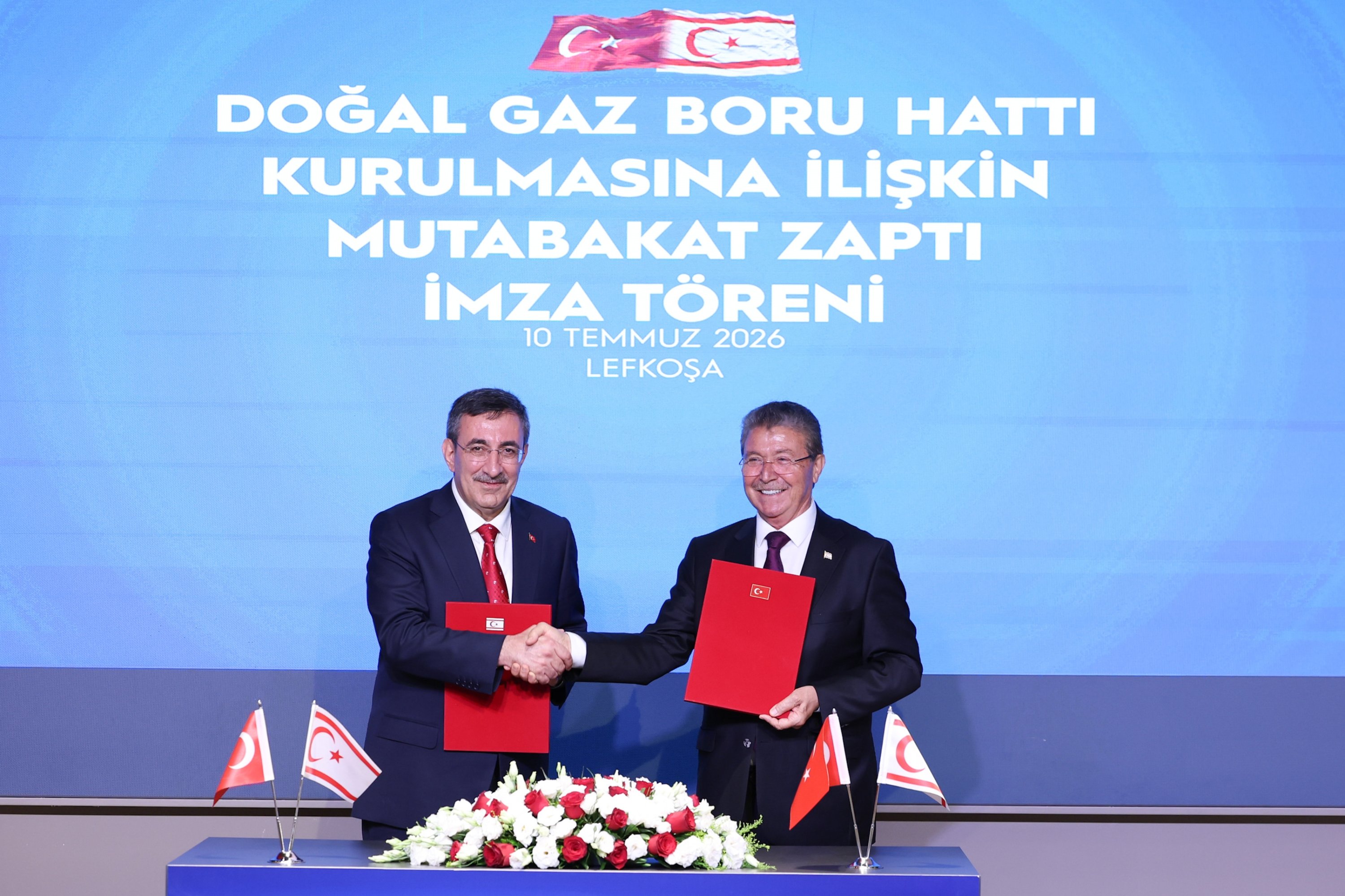
The recently announced TRNC natural gas pipeline project represents another pillar of this strategy. According to the project, a natural gas transmission pipeline approximately 101 kilometers long, including 97 kilometers offshore, will connect Anamur to Teknecik. In its initial phase, the natural gas will be used for electricity generation.
Energy and Natural Resources Minister Alparslan Bayraktar highlighted the geopolitical significance of the project, stating that the pipeline would be designed as a bidirectional system capable of transporting natural gas produced in the Eastern Mediterranean to Europe through Türkiye in the future.
The project extends beyond strengthening the TRNC’s energy supply security. For the first time, Türkiye is positioning the TRNC not merely as an island economy that consumes energy, but as a potential component of a future regional energy corridor. Its immediate objective is to ease the TRNC’s long-standing electricity supply challenges. Electricity generation in the TRNC depends largely on the Teknecik Power Plant, which operates primarily on imported fuel oil. Population growth, tourism and rising summer electricity demand periodically create supply constraints.
Türkiye has also strengthened the TRNC’s energy supply security. Seven mobile power plants with a combined installed capacity of 175 megawatts have been commissioned at the Teknecik Power Plant. Since 2021, fuel oil supplies have also been provided largely by Türkiye. Officially, energy-related support has exceeded TL 8 billion ($170 million) over the past five years, with additional funding allocated for 2026. The introduction of natural gas is expected to reduce electricity generation costs, support the transition to a cleaner fuel and strengthen energy supply security. Replacing fuel oil with natural gas in electricity generation could reduce carbon emissions while limiting the TRNC’s dependence on imported petroleum products.
From the perspective of Europe’s energy diversification objectives, an export model for the Eastern Mediterranean that excludes Türkiye is becoming increasingly difficult to justify as the optimum long-term economic and strategic solution. Future projections indicate that avoiding a winter marked by depleted gas storage will increasingly depend on Türkiye.
While transporting Eastern Mediterranean gas to Europe through Egypt may remain a practical solution in the short term, growing assessments indicate that, given current geopolitical risks, the safest, most cost-effective and most sustainable overland corridor is through Türkiye.
For Türkiye, however, the long-term debate will extend beyond the physical transit of Eastern Mediterranean gas. The strategic distinction will lie not in whether the gas passes through Türkiye, but in whether it is traded within Türkiye and the extent to which the country plays a role in regional pricing mechanisms. Future projections indicate that pipeline infrastructure, trading capacity, storage, market liquidity and price formation mechanisms will together determine Türkiye’s position in the energy geopolitics of the region.