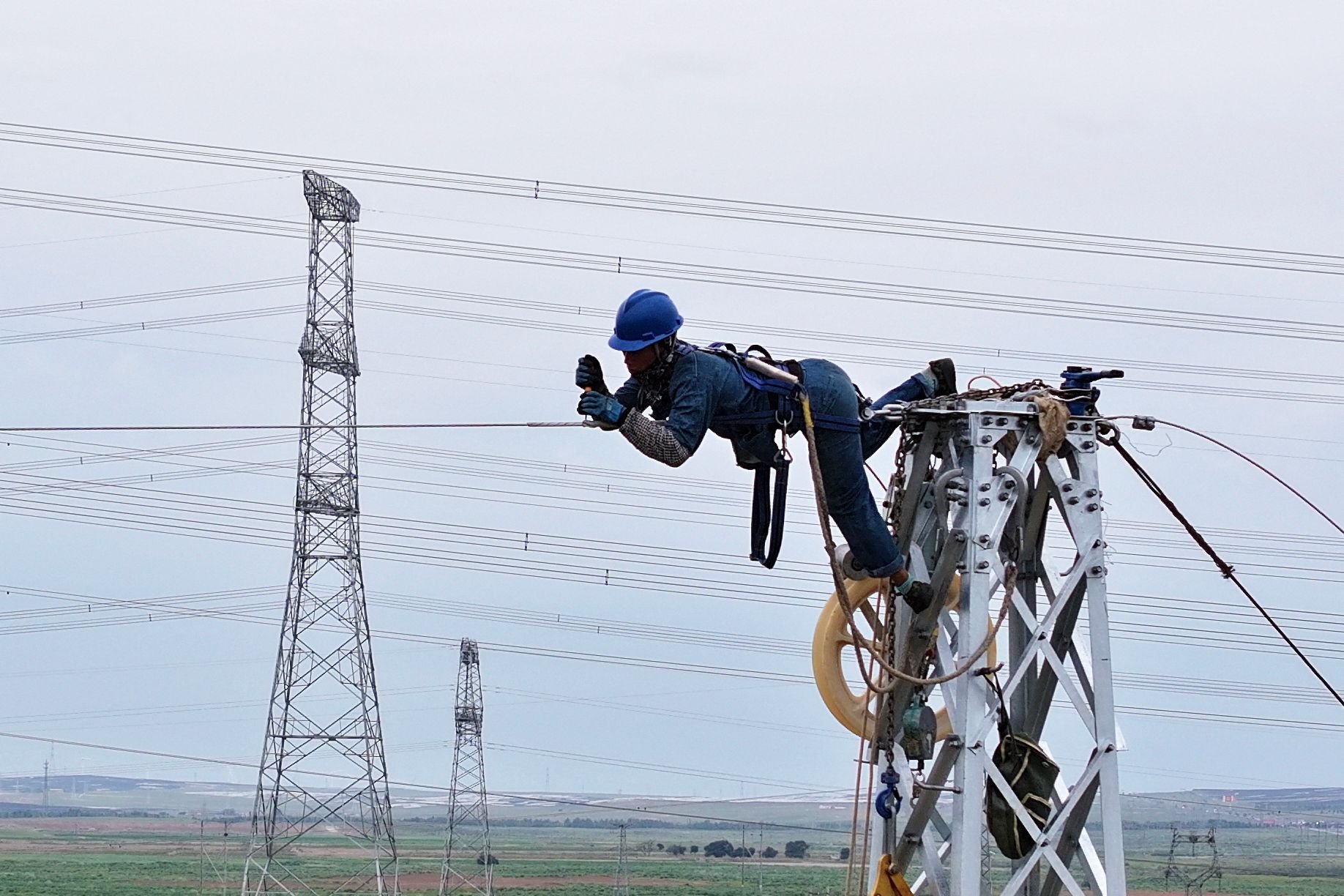
Last year, 2.4 trillion kilowatt-hours of electricity were transmitted from western China to the east – that’s enough to power five Germanys.
More than 80% of that electricity came from clean, renewable sources, a result of China’s West-to-East Power Transmission Project, which is one of the most ambitious and transformative energy initiatives in the world today. Since its launch, the project has reshaped the nation’s energy landscape by channeling vast amounts of clean power from China’s western regions to its densely populated and industrialized eastern coast, traveling thousands of kilometers, crossing mountains, deserts, rivers and reaching over 500 million people in major cities like Shanghai, Guangzhou and Beijing.
The project was first formally proposed in the early 2000s and became a key part of China’s national development strategy in 2001. It was born from a structural imbalance: Eastern China is home to the country’s most concentrated economic activity and highest electricity demand, yet the region lacks the space and natural conditions for large-scale renewable energy development. Meanwhile, the western regions are rich in solar, wind and hydropower resources, but in the past, there has been insufficient local demand or infrastructure to distribute this power elsewhere.
Take some of these western regions for example: Inner Mongolia leads the country in wind power, with over 86 gigawatts of installed capacity, making it China’s largest wind energy base; Qinghai is home to the Hainan Prefecture Ecological Solar Park, which is one of the largest solar farms in the world and spans across the plateau with 15 gigawatts of installed capacity; meanwhile, Yunnan and Sichuan play a major role in hydropower generation with their fast-flowing rivers and rugged terrain.
In contrast, eastern cities, while being China’s economic powerhouse, are dense, industrial and energy-hungry. Mega-regions like the Yangtze River Delta and the Pearl River Delta are home to China’s most productive manufacturing hubs and urban centers. These areas have long relied on coal-fired power, and have had limited access to the abundant renewable energy produced in the west, a large portion of which has been underutilized.
The disconnect between where clean energy is produced and where it’s needed is not unique to China. Around the world, urban and coastal centers demand the most power but rarely have the capacity to generate enough clean power locally.
Closing this energy gap will benefit not only China but also contribute to the world’s transition to cleaner energy.
China’s answer to this dilemma has been to connect the country through high-efficiency, long-distance electricity highways physically. What makes this power transfer possible is China’s development of ultra-high voltage (UHV) transmission technology. Unlike conventional power lines, UHV lines can carry electricity over thousands of kilometers with very little loss. China began investing in UHV research in the early 2000s and now holds over 80% of the world’s UHV-related patents. By the end of 2023, the West-to-East Power Transmission Project had completed 39 long-distance UHV corridors, creating an interconnected network that functions as the country's green arteries for its power system.
Building on its domestic success, China also began sharing its UHV technology with the world.
Chinese President Xi Jinping has cast the West-to-East Power Transmission Project as part of a broader global effort, saying that “China is willing to work with the international community to strengthen energy cooperation comprehensively, safeguard energy security, address climate change, protect the ecological environment and promote sustainable development, to better benefit people around the world.” It is a commitment that positions China’s UHV technology as a clean power solution not only to the country itself.
Earlier this year, the Brazilian subsidiary of China’s State Grid officially kicked off a ±800 kV UHVDC transmission project in northeastern Brazil, marking the third overseas UHV transmission project of the company. The project will integrate wind, solar and hydropower from Brazil’s northeastern and northern regions, transmitting it through the states of Maranhao, Tocantins and Goias to supply clean electricity to Brasília and surrounding areas, serving a population of around 12 million.
With the success of UHV transmission technology in Brazil, the project demonstrates its compatibility with diverse geographical conditions, paving the way for its application in more countries.
China’s West-to-East Power Transmission Project proves that clean energy does not have to stay where it’s made. As urbanization continues around the world, we now have a powerful solution to the growing demand for electricity, particularly that comes from clean resources. Even if the population continues to concentrate in a few megacities, renewable power can still travel across rivers, mountains and deserts and light up the entire nation.