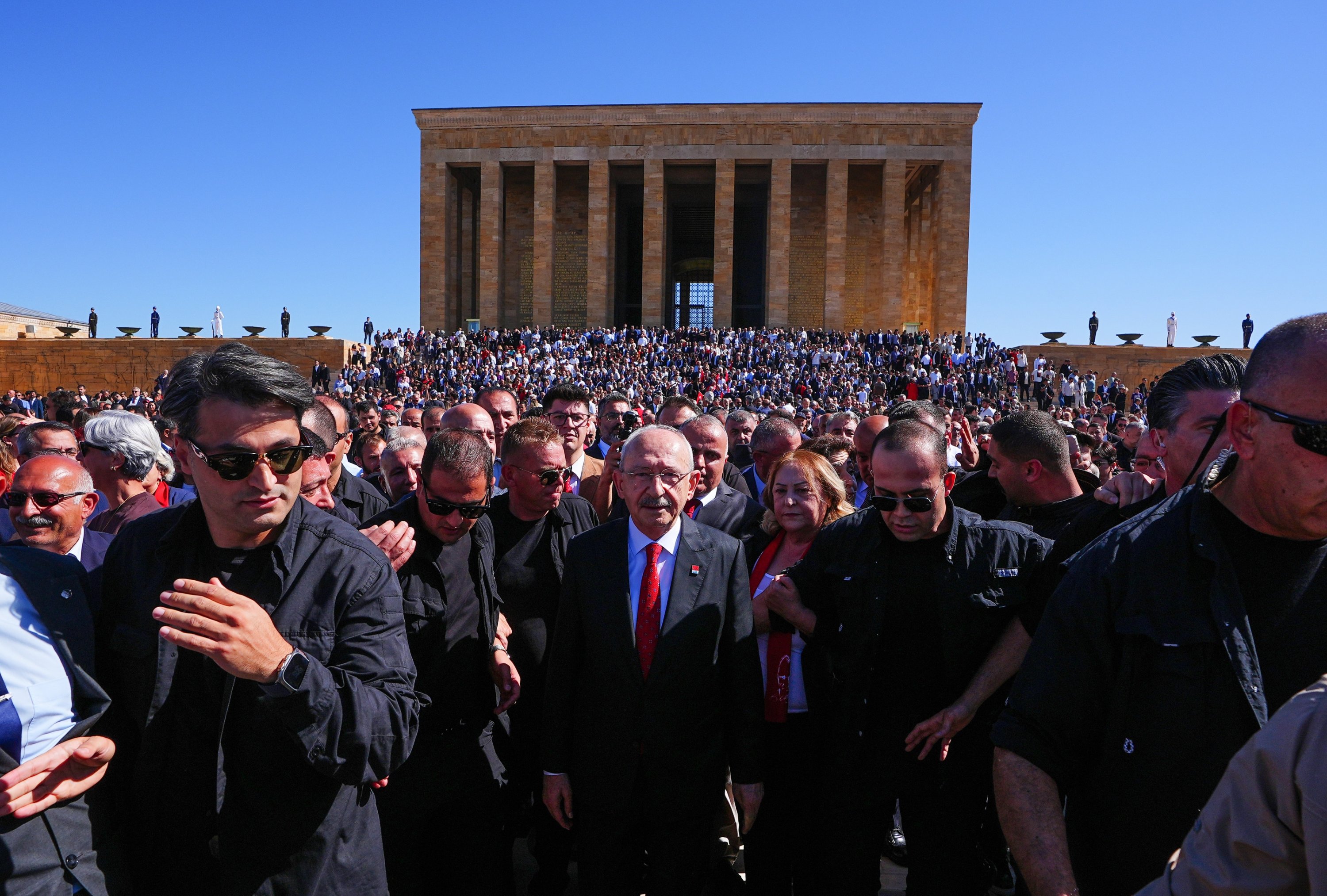
The Republic of Türkiye’s first political party, the Republican People’s Party (CHP), marked its 103rd anniversary on Wednesday. The party’s top officials paid a visit to Anıtkabir, the mausoleum of its founder, Mustafa Kemal Atatürk, as the CHP struggles to survive after a major rift.
Chairperson Kemal Kılıçdaroğlu led a delegation to the mausoleum and commemorated both Atatürk, who was also the first president of Türkiye, and another anniversary: the liberation of the western city of Izmir, a CHP stronghold, from occupying Greek forces 104 years ago. The delegation also visited the tomb of Ismet Inönü, Türkiye’s second president and the CHP’s second chairperson, who is buried near Anıtkabir.
Until July, the CHP was Türkiye’s main opposition party. When the party’s ousted chairperson Özgür Özel founded the New Party (YP), most of its lawmakers left the CHP.
The CHP’s original name was the “People’s Party,” and “Republican” was added to the name in 1924.
One of the world’s oldest political parties, the CHP remained in power from 1923 to 1950 and was shut down following the 1980 military coup. The party was later reopened in 1992.
Except for those who served in an acting capacity, the CHP has been led by Mustafa Kemal Atatürk, Ismet Inönü, Bülent Ecevit, Hikmet Çetin, Altan Öymen, Deniz Baykal, Kemal Kılıçdaroğlu and Özgür Özel.
The CHP considers the Sivas Congress its first party congress. Its second congress, held on Oct. 15, 1927, went down in history as the congress where Atatürk delivered his “Great Speech” ("Nutuk").
During the congress, Atatürk spoke for a total of 36 hours and 33 minutes between Oct. 15 and 20, describing, based on documents, all stages of the National War of Independence that began on May 19, 1919, as well as the circumstances surrounding the establishment of the Republic of Türkiye. At the congress, which concluded with his “Address to the Youth,” “Republicanism, Populism, Nationalism and Secularism” were established as the party’s four fundamental principles.
At the CHP’s third ordinary congress, held on May 10, 1931, “Statism and Revolutionism” were added to the party’s principles. This completed the process of incorporating the six principles that formed the philosophy behind the “Six Arrows,” which would become the party’s emblem, into its program and bylaws.
The party held its first extraordinary congress on Dec. 26, 1938, following Atatürk’s death. Ismet Inönü, who was elected chair, held the position for approximately 33 years.
Following Inönü’s resignation, Bülent Ecevit took over as party chair at the sixth extraordinary congress held on May 14, 1972. The 24th Ordinary Congress, held on May 24, 1979, was the CHP’s last congress under Ecevit’s leadership. After the Sept. 12, 1980 coup, Ecevit announced in a petition dated Oct. 30, 1980, that he had resigned as party chair and never returned to the CHP.
The party, which had been shut down following the coup, returned to the political scene on Sept. 9, 1992, with Deniz Baykal elected as its chairperson during the congress held that day.
Following the merger of the Social Democratic Populist Party (SHP) and the CHP on Feb. 18, 1995, Hikmet Çetin was appointed party chairperson. Deniz Baykal was reelected chair at the Ordinary Congress held on Sept. 9, 1995.
Baykal resigned on April 21, 1999, after his party failed to pass the electoral threshold in the general elections held on April 18, 1999. Altan Öymen, who was elected chair at the congress following Baykal’s resignation, held the position for 15 months. At the 11th Extraordinary Congress held on Sept. 30, 2000, Baykal was once again elected chair.
The CHP returned to Parliament as the main opposition party in the general elections held on Nov. 3, 2002, winning 19.4% of the vote.
After Deniz Baykal resigned on May 10, 2010, over secretly recorded footage allegedly showing an extramarital affair, Kemal Kılıçdaroğlu was elected the CHP’s seventh chair at the party’s 33rd Ordinary Congress.
Kılıçdaroğlu served as CHP chair for 13 years before facing Manisa lawmaker Özgür Özel at the party’s 38th Ordinary Congress, held on Nov. 4-5, 2023.
Since no candidate secured a simple majority in the first round, the vote went to a second round. Following the second-round vote, Özgür Özel was elected the CHP’s new chair with 812 votes.
Özel was reelected chairperson at the 21st Extraordinary Congress held on April 6, 2025, the 22nd Extraordinary Congress held on Sept. 21, 2025, and the 39th Ordinary Congress held on Nov. 28-30, 2025.
Following the CHP’s 38th Ordinary Congress, at which Özgür Özel was elected party chair, former Hatay Mayor Lütfü Savaş and several party delegates took the matter to court, arguing that the congress had been held in violation of the principles of internal party democracy, equality and free will, and seeking its annulment. The case focused on allegations of vote-buying by Özel’s supporters. A trial on the matter concluded in May, with a court in Ankara ruling that the 2023 intraparty election was subject to “absolute nullity” and ordering the reinstatement of Kılıçdaroğlu.
After being removed from office by the court, Özel objected to the court’s interim ruling on May 22 and filed an individual appeal.
Following an application by Kemal Kılıçdaroğlu’s lawyer, CHP headquarters were evacuated by police on May 24. Özel left the party headquarters with his supporters and walked to Parliament.
One day before the evacuation, on May 23, Özel made a countermove by being reelected as CHP parliamentary group chair at a closed-door group meeting held by the CHP in Parliament.
Following the absolute-nullity ruling, Kılıçdaroğlu held a public gathering at the party headquarters on May 30, meeting with party members at the headquarters for the first time in two and a half years.
At a meeting of the Party Assembly on June 2, Kılıçdaroğlu selected members of the Central Executive Board from among those who remained party members and had served on the Party Assembly elected at the 37th Ordinary Congress, where he was last elected chairperson, and resumed party activities.
From that date onward, a process that Kılıçdaroğlu described as “cleansing” began within the CHP. Numerous party members, including nine lawmakers, were referred to the High Disciplinary Board with requests for their definitive expulsion, while appointments were made to provincial and district party leadership positions in all 81 provinces and their districts. The “cleansing” targeted CHP members involved in corruption cases, including mayors who were arrested on such charges while Özel was leading the party.
Later, 91 lawmakers resigned from the CHP and founded the YP under Özgür Özel’s leadership, reducing the CHP’s number of seats in Parliament to 44. As a result, the CHP lost its position as the main opposition party in Parliament and became the fifth-largest party in terms of number of seats.