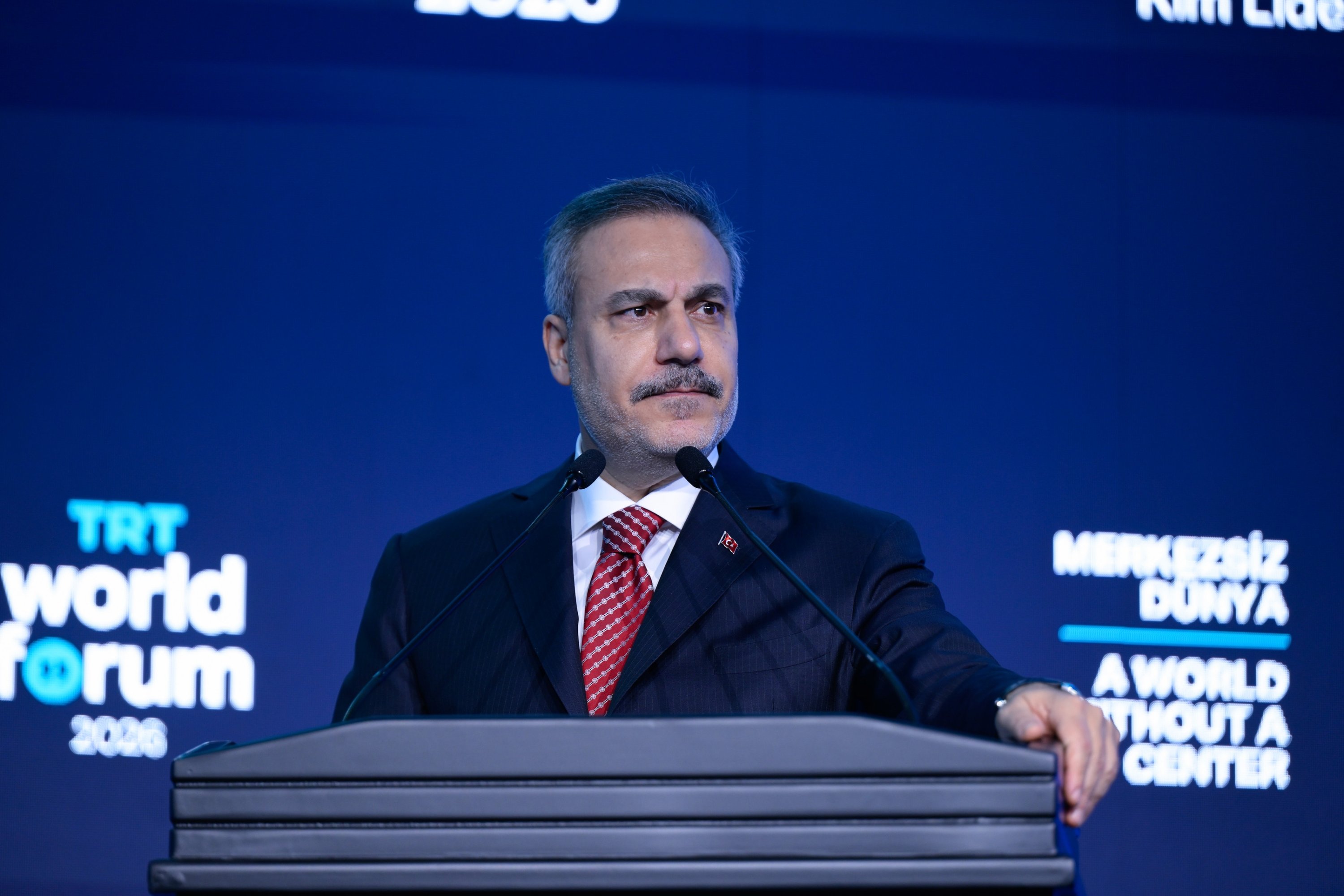
Turkish Foreign Minister Hakan Fidan on Saturday urged the international community to launch a global initiative to protect critical maritime chokepoints and strengthen international connectivity, warning that rising geopolitical tensions and disruptions to vital trade routes pose growing threats to global economic and security stability.
Speaking at the TRT World Forum in Istanbul, Fidan called for new frameworks for international cooperation grounded in mutual trust, shared interests and regional ownership.
"No country, however powerful, can insulate itself from the consequences of a fragmented and insecure international environment. Security is indivisible," he said.
"Your security cannot be sustained at the expense of the security of the others," Fidan added, emphasizing that effective cooperation must be built around the priorities of the countries concerned rather than imposed by external actors.
Fidan warned that military confrontation in the Black Sea and growing insecurity around the Strait of Hormuz and Bab el-Mandeb pose serious risks to international trade, energy supplies and food security.
"The Black Sea has increasingly become an arena of military confrontation," he said, noting that attacks on commercial vessels and disruptions to maritime traffic threaten the movement of essential goods, particularly grain shipments.
He said similar challenges in the Middle East were exacerbating global vulnerabilities.
"Israel's expansionist policies, its continued aggression against neighboring countries, and the genocide in Gaza are undermining regional stability and prospects for a just and lasting peace in the region," he said.
Fidan stressed that preventing escalation and addressing the root causes of conflicts were essential to protecting the networks that sustain the global economy.
Highlighting the growing strategic importance of maritime chokepoints, Fidan said the concentration of global trade and energy flows along a limited number of routes creates structural vulnerabilities.
"A shipping lane can become a battlefield, as we've seen in the Black Sea. An energy pipeline can be turned into an instrument of political pressure. A single chokepoint can disrupt supply chains and economies thousands of kilometers away," he said.
He said greater connectivity should not become a zero-sum geopolitical contest, calling instead for stronger existing networks and alternative transport corridors to reduce excessive dependencies.
"Diversification is not about replacing one dependency with another; it is about creating options, reducing vulnerabilities, and ensuring that no single disruption can paralyze the wider system," he said.
Fidan highlighted Türkiye's Middle Corridor, which connects Asia and Europe through the Caspian region and South Caucasus, as well as the Development Road Project, which links the Gulf to Europe through Iraq and Türkiye.
He said the projects were part of a broader strategy to strengthen regional economic integration and supply chain resilience.
Turning to the future of international cooperation, Fidan proposed a new global initiative focused on protecting maritime routes and preventing the weaponization of critical infrastructure.
"In this spirit, Türkiye believes that the time has come to consider a global initiative dedicated to safeguarding maritime chokepoints and strengthening the resilience of international connectivity," he said.
He said the proposed initiative could bring countries together to preserve freedom of navigation, ensure uninterrupted flows of essential commodities, diversify transport and energy corridors, and prioritize diplomacy in addressing emerging threats.
"This should not be another exercise in creating institutional structures for their own sake. It should be a practical framework for collective action, bringing together states and relevant international stakeholders around shared responsibilities and tangible outcomes," he said.
Fidan also emphasized the importance of regional cooperation mechanisms, saying security arrangements must reflect the needs and priorities of countries directly affected by regional challenges.
He cited Türkiye's diplomatic efforts under the Black Sea Grain Initiative as an example of how sustained engagement can produce tangible results even during armed conflict.
"Our experience with the Black Sea Grain Initiative demonstrates the value of sustained diplomacy," he said.
He also pointed to emerging regional cooperation formats involving Türkiye, Saudi Arabia, Pakistan and Egypt, as well as coordination with European partners, as mechanisms for addressing shared security challenges.
"With this understanding, Türkiye is pursuing complementary regional cooperation initiatives. The Mecca Alliance for Defense, bringing together Türkiye, Saudi Arabia and Pakistan, aims to strengthen cooperation in the field of collective defense through an approach that is inclusive and responsive to regional security needs," Fidan said.
"The R4 mechanism, comprising Türkiye, Egypt, Pakistan and Saudi Arabia, provides a broader platform for developing common approaches and advancing practical cooperation on regional challenges. Furthermore, the R4-E4 format, bringing together the R4 countries with France, Germany, Italy and the United Kingdom, creates an additional channel for dialogue and coordination between regional and European partners," he added.
"These initiatives are not competing with other instruments, nor are they intended to create new divisions," he said.
"Their purpose is to expand the space for cooperation, strengthen regional capacity and connect different centers of responsibility."
Fidan said the changing international environment offers an opportunity to build a more inclusive global order in which regional actors assume greater responsibility.
"A world without a major center of gravity does not need to be a world without order," he noted.
"The emerging international order should be shaped not only by the dominance of a few, but by the capacity of many to act responsibly and collectively."
Reaffirming Türkiye's willingness to contribute to international efforts, Fidan said the ultimate goal should be to transform connectivity into an instrument of collective security and shared prosperity.
"Türkiye stands ready to contribute to such an effort and to work with all partners who share this vision," the minister added.
"This is the kind of leadership our times demand, and this is the responsibility Türkiye is prepared to assume."