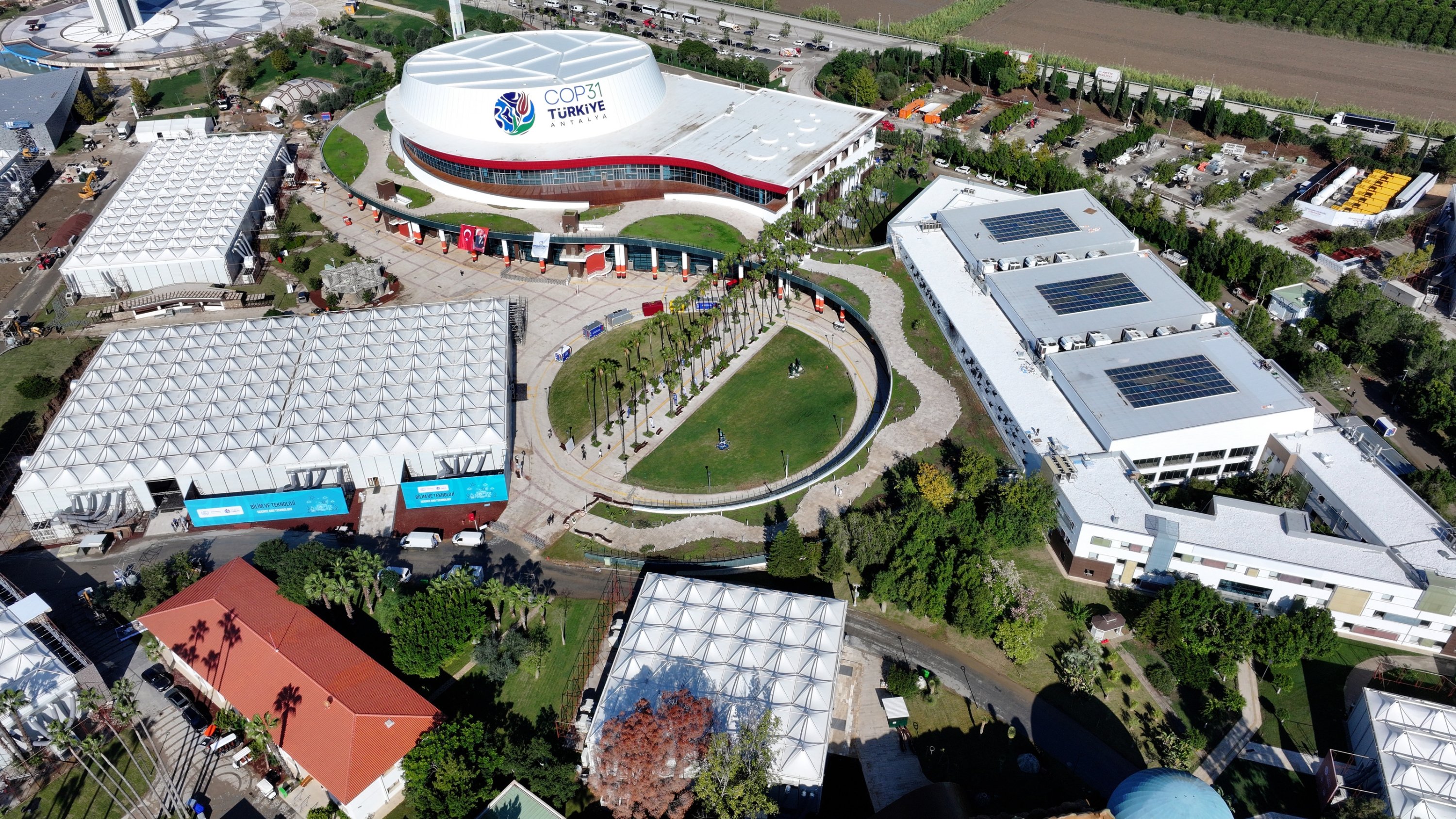
Türkiye, which has been involved in climate negotiations since the 1990s, when global climate talks gained momentum, is preparing to open a new chapter with its hosting of and presidency over COP31.
COP31, the world’s most important climate-themed gathering, will be held next week in Antalya, a Mediterranean city in southern Türkiye, which has been a venue of high-profile events in recent years, including the Antalya Diplomacy Forum. Prior to that, Türkiye has contributed to international efforts to combat climate change to date.
As part of efforts led by the United Nations to establish global cooperation in combating climate change, the U.N. Framework Convention on Climate Change (UNFCCC) was opened for signature at the Earth Summit held in Rio de Janeiro in 1992. The convention, which became the foundation of international cooperation in the fight against climate change, entered into force in 1994. Following the convention's entry into force, the Conference of the Parties (COP) began international climate negotiations. The COP was authorized to regularly review the implementation of the convention and adopt the necessary decisions to promote its effective implementation.
While the first COP summit was held in Berlin in 1995, Türkiye participated in COP summits as an observer country until 2004, when it became a party to the UNFCCC. Having joined the convention on May 24, 2004, Türkiye has since attended subsequent COP summits as a party.
Following its accession to the convention, Türkiye restructured its Climate Change Coordination Board that same year and established eight technical working groups. The Ankara Climate Change Conference was also held on Sept. 1-3, 2004.
In 2006, Türkiye submitted its first greenhouse gas inventory to the UNFCCC Secretariat. Parliamentary commissions on global warming were also established.
Türkiye signed the Kyoto Protocol in 2009. Adopted in 1997 and entering into force in 2005, the protocol was regarded at the time as the most significant step taken toward reducing greenhouse gas emissions.
In May 2010, the National Climate Change Strategy Document was published, followed in 2011 by the National Climate Change Action Plan and the Climate Change Adaptation Strategy and Action Plan. These documents were regarded as important steps toward fulfilling Türkiye's obligations in international climate negotiations.
The Paris Agreement, a legally binding international treaty on climate change, was adopted at COP21 in Paris on Dec. 12, 2015, and entered into force on Nov. 4, 2016.
At the heart of this global framework are the Nationally Determined Contributions (NDCs), through which countries party to the agreement set out concrete commitments to reduce greenhouse gas emissions and strengthen their resilience to the adverse effects of climate change.
Türkiye signed the Paris Agreement on April 22, 2016, and became a party to it on Nov. 10, 2021. Like all other parties, Türkiye began submitting NDCs to the UNFCCC Secretariat every five years, each time including more ambitious emission reduction targets and, on a voluntary basis, climate change adaptation targets.
Within the framework of the Glasgow Climate Pact, adopted by parties at COP26 in addition to the UNFCCC and the Paris Agreement, Türkiye submitted its Updated First Nationally Determined Contribution on April 13, 2023.
With this submission, Türkiye reaffirmed its commitment to reducing greenhouse gas emissions by 41% by 2030 compared with the reference scenario outlined in its First Nationally Determined Contribution and Intended Nationally Determined Contribution, which used 2012 as the base year.
Türkiye strengthened its targets in its Second Nationally Determined Contribution (NDC 3.0), pledging to achieve a greenhouse gas emissions reduction of 466 million tons of carbon dioxide equivalent by 2035 compared with the reference scenario and limit its emissions to 643 million tons of carbon dioxide equivalent.
International initiatives undertaken under the Zero Waste Project, launched in 2017 by the Ministry of Environment, Urbanization and Climate Change under the auspices of first lady Emine Erdoğan, have also become one of the key components of Türkiye's climate diplomacy agenda. On Dec. 14, 2022, the U.N. General Assembly designated March 30 as International Zero Waste Day. At the same meeting, the U.N. Secretary-General's Advisory Board of Eminent Persons on Zero Waste, announced by Antonio Guterres, was established on April 12, 2023. At Guterres' proposal, Emine Erdoğan assumed the chairmanship of the U.N. Advisory Board of Eminent Persons on Zero Waste.
Following the consensus reached at COP30, held last year in the Brazilian city of Belem, Türkiye took on the responsibility of hosting COP31 and holding its presidency.