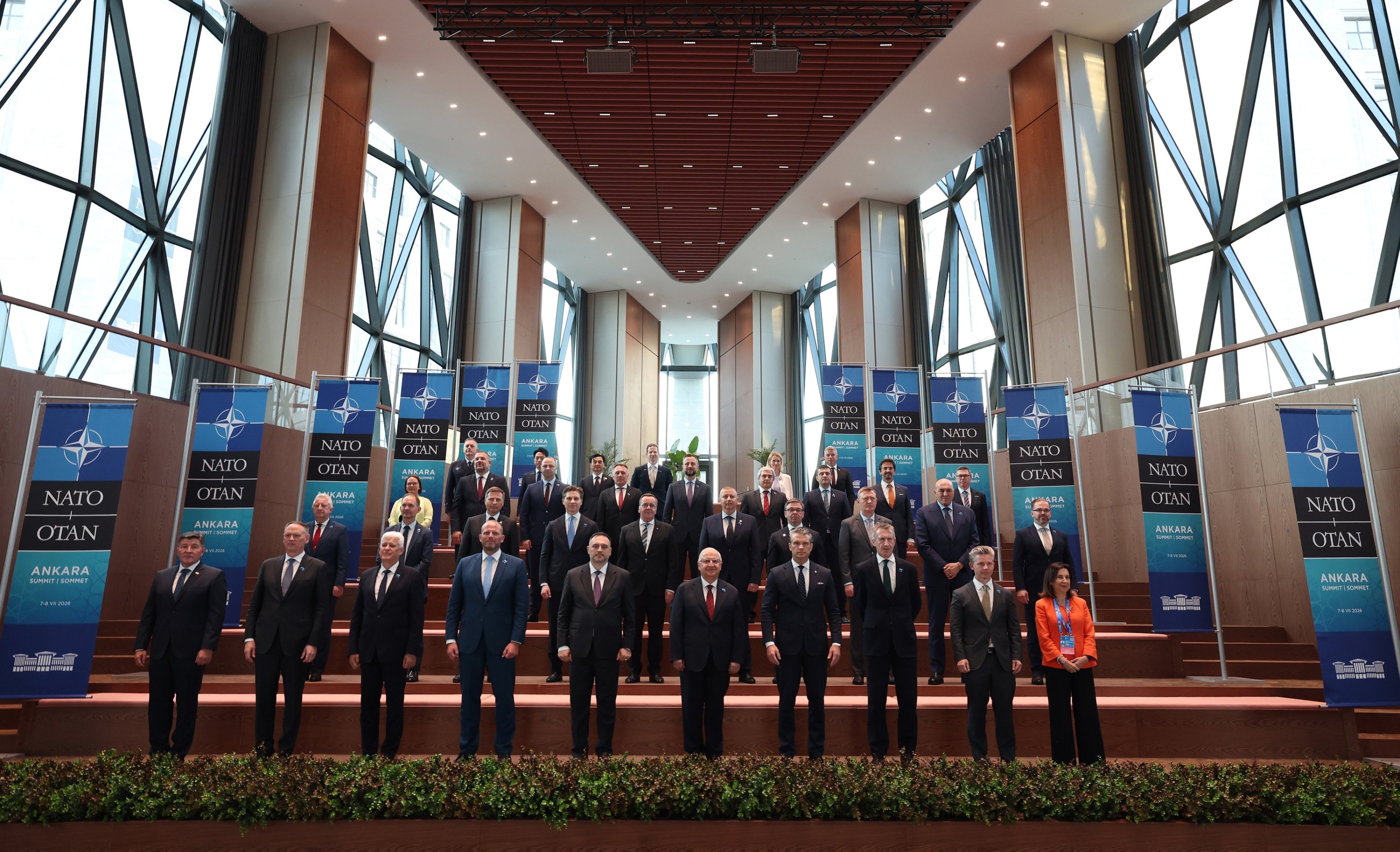
Turkish National Defense Minister Yaşar Güler welcomed NATO defense ministers and senior alliance officials to the Ay Yıldız (Crescent and Star) Joint Headquarters in Ankara on Tuesday, using the high-profile reception to showcase Türkiye's next-generation military command center as the country hosts the 36th NATO Heads of State and Government Summit.
The reception was held in the Yıldız (Star) section of the still-under-construction headquarters, according to Türkiye's National Defense Ministry. Güler greeted guests upon their arrival before delivering remarks during the event, which formed part of the two-day NATO summit in the Turkish capital.
The gathering offered one of the first major international glimpses inside the sprawling Ay Yıldız complex, an ambitious defense project that will eventually bring together the Turkish Armed Forces' top command under one roof.
Designed to centralize Türkiye's military leadership, the headquarters will house the National Defense Ministry, the General Staff, and the commands of the Land, Naval and Air Forces in a single integrated complex. Officials say the project will strengthen coordination, speed decision-making and enhance the country's joint operational capabilities.
Construction of the headquarters began in 2021 following a groundbreaking ceremony attended by President Recep Tayyip Erdoğan. Located in Ankara's Etimesgut district, the 12.6 million-square-meter site is expected to accommodate approximately 15,000 personnel once completed, with the full project scheduled for completion in early 2028.
Inspired by the crescent and star on the Turkish flag, the headquarters combines symbolic architecture with advanced military infrastructure. The facility incorporates smart-building technology, environmentally sustainable features and modern command, control and communications systems designed to support both current and future operational needs.
Turkish officials describe the complex as a cornerstone of the country's defense modernization strategy, strengthening institutional integration while improving Türkiye's ability to contribute to NATO missions. Because of its scale and centralized command structure, it has frequently been compared to the Pentagon in the United States.
The reception came as Türkiye hosts the 36th NATO Heads of State and Government Summit, marking the second time the country has welcomed the alliance's leaders after the 2004 summit in Istanbul.
The two-day summit, held in Ankara, has brought together leaders from NATO's 32 member states, senior alliance officials, Asia-Pacific partners and invited guests, including Ukrainian President Volodymyr Zelenskyy.
Discussions are expected to focus on reinforcing allied unity amid evolving transatlantic dynamics, maintaining long-term support for Ukraine, increasing defense spending and strengthening NATO's future military posture.
A central topic is the alliance's proposed "NATO 3.0" vision, which envisions European allies assuming greater responsibility for conventional defense while the United States reassesses its military presence across Europe. The strategy reflects growing calls for increased burden-sharing within the alliance as NATO adapts to an increasingly complex global security environment.
The summit also includes talks on defense industrial cooperation, military readiness and the implementation of commitments made at previous alliance meetings.