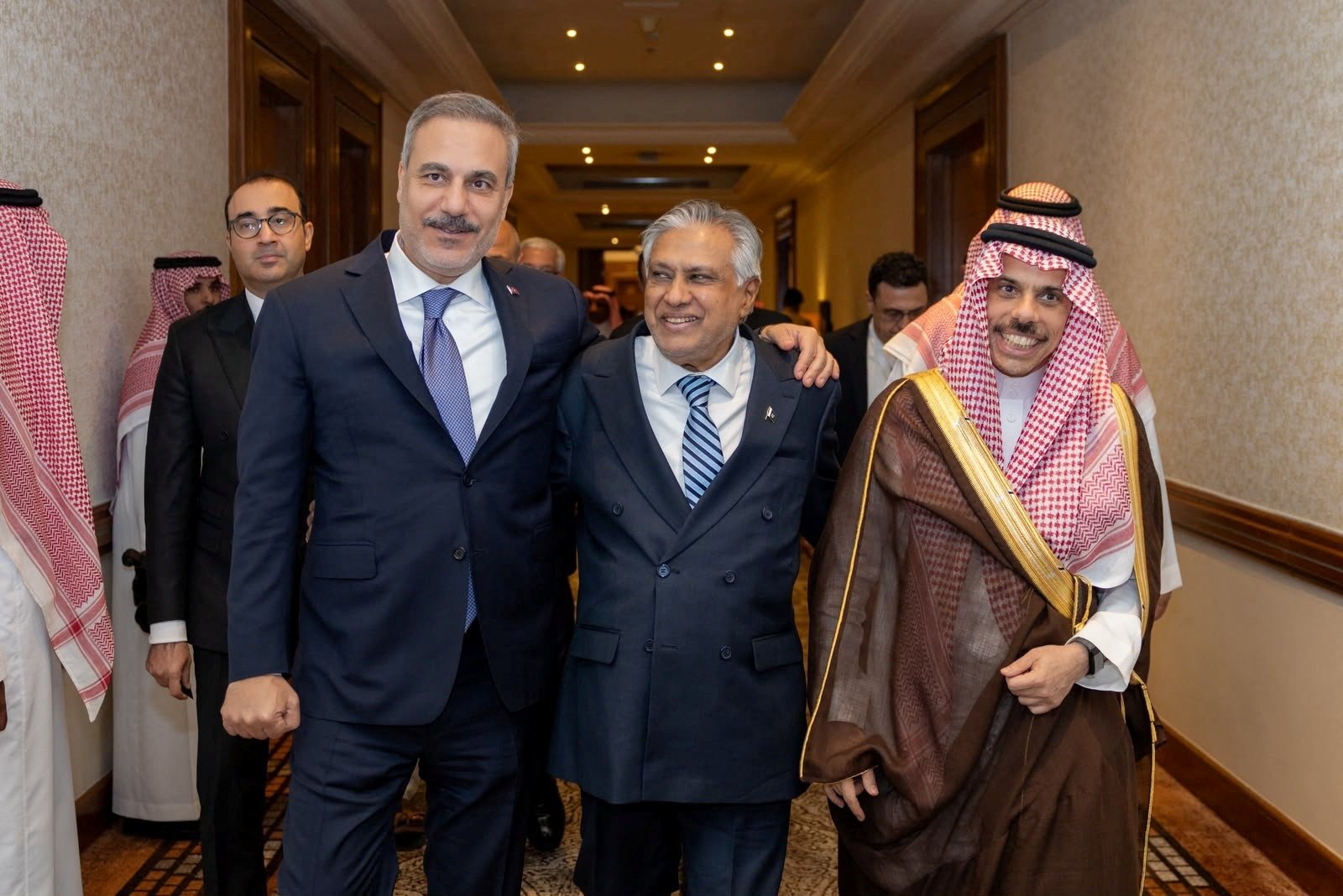
A curt statement followed an Oct. 5 meeting of ministers and army chiefs in Riyadh on the Mecca Joint Defense Alliance. The Strategic Political and Defense Committee of the alliance, in its second meeting after an Istanbul gathering, decided to deploy military forces and capabilities to Saudi Arabia. The move is the most concrete step since the agreement was signed in August by top officials of Türkiye, Pakistan and Saudi Arabia, to showcase the impact of the alliance in the broader region. Experts say the alliance remains focused on defense amid tensions between Saudi Arabia and the Houthis in Yemen, which stepped up attacks on the kingdom.
The Sabah newspaper reported on Wednesday that Türkiye would provide low- and medium-altitude aerial defense systems to Saudi Arabia along with assistance in drone technologies and electronic warfare. The newspaper also reported that Saudi Arabia was working on setting up a base for Türkiye. A Foreign Ministry official told Daily Sabah that the Saudi side conveyed “some expectations” to Türkiye and they would examine those.
Gökhan Ereli, assistant professor in the Political Science and International Relations Department at Ibn Haldun University in Istanbul, told Daily Sabah that the multilateral defense mechanism represents “a strictly territorial security framework.”
“It is fundamentally defensive. Under no circumstances will allied military assets deployed through this agreement be drawn into the internal combat operations of the Yemeni theater. Their mandate remains exclusively confined to fortifying Saudi Arabia's capacity to intercept cross-border hostilities. This ensures the kingdom can effectively shield its sovereign territory from external strikes. Ultimately, by consolidating these defensive lines, the pact establishes a robust deterrent that substantially bolsters the broader security architecture of the region,” Ereli stated.
As civil war in Yemen flared up this summer, Houthis spread it to Saudi Arabia, prompting the central government in Yemen to launch an all-out operation against the group this week. Saudi Arabia’s oil and military installations are among the main targets of the Houthis.
Ereli says the unified posture of Saudi Arabia, Türkiye and Pakistan was a result of current geopolitical realities.
“The Houthi movement continues to operate as a profound destabilizing force. They project a sustained, asymmetric threat both within Yemen's borders and across the wider regional landscape. Countering this hazard is paramount. Furthermore, the structural stability of the entire region remains deeply intertwined with the political trajectory of Sanaa. Protecting the fundamental welfare of the Yemeni people and ensuring the survival of their legitimate political authority are not merely localized objectives. They serve as indispensable prerequisites for achieving durable regional peace and preventing further systemic fragmentation,” he said.
Yusuf Bahadır Keskin, assistant professor at Amasya University Social and Strategic Research Center (AÜSSAM), says the alliance was at a “critical threshold,” citing the clause of the Mecca Joint Defense Agreement, which says an attack on one party would be viewed as an attack on all sides of the agreement.
“Nowadays, we witness that this won’t remain on paper. Houthis crossed a boundary here. Though they deny it, we saw attacks targeting the infrastructure of sacred sites. We see attacks on oil facilities and military bases in Saudi Arabia. This is beyond a mere border issue. It is an overall threat to the security of the kingdom and the region,” Keskin said.
He stated that Houthis’ aggression toward the legitimate government in Yemen was also unacceptable for the wider region. “Even though attacks on Saudi Arabia may cease at one point, it is not realistic to expect the situation to calm down in the short run,” he stressed.
Keskin highlighted that the Mecca alliance openly demonstrated that it would take “active responsibility in defense of Saudi Arabia” through the message given in Riyadh during the meeting of foreign and defense ministers and military officials on Monday.
“At this stage, the alliance’s strategy toward the Houthis should be understood primarily in terms of deterrence and defense support. Looking at the statements, there is no promise or plan for a ground operation inside Yemen or a joint offensive. The focus is clear: defending the kingdom’s territory. But there is another side to this. If the deterrence messages are ignored, the Houthis will have to face a much tougher intervention. In other words, the door is not closed, but the sequence is clear,” he underlined.
“Ankara and Islamabad could concretely contribute in areas such as air defense systems, intelligence sharing, advisory support or limited air assets. Each of these would significantly raise the cost of Houthi attacks targeting Saudi cities, energy infrastructure and holy sites. It would also make any potential retaliation much more effective and destructive,” Keskin added.
“Pakistan already has a longstanding military presence in Saudi Arabia, and expanding that presence could be on the agenda. Perhaps even the establishment of a Turkish military base in the kingdom could come up in the months ahead. For now, on the Turkish side, the focus appears to be more on training and the integration of defense industry products,” he also said.
President Recep Tayyip Erdoğan said last month that the defense alliance was “part of a shared effort to promote regional security and stability.”
In an interview with U.S. magazine Newsweek, Erdoğan has stressed that Türkiye’s broader diplomatic priority was to prevent existing conflicts from spreading and to keep channels for negotiations open.
“Conflicts directly affect the security, economy and stability of our region. At times like these, it is the shared responsibility of the international community to expand the space for diplomacy rather than narrow it,” said Erdoğan.
Keskin says that Foreign Minister Hakan Fidan’s emphasis on a measured stance after the meeting in Riyadh shows that deterrence and a diplomatic solution are “still being given a chance.”
In his first statement after the meeting, Fidan underlined that they discussed in detail “what could be done to resolve the issue (of the Yemen conflict) peacefully and through dialogue.” Fidan said the talks focused both on strengthening the institutional structure of the alliance and on possible steps that could be taken in response to the current situation involving Saudi Arabia and Yemen.
“Diplomacy remains on the table, but there is also very serious preparation on the ground,” Keskin pointed out.
He added that the positions of Türkiye and Pakistan could have a profound impact on the regional balance, both in terms of deterrence and operational capacity.
“For Türkiye, the issue has both symbolic and strategic significance: the security of an ally, the protection of Islam’s holy sites, and the security of the Turkish Ministry of National Education-affiliated school in Abha, its staff and Turkish citizens, with the city located approximately 100 kilometers from the Yemeni border. When these three factors come together, the possibility of Türkiye becoming directly involved in the process, if necessary, will also increase,” he said.
“The latest developments represent the alliance’s first serious test. Since the alliance was announced, the Houthis have effectively been testing it, and that test has now crossed the red line. Everyone is now watching how the alliance will respond to this challenge. If the necessary steps are not taken at this stage, it could undermine the alliance’s credibility in the years ahead. But if it demonstrates the right and resolute stance, the Mecca alliance will have taken a very important step toward becoming a genuine security architecture in the region,” Keskin concluded.