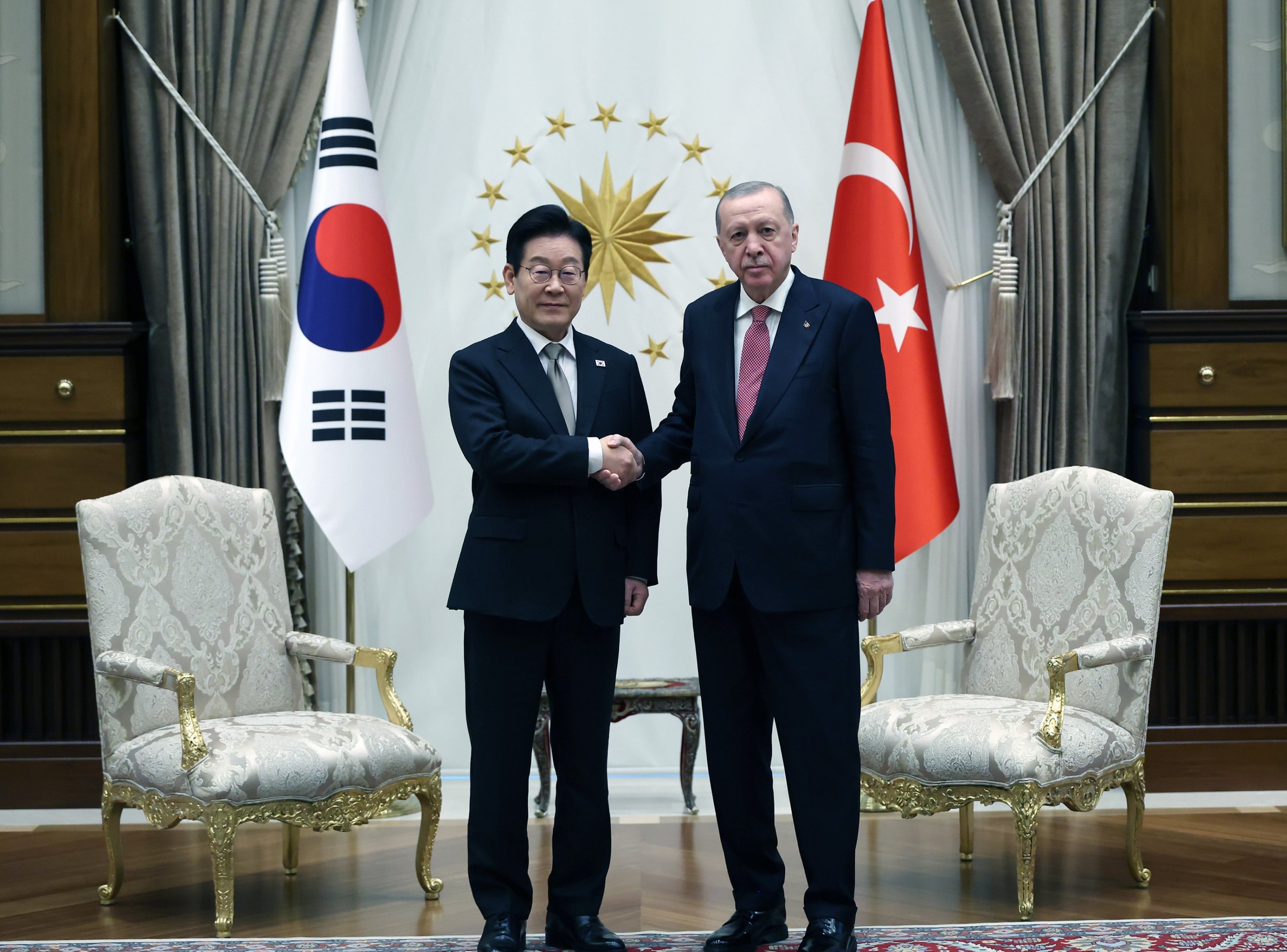
President Recep Tayyip Erdoğan said Ankara and Seoul share the same stance on regional and global issues, including the Gaza crisis and Ukraine, stressing that both countries support upholding the cease-fire, preventing further civilian deaths and advancing a two-state solution.
“Regarding the situation in Gaza, Türkiye and South Korea both support maintaining the cease-fire, preventing the killing of innocent people, and advancing a two-state solution,” he told reporters at a joint news conference in the capital Ankara, after signing various agreements with President Lee Jae Myung.
The president added that Türkiye sees strong potential for joint work with South Korea in a wide geography, including Syria, Gaza, the reconstruction of Ukraine, as well as Iraq, Africa and Central Asia. He noted that the two countries agreed to maintain their cooperation in international and regional platforms, including the United Nations, the G-20 and the MIKTA platform. He added that Türkiye appreciates South Korea’s successful chairmanship of MIKTA.
“We believe we can work together with South Korea in various regions, including Syria, Gaza, the reconstruction of Ukraine, as well as Iraq, Africa and Central Asia,” he said.
Erdoğan also reiterated Türkiye’s commitment to diplomatic efforts aimed at ending the Russia–Ukraine conflict, saying Ankara stands ready to support any initiative that advances a lasting peace.
“As Türkiye, we will continue to support all diplomatic efforts aimed at securing lasting peace in the Russia–Ukraine conflict, including the Istanbul process,” he said.
On the reconstruction front, Erdoğan highlighted joint prospects with Seoul, particularly in war-torn regions.
“We foresee working together with South Korea on the reconstruction of countries such as Syria and Gaza,” he said.
He also issued a call to allied nations regarding Palestinian statehood.
“As Türkiye, we expect all allied nations that have not yet taken action to recognize the State of Palestine,” Erdoğan added.
For his part, Lee thanked Türkiye for its hospitality and said he was pleased to visit a “brother nation” in a year marking both the 75th anniversary of Türkiye’s participation in the Korean War and his first year in office.
Lee said the two countries’ partnership, forged during the Korean War and formalized with the establishment of diplomatic ties in 1950, has grown rapidly and reached the level of a strategic partnership in 2012.
“Cooperation based on mutual interest in political, economic, cultural and people-to-people fields has continued to deepen,” he said.
Pointing to Türkiye’s strategic location at the intersection of Europe and Asia, Lee said Turkish–Korean cooperation has strengthened Korean firms’ access to the European market.
“In today’s talks with President Erdoğan, we reviewed bilateral cooperation built on our longstanding friendship and discussed ways to advance our strategic partnership toward a future-oriented, mutually beneficial framework,” he said.
Lee said the two leaders also discussed regional and global developments, stressing that both sides are determined to expand solidarity amid shifting geopolitical dynamics.
“In a period when both countries are striving to strengthen their defense industries, we are committed to continuing joint production, technology cooperation and training exchanges based on mutual trust,” he noted.
He cited the ALTAY Main Battle Tank program as an example of successful cooperation and expressed hope for similar projects that would bolster both countries’ defense capabilities while contributing to regional and global peace.
Lee said the two governments agreed to ensure smooth progress in the negotiation and evaluation process for the Sinop Nuclear Power Plant project.
He added that South Korea’s advanced nuclear technology and operational expertise could make a “concrete contribution” to Türkiye’s nuclear development efforts.
Lee also welcomed the participation of Korean companies in Türkiye’s domestic biotechnology projects, saying the initiative carries added meaning given the “brotherhood forged in blood” between the two nations.
He highlighted major joint infrastructure projects such as the Çanakkale Bridge and the Eurasia Tunnel and said both sides hope to further strengthen cooperation in infrastructure development.
“We are determined to deepen strategic joint initiatives in advanced science and technology, including renewable energy and artificial intelligence,” he said.
Lee announced that Türkiye and South Korea agreed to resume the Joint Economic Commission meeting after a 10-year pause in order to review progress across various sectors.
On regional issues, Lee said the leaders discussed developments on the Korean Peninsula and thanked President Erdoğan and the Turkish government for their consistent support for Seoul’s policy toward North Korea.
He also praised Türkiye’s efforts to promote peace in the Middle East and described Ankara’s work on addressing the situation of Syrian refugees as “highly meaningful.”
Lee welcomed the growing interest in Korean culture and language across Türkiye, noting the rapid spread of South Korean content on digital platforms.
Following bilateral and interdelegation talks, officials proceeded to a signing ceremony covering a range of fields from veterans’ affairs to nuclear energy and infrastructure.
A memorandum of understanding on cooperation in commemorating the Korean War was signed by Türkiye’s Family and Social Services Minister Mahinur Özdemir Göktaş and South Korea’s Minister of Patriots and Veterans Affairs Kwon Oheul.
A second agreement, focusing on cooperation in nuclear energy, was signed between Türkiye Nuclear Energy Inc. (TÜNAŞ) Director General Necati Yamaç and Korea Electric Power Corporation (KEPCO) CEO Kim Dong-cheol.
The third memorandum of understanding, covering transport and infrastructure cooperation, was signed by Turkish Highways Director General Ahmet Gülşen and, on behalf of the Korea Expressway Corporation and Korea Overseas Infrastructure and Urban Development Corporation, South Korea’s Ambassador to Ankara Jeong Yeon-doo.
The longstanding relationship between the two countries was further strengthened when Türkiye sent troops during the Korean War of 1950-1953. Türkiye became one of the countries that sent the most troops to the Korean War in response to the call of the U.N.
The final resting place of 462 out of the 721 Turkish soldiers lost in the war is located in the U.N. Memorial Cemetery in the South Korean city of Busan. Koreans frequently visit the monumental cemetery, which includes Turkish martyrs.
Ties between the two countries have been strengthened in recent years through cultural and social ties. Korean music and dramas have become quite popular in Türkiye in recent years, boosting Korean language learning as this culture gains recognition. Meanwhile, Türkiye is also garnering interest among young South Koreans for its cuisine and tourist attractions.