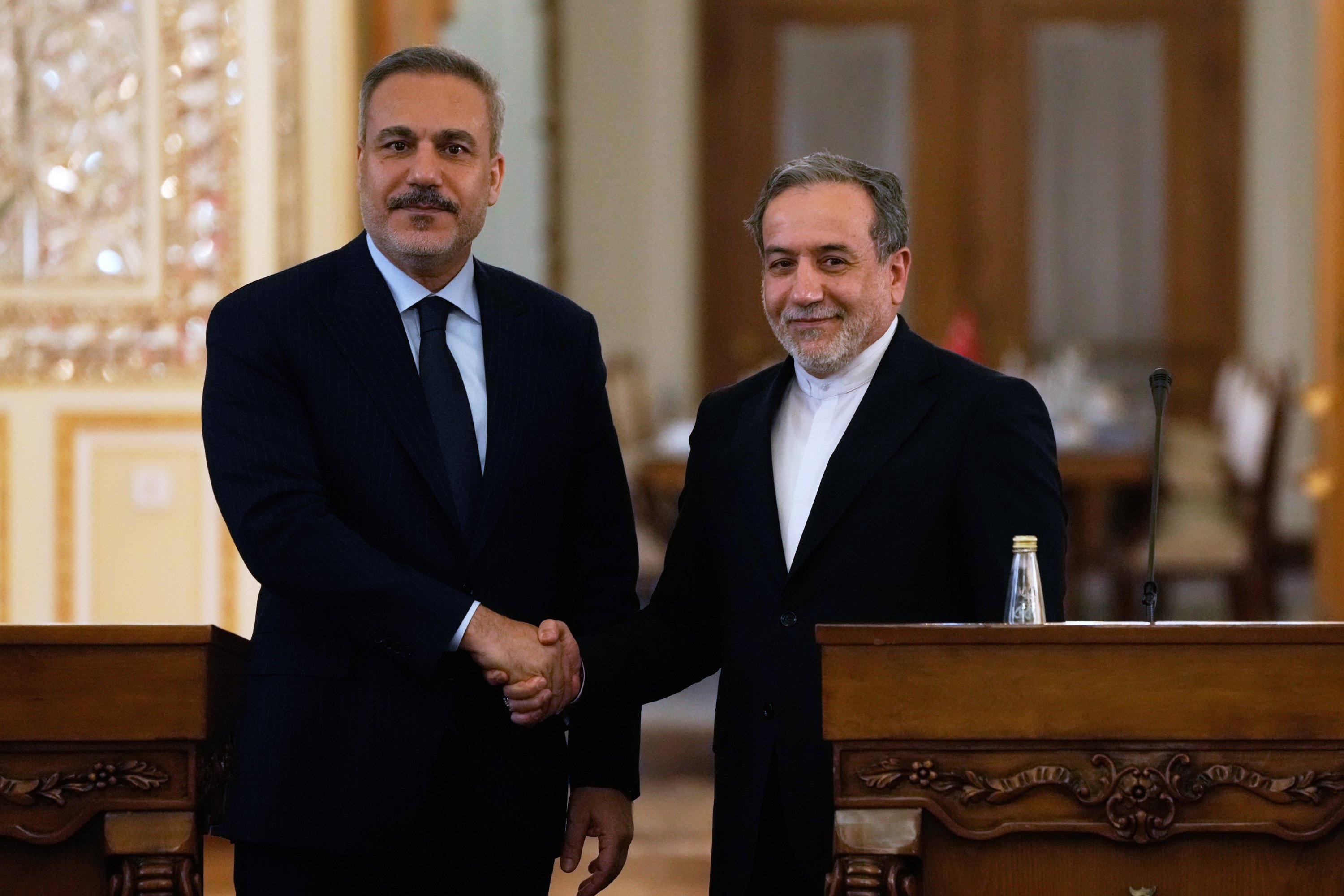
Türkiye's peace diplomacy is at work again as the world awaits the outcome of the war of words between the U.S. and Iran. Turkish diplomatic sources told media outlets on Wednesday that Ankara contacted both countries to de-escalate tensions.
Foreign Minister Hakan Fidan held a second phone call in two days with his Iranian counterpart Abbas Araghchi on Wednesday, Foreign Ministry sources said. Sources said Fidan underlined the need for negotiations to alleviate existing regional tensions.
Türkiye is worried about turmoil in its eastern neighbor as the U.S. threatened to strike Iran, following days of riots that reportedly left thousands dead.
A senior Iranian official speaking to Reuters on Wednesday warned that Iran would strike U.S. military bases in regional countries if the U.S. attacks. "Tehran has told regional countries, from Saudi Arabia and UAE to Türkiye, that U.S. bases in those countries will be attacked if the U.S. targets Iran ... asking these countries to prevent Washington from attacking Iran," the official told Reuters.
Türkiye maintains close ties with both sides of the potential conflict and is one of the most vocal opponents of Israel's genocide, which joined the U.S. in support of action against Tehran. Fidan was also scheduled to visit the UAE on Wednesday, one of the countries Iran sought assistance to prevent further tensions with the U.S.
Ankara walks on a tight rope of diplomacy in a volatile region, rocked by Israel's expansionist attacks from Lebanon to Syria.
Türkiye does not want chaos in neighboring Iran, the spokesperson of the ruling Justice and Development Party (AK Party) said on Monday as he warned that foreign interference, particularly provocations encouraged by Israel, would only trigger deeper instability across the region. Çelik said Ankara does not deny that Iran faces social and political challenges but stressed that solutions must emerge through Iran’s own internal dynamics and national will. “We never want chaos in our neighbor Iran,” Çelik said, referring to ongoing protests in the country. “There are problems in Iranian society and state life, but these must be resolved by the Iranian people themselves, through their own mechanisms."
Çelik cautioned that outside intervention has historically produced destructive outcomes, warning that any attempts to exploit unrest in Iran through external pressure or provocation would lead to far greater crises. He said Israel’s actions in the region demonstrate a pattern of fueling instability beyond its borders. “Foreign interventions always make things worse,” he said. “We clearly see that attempts, especially those encouraged by Israel, to stir chaos in Iran would have serious and dangerous consequences for the entire region.”
Devlet Bahçeli, leader of the government ally Nationalist Movement Party (MHP), highlighted this risk. Addressing lawmakers of the MHP at a parliamentary group meeting on Tuesday, he said what was happening in Iran was beyond mere protests. “What we should really pay attention to is an organized, multiactor provocation by (foreign) intelligence and imperialists,” he said. “Any unrest or division in Iran threatens Türkiye and the regional countries. Iran’s political, territorial integrity, peace and stability are a matter of life and death for Türkiye,” he said.
The two countries trace back their relations to the Ottoman times, and after multiple campaigns by the sultans, the Ottomans and Iranians managed to carve a state of peace that endured for centuries, although their interests clashed at times.