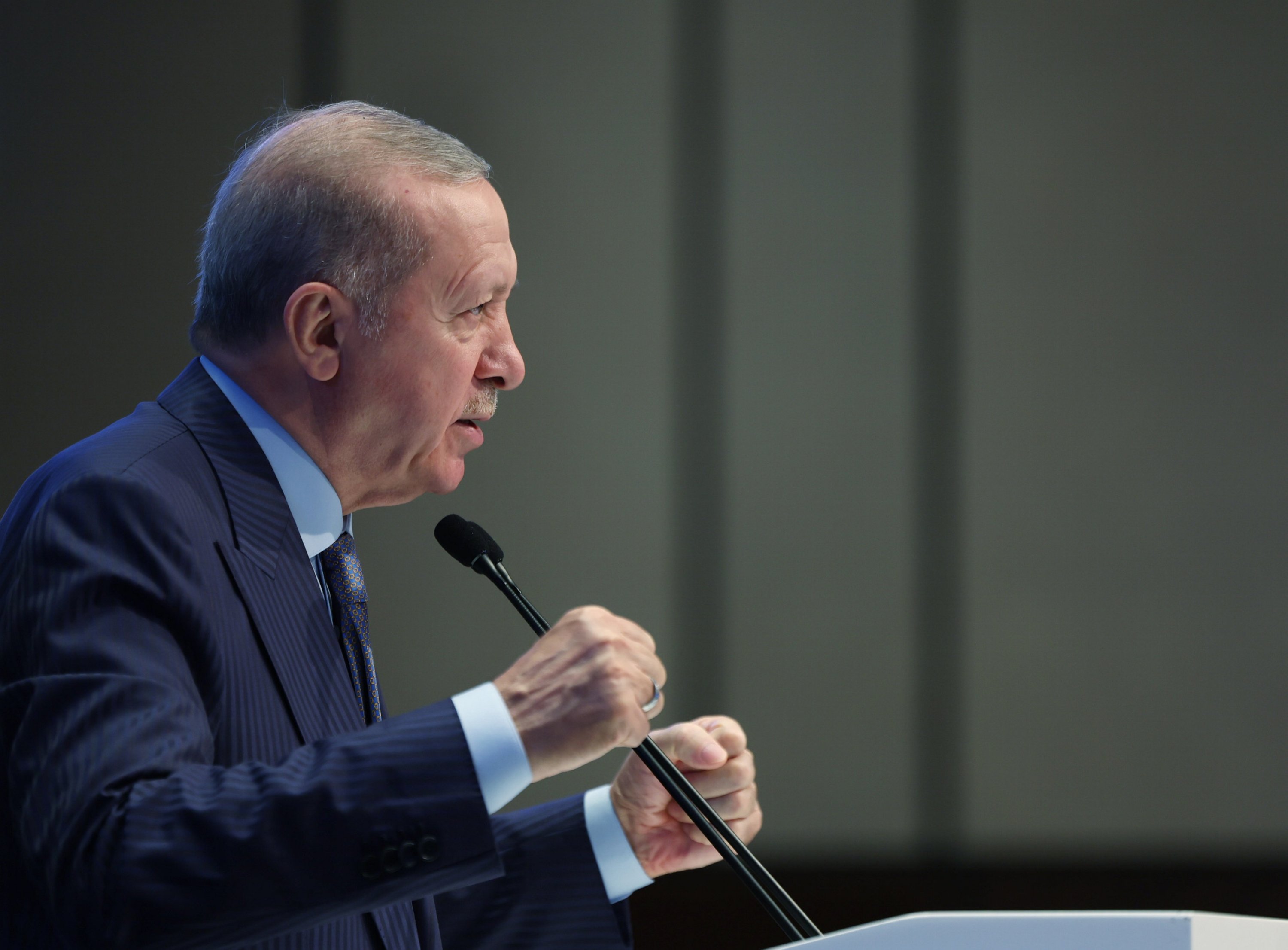
A constitutional amendment that ended the largely ceremonial role of the president boosted President Recep Tayyip Erdoğan’s place in the annals of Turkish democracy. The charismatic leader whose party has won successive elections since 2002 marks 11 years in power on Sunday, as the first president directly voted into office by the nation.
During Erdoğan’s tenure as democratically elected president, Türkiye has weathered several crises and raised its diplomatic profile as a significant power broker and a force to reckon with, from mediating crises between Ethiopia and Somalia to the conflict between Russia and Ukraine and giving a powerful voice to Türkiye against Israel’s attacks on Gaza. At home, Erdoğan mobilized the nation and steered the recovery after the “disaster of the century” or earthquakes that killed tens of thousands of people in southern Türkiye in February 2023. Most recently, the People’s Alliance under the leadership of Erdoğan embarked upon an ambitious plan to disarm the PKK and end decades of violence by the terrorist group.
It was a rough path for Erdoğan, who himself and his party faced numerous challenges over the past two decades, but ultimately, the public’s will for true democracy won. Erdoğan had to wait seven years for the first direct presidential election, following a 2007 amendment that changed the election rules and was approved by a public referendum. Before the amendment, the presidency was a ceremonial role and Parliament elected the president. Opposition parties initially opposed the arrangement, but when the election date neared, they fielded their own candidates one after another. Erdoğan, the candidate of his Justice and Development Party (AK Party), was challenged by former Organisation of Islamic Cooperation (OIC) Secretary-General Ekmeleddin Ihsanoğlu, who was supported by the majority of opposition parties, and Selahattin Demirtaş, co-chair of the now-defunct Peoples’ Democratic Party (HDP).
Erdoğan secured more than 51.7% of the vote, becoming the 12th and first directly elected president of the Republic of Türkiye. Three years later, he won another victory for further changes to the presidential system, when more than 51% of the voters approved the executive presidency system, granting more powers to the president in a 2017 referendum. In 2018, another presidential vote was held, this time pitting Erdoğan against more challengers, but the veteran politician managed to beat his rivals again. His last election was in 2023 and Erdoğan etched his name in the annals of Turkish democracy again by defeating Kemal Kılıçdaroğlu, the joint candidate of a six-party opposition bloc, although this time in a runoff vote.
In a social media post on Sunday, AK Party’s deputy chair, Efkan Ala, marked the day and said the era of running Türkiye “without public consent” was “over.” “The irade is now idare,” he said, using Turkish words for “will” and “administration” respectively.
The presidency in its original form was a powerful authority, as evidenced during the tenure of Mustafa Kemal Atatürk, the country’s first president and founder of the Republic of Türkiye. His successor, Ismet Inönü, was branded as “National Chief” for his immense power that even continued when his Republican People’s Party (CHP) was in opposition. But after the 1960 coup that ousted President Celal Bayar from power, it became a mere symbol of “authority” without any real power, while the post of prime minister evolved into the actual seat of governance. The post only had its influence when former army chief Kenan Evren launched a coup in 1980 and installed himself as president. Before and after that coup, prime ministers and presidents rarely aligned, and this separation was most evident during the tenure of Ahmet Necdet Sezer, who infamously clashed with then-Prime Minister Bülent Ecevit in 2001 during a National Security Council meeting, paving the way for an economic crisis.
Ala said Erdoğan’s election was a turning point in Turkish history, marking a revolution that eliminated the shadow of “tutelage.” He was referring to the influence of a political and military elite that had threatened with a coup and occasionally succeeded in launching it in the past, whenever they felt their interests were threatened.
“This reform led by the AK Party strengthened national sovereignty, reinforced democratic representation and put the nation’s approval at the heart of politics. Decisions, authority and responsibility now are being shaped directly by the will of they people,” Ala said.
“National will is the strongest foundation. This step ensured that Türkiye continues its path stronger and decisively. We turned the page on the crisis stemming from the presidential elections,” he said.