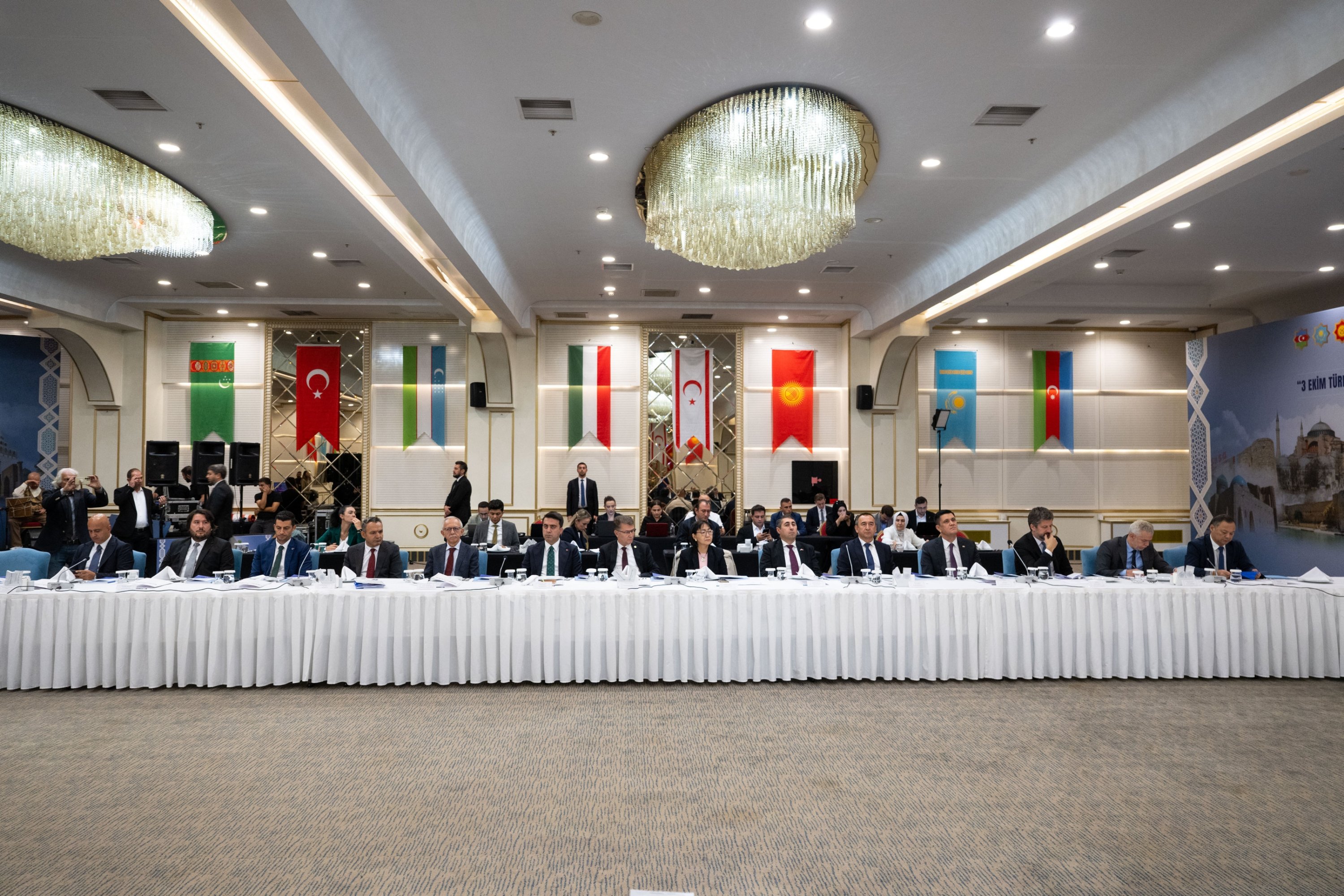
President Recep Tayyip Erdoğan will visit Azerbaijan’s Gabala province on Tuesday to attend the 12th leaders summit of the Organization of Turkic States (OTS) and discuss regional peace and security.
“During the Summit themed 'Regional Peace and Security,' the strengthening of the Organization of Turkic States' institutional structure and efforts for cooperation within the organization will be discussed, and it is expected that various documents and decisions, including the Gebele Declaration, will be adopted,” Communications Director Burhanettin Duran wrote on social media.
The president is expected to hold bilateral meetings with leaders on the sidelines of the summit, he added.
Originally founded as the Cooperation Council of Turkic-Speaking Countries (the Turkic Council), the organization's foundations were laid by the Nakhchivan Agreement signed on Oct. 3, 2009, by Azerbaijan, Kazakhstan, Kyrgyzstan and Türkiye.
The OTS aims to integrate the Turkic world through shared historical and cultural values and cooperation in diverse fields, including economy, politics, education, culture, defense, security, transportation, customs, tourism and sports. It also serves to enhance the geopolitical position of the Turkic world, with its member countries covering a total area of 4.25 million square kilometers (over 1.6 million square miles) and a population of around 160 million, gaining considerable regional recognition over the past 15 years. The OTS originally emerged as a summit between the heads of Turkic states in 1992, when the countries of the former Soviet Union (USSR) began declaring independence.
In recent years, the OTS has expanded its international partnerships, collaborating with the United Nations, the Organisation of the Islamic Cooperation (OIC), the OSCE, and the World Customs Organization. Its representative office in Budapest has helped cement ties with Hungary, its first full European and EU observer and strengthen engagement with the European Union, the OECD and the Visegrad Group.
The Turkic World – 2040 Vision Document, adopted in 2021, provides a framework for the bloc’s long-term ambitions. It calls for stronger political solidarity, expanded economic and technical cooperation, enhanced people-to-people ties and joint efforts to preserve cultural and historical heritage. The roadmap highlights the group’s transition from a cultural alliance to a comprehensive regional organization with global ambitions.
Türkiye champions multilateral relations between member states, as well as with observers like Hungary, as Ankara seeks to diversify its partnerships, which have long been anchored in Western states.
On the other hand, one of Türkiye’s goals is for the Turkish Republic of Northern Cyprus (TRNC) to be recognized and further included in relations with the Turkic states. The TRNC is currently an observer state.
Meanwhile, the TRNC President Ersin Tatar stated on Monday that ties between the TRNC, Türkiye and Azerbaijan are strengthening day by day, as the concept of "one nation, three states" continues to gain momentum ahead of the Gabala summit.
"The concept of 'one nation, three states' is becoming more widespread," Tatar said, emphasizing the growing cooperation between the three Turkic nations.
Tatar highlighted the importance of the TRNC's observer status within the Organization of Turkic States and noted that they are working to deepen relations with member countries.
Highlighting the geopolitical and geostrategic importance of the TRNC's established presence in the Eastern Mediterranean for the Turkic world, he said the TRNC would again be represented at the summit under its own flag and constitutional name.
Noting that the TRNC is making continuous progress in its relations with Ankara and Baku, Tatar said: "Especially after the Second Karabakh War, Azerbaijan's interest in the TRNC has helped reinforce this concept both there and here.
"We are also striving to advance our relations not just with Azerbaijan, but with other member states of the organization as well," he added.