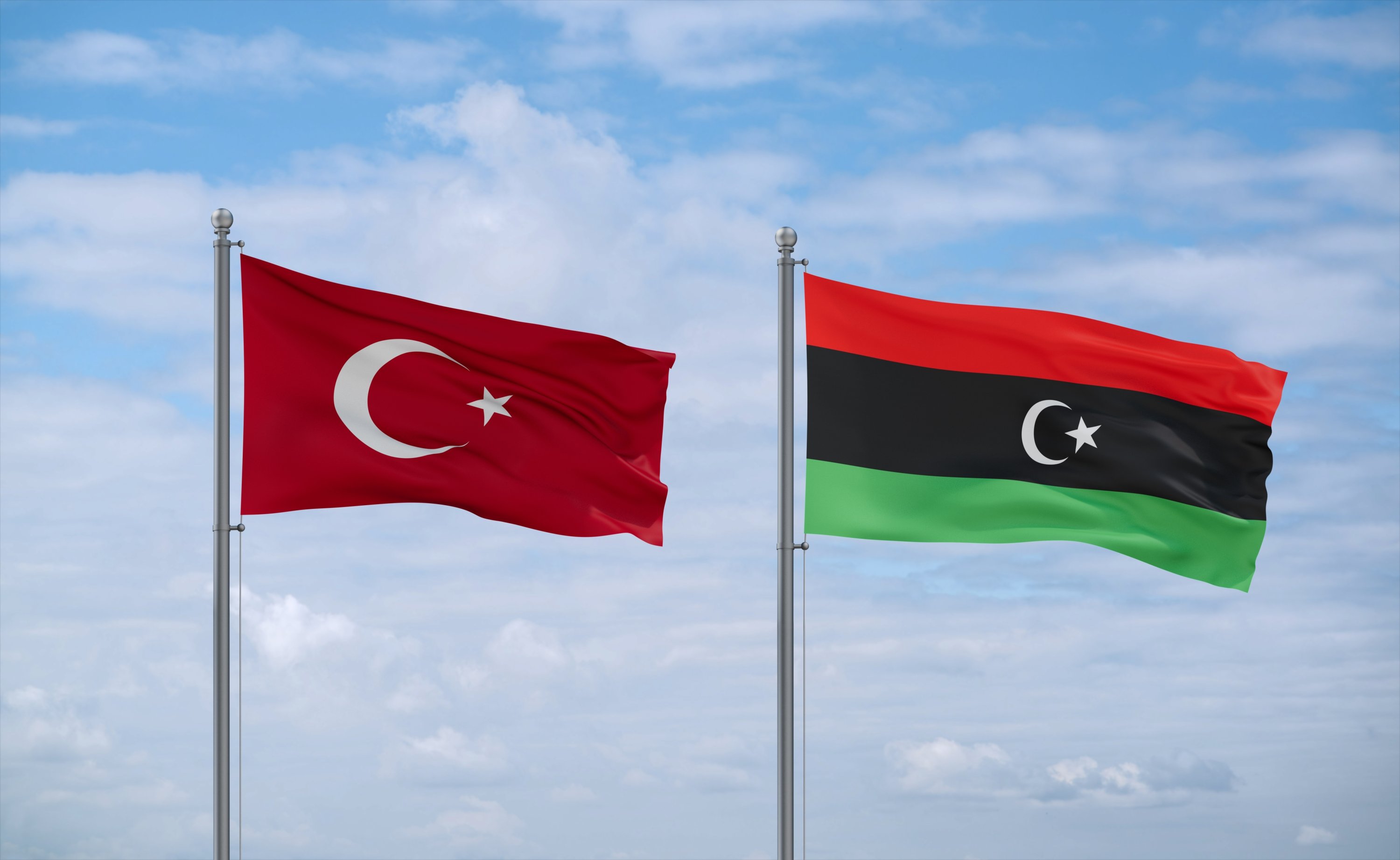
Greece is pushing again against a 2019 maritime deal between Türkiye and Libya. After Ankara, Libya’s eastern Benghazi-based government on Saturday rejected recent remarks from Greek officials about the legitimacy of the deal.
Libyan Prime Minister Osama Hammad stated that the deal between the two countries is internationally legitimate. He reaffirmed Libya's firm rejection of any challenges or interference with its sovereign decisions, particularly regarding international agreements made with allies.
The Libya-Türkiye cooperation is carried out under international legitimacy and does not violate the sovereignty of any country, Hammad noted.
He emphasized that Libya reserves the right to respond firmly to any actions that jeopardize its territorial integrity or political sovereignty, and he warned Greece about the consequences of continuing its policy of provocation and escalation. Hammad also emphasized that Libya's maritime rights are nonnegotiable and can only be discussed within international legal frameworks, noting that his government has taken decisive steps in response to Greece's recent attitudes.
Greek Prime Minister Kyriakos Mitsotakis' statements targeting the deal have provoked serious reactions from authorities in eastern and western Libya.
The Libyan National Unity Government had expressed deep concern in a June 19 statement regarding the announcement by Greece in the Official Journal of the EU on June 12 for tenders for hydrocarbon exploration and exploitation in the areas disputed with Libya, south of the island of Crete.
The Libyan National Unity Government statement, which emphasized the importance of respecting international law, said the steps are a clear violation of Libya's sovereign rights, expressing clear objection to any exploration or drilling activity in those areas without a prior legal framework that respects the rules of international law.
It urged Greece to adopt constructive dialogue and negotiations based on international legal principles that consider the interests of all parties to reach fair and equitable solutions.
Türkiye on Friday said the conclusions adopted at the European Union leaders’ summit demonstrate that Greece and the Greek Cypriot administration continue efforts to impose their “maximalist claims,” which Ankara says violate international law and the principle of equity. “The results adopted at the European Union (EU) Leaders’ Summit held on June 26, 2025, demonstrate that Greece and the Greek Cypriot Administration of Southern Cyprus (GCASC) continue their efforts to impose their maximalist claims, which are contrary to international law and the principle of equity, on the EU,” Foreign Ministry spokesperson Öncü Keçeli wrote on X.
Keçeli reiterated Türkiye’s position that the 2019 Memorandum of Understanding signed with Libya on the delimitation of maritime jurisdictions in the Eastern Mediterranean is “entirely legitimate under international law.” He said the agreement clearly shows that Ankara will not allow violations of its lawful rights and interests in the region. He criticized the EU for issuing “politically motivated and biased” statements on a sensitive matter such as maritime delimitation, which he emphasized involves legal and technical complexities. “Instead of endorsing legally invalid claims, the EU should call on all its members to comply with international law,” Keçeli said. He added that Türkiye will continue to firmly defend its legitimate rights and interests in the Eastern Mediterranean within the framework of international law.
The 2019 maritime boundary agreement that includes provisions for Turkish hydrocarbon exploration within Libya’s territorial waters is still not fully implemented. In 2022, the two countries signed a hydrocarbons memorandum of understanding, paving the way for Turkish companies to conduct seismic surveys and drilling operations. The agreement took a new turn on June 25 when Turkish Petroleum (TPAO) signed a memorandum of understanding with Libya’s National Oil Corporation (NOC) for a 2D seismic survey in the Libyan waters. Under the memorandum, TPAO will conduct surveys in four offshore blocks off the Libyan coast, over an area covering 10,000 kilometers (6,213.71 miles). The data collected during the surveys will be processed within nine months.
After a long period of tensions marked by disputes over irregular migration, the Cyprus dispute, energy exploration and territorial sovereignty in the Aegean, Ankara and Athens have been taking confidence-building steps for a fragile normalization of their relations since late 2023. The normalization sustained momentum in the past two years, with talks between leaders as well as sporadic high-level meetings of top officials to discuss sources of dispute. Yet, both countries stand firm in their maritime rights, which are still not fully agreed upon after decades of hostilities dating back to the post-World War I period.