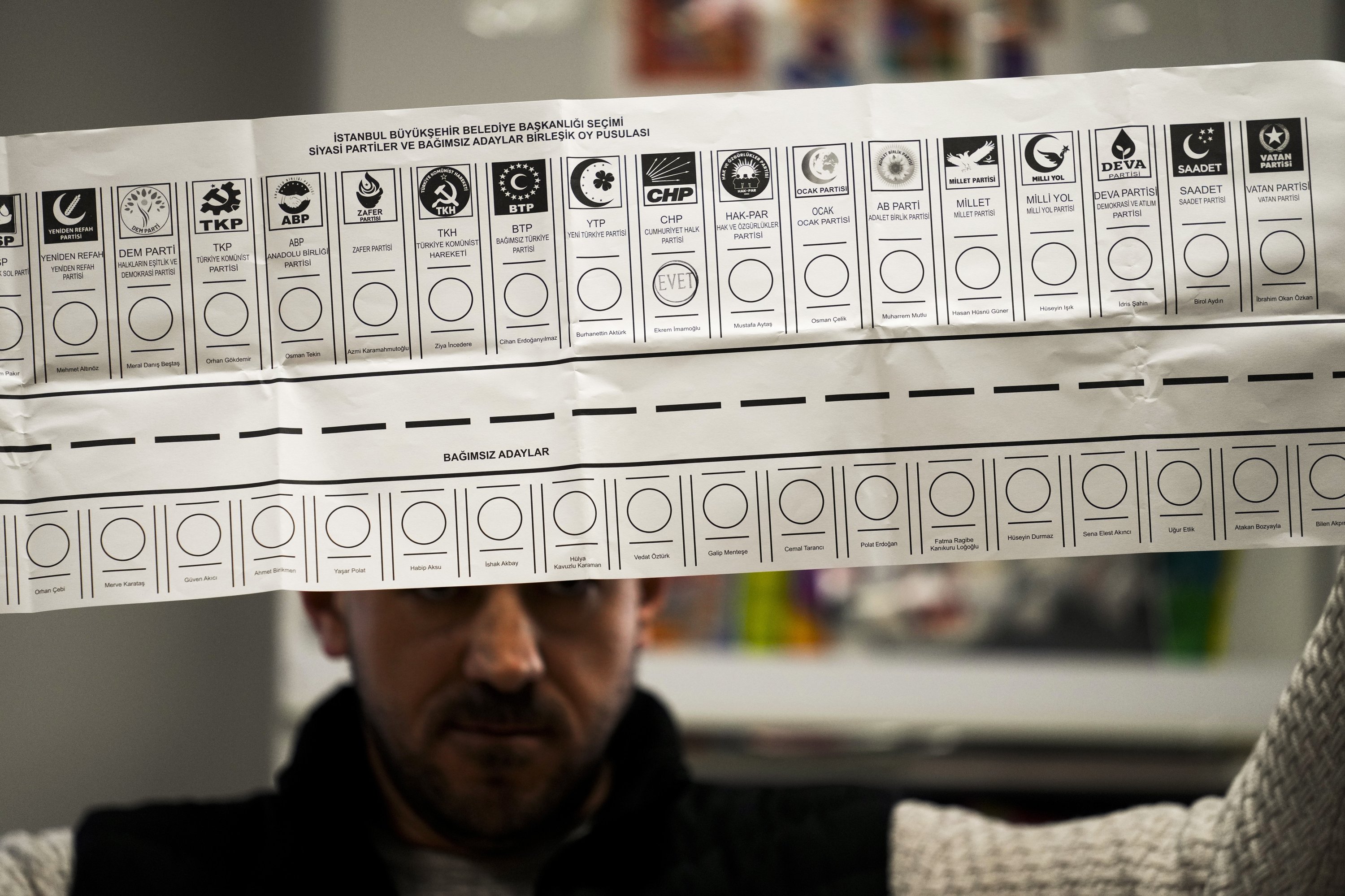
The elections have been a two-handed game in the past two decades, thanks to the Justice and Development Party’s (AK Party) incomparable success. Its main rival, the Republican People’s Party (CHP), fights for political survival amid internal friction and mounting allegations of corruption. Smaller parties continue to calculate the risks of aligning with it in the next election and going alone or through a separate alliance against the AK Party and its beloved leader, President Recep Tayyip Erdoğan.
Erdoğan has been a game-changer in Türkiye’s democratic history and has been at the helm of Türkiye the longest since its founder, Mustafa Kemal Atatürk, as prime minister and president. After more than two decades in power, his AK Party is still ahead according to some opinion polls. In others, the party has a narrow gap with the CHP, while neither of the parties’ rivals comes close. For instance, an April survey by Optimar shows the Peoples’ Equality and Democracy Party (DEM Party) scored 9.6% after the CHP, while another poll from March by Genar indicates the DEM Party can secure 8.9% of the vote after the AK Party and the CHP.
According to the official figures, there are 188 political parties in Türkiye. Most remain functional in name only, while several among them have less than 100 members, and maybe even fewer voters. The abundance of parties is a sign of the democratic wealth of the country, which has gone through three coups and more attempts by the military to interfere in politics. It is also a blessing for bigger, older parties, which usually rely on voter behavior to side with the winning side in the elections, though their loyalty might lie elsewhere at other times.
Some are “relics” not in the true sense of the word, but rather, due to the waning popularity of political views they defended. Those relics also include spiritual successors of once-popular parties. The newcomers referred to in the title, meanwhile, are mostly founded by dissidents of bigger parties, though some among them are truly new to politics, seeking to garner votes from those dissatisfied with the course their old parties took, namely the AK Party, the CHP and the AK Party’s ally, the Nationalist Movement Party (MHP).
Here are likely winners and losers of the next election scheduled to be held in 2028, although AK Party signaled that it may be rescheduled to the fall of 2027. Wins and losses, however, can be limited to the parliamentary seats as the AK Party and the CHP will likely dominate the polls again, based on recent surveys.
The “A Party,” as it formally refers to itself, was founded in 2024 by Yavuz Ağıralioğlu, a 54-year-old former lawmaker who made his foray into politics in the Great Unity Party (BBP) before switching to the Good Party (IP) in 2018, only to resign in 2023. The party has set out to be a “key” to what it called “a deadlock in the system,” according to its manifesto, a reference apparently to the unending race between the AK Party and CHP. This was affirmed by Ağıralioğlu in a recent interview. He also claimed that the party has become popular among voters of the AK Party, MHP and IP, and to a degree, the CHP. With former AK Party and IP members among its founders and executive board, the A Party inevitably set its politics strictly to the right and its proposed policies, such as immediate deportation of all migrants and Syrian refugees, draw comparisons to fellow underdogs in the political scene.
Soon after its foundation, the party joined the growing list of political pundits’ “third-way parties” in the face of the AK Party and the CHP domination. In the ideological sense, it does not offer an all-embracing approach, but it managed to make it to the opinion polls, scoring slightly above 1% in Optimar’s survey. Areda-Survey’s poll put it above 4%. The party is not intent on being a part of future alliance against or with the AK Party, but as a quote attributed to late veteran politician Süleyman Demirel says, “Even 24 hours is a long time in politics,” and this stand may change in an instant when the election season begins.
Often leading or trailing behind the A Party in opinion polls, the YRP proved its potential in the 2024 municipal elections by securing more than 6% of the vote. Founded in 2018 by Fatih Erbakan, son of former Prime Minister Necmettin Erbakan, it follows the path of the late politician, specifically “National View” ideology, something also shared by the Felicity Party (SP). The YRP allied with the People’s Alliance of the AK Party and MHP in 2023 before parting ways after the elections.
Younger Erbakan seeks to build upon the legacy of his father, who managed to rally disenfranchised conservative voters stuck in center-right parties for decades. Erbakan’s “National View,” which also sought to attract voters with wildly different world views, especially through anti-imperialist elements of the ideology, made the now-defunct Welfare Party (RP) a rising star in the politics of the 1990s. The RP is where President Erdoğan honed his political and oratory skills, and the AK Party has managed to attract some of its former supporters when the party was closed and its reincarnation, the Virtue Party (FP), was split.
The YRP did not veer much from the RP in its policies and mainly targeted voters who were adherents of the National View and disillusioned with the AK Party’s changing ways, specifically the widening political spectrum of the party. A rise in the polls indicates that this strategy may work. Forty-seven-year-old Erbakan is among the youngest of the leaders of prominent parties, but age has rarely been a determining factor in the choices of voters in multiparty elections since 1950.
The party recently tried to lure voters critical of the government’s policies toward Israel, adopting a rhetoric that the AK Party was not doing much to stop Israel’s genocide in Gaza and its power in the international community. It is unclear how it may bring more votes to the party, where the economic challenges are expected to be a more significant factor in the choices of the voters in the next election.
The YRP does not favor another bid in the People’s Alliance, but it is open to aligning with the SP in the next election. Though Erbakan is confident about going solo, he also signaled openness to allying with other parties as well, including the Democracy and Progress (DEVA) and the Future Party (GP), which were founded by former members of the AK Party.
Although they are separate entities under Turkish laws, DEVA and GP are almost one in their policies and voter base. This eventually led to an alliance in the parliament under the New Path banner, together with the SP.
The DEVA was founded in 2020 by Former Minister Ali Babacan, once a rising young politician in the AK Party. He apparently followed the example of former Prime Minister Ahmet Davutoğlu, who established SP one year before. In the 2023 elections, both parties relied on the main opposition to secure parliamentary seats, while they had no dream of having their own candidates against Erdoğan and his rival, CHP’s Kemal Kılıçdaroğlu. Babacan and Davutoğlu succeeded in convincing former AK Party supporters, including former ministers and those who served on the AK Party boards. Yet, this has not been enough to pass the electoral threshold.
Like the parties above, they can be lumped with right-wing or center-right parties, and their policies do not differ much from the AK Party’s policies in the early 2000s. Indeed, they have more in common with the AK Party than the six-party bloc they supported against Erdoğan in 2023. Their alliance with the opposition will likely continue in the next election, though they may prefer siding with the FP and the YRP instead of the CHP. Defeat of the CHP’s candidate Kılıçdaroğlu in the 2023 elections cost the main opposition party’s chair his seat but also revealed seething anger among CHP supporters against DEVA and FP lawmakers who won seats with CHP loyalists’ votes. The FP and DEVA were accused of being freeloaders who run under the CHP banner in the legislative elections in exchange for voicing their support for Kılıçdaroğlu’s candidacy. This mounting criticism effectively shut the door to another alliance, though both parties still appear to be on good terms with the CHP administration after Kılıçdaroğlu was replaced with Özgür Özel following his devastating electoral loss.
Once hailed as the primary alternative to the MHP, IP now floats somewhere between a hub for nationalists who fell out with the MHP due to its proliferating alliance with the AK Party and a stopover or last destination for CHP voters believing that the party is too left-wing for their taste. The IP’s sole ideological compass adhering to the right-wing politics of yesteryear may bring in votes from the elderly voters, unlike the Victory Party (ZP), which appears to lure much younger voters despite a similar policy with the IP.
The party's membership and poll numbers show a downward trend, as voters who prioritize national stability increasingly return to the MHP or look toward newer nationalist experiments. The party now faces the risk of becoming a "relic" before it ever truly matures, as it struggles to convince the public that it offers anything more than a diluted version of the MHP’s robust nationalism, willing to take risks for sustaining the state.
Party Chair Müsavat Dervişoğlu underlined that they were not open to alliances, especially establishing a “nationalist league” and relying on what little support it has to run in the future elections independently. Any future alliance may further erode the support, as the 2023 elections demonstrated.
One of the youngest parties, the ZP was founded in 2021 by 65-year-old Ümit Özdağ. Özdağ’s easygoing public image and oratory skills helped the party to attract voters at a time of rising anti-migrant, anti-refugee sentiment in the public. A diehard nationalist, Özdağ tempted impressionable youth with his radical discourse, which is blamed for notorious riots against migrants and refugees.
Unfortunately for the ZP, this appears to be the only thing the party is known for. With the end of the Syrian civil war and refugees returning home, the party might lose voters attracted to Özdağ’s narrative of “sending all refugees home immediately by Victory Tourism buses.”
In the 2023 elections and subsequent polls leading to 2026, the ZP has functioned more as a disruptor than a viable governing partner. Its aggressive stance often alienates the very conservative-nationalist base it hopes to win from the MHP and the AK Party. Though it captures a small, reactionary segment of the youth vote, its lack of a holistic platform makes it an unlikely contender for any serious power-sharing in the future. Still, the ZP is among the most willing to form alliances and most recently, called on the CHP to establish one with them for an “Ataturkist alliance.”
The DEM Party does not quite fit in the categories of relic or newcomer, but developments may render it the former. The latest incarnation of a left-wing ideology claiming to fight for the rights of the Kurdish community, the DEM Party holds considerable sway among the electorate, often trailing behind the CHP and occasionally overtaking the MHP in the opinion polls. Its spiritual predecessors have also enjoyed the same success in the elections.
The party’s electorate is strictly confined to Kurds, especially those concentrated in southeastern Türkiye. Despite securing roughly 8% in recent surveys, the party remains hamstrung by its inability to distance itself from the shadow of terrorism, which remains a red line for the majority of the electorate. Like its predecessors, the DEM Party has been a staunch supporter of the PKK terrorist group. A surprise initiative by the government to end the PKK terrorism outside of solely military means limited the DEM Party’s ambitions to thrive on pro-PKK propaganda to attract voters. In the past two years, the DEM Party has found itself in unexpected places: a messenger between PKK jailed ringleader Abdullah Öcalan and the general public, a guest at the Presidential Complex and in the offices of MHP leader Devlet Bahçeli, who publicly caught them off guard when he extended an olive branch to the party he once openly despised through well-known remarks in the past.
That the DEM Party and the CHP flirted with the idea of an alliance in the past elections and a so-called “urban compromise,” a not-so-hidden alliance for the DEM Party to support the CHP in big western cities where it has a slim chance of winning, is attributed to the main opposition’s growing success. Yet, with the terror-free Türkiye initiative launched by Bahçeli, the DEM Party has aligned more with the People’s Alliance, at least for the sake of the initiative. The DEM Party’s strict opposition and scathing rhetoric did not change much, though. The CHP or the DEM Party itself may try another shot at an alliance, hidden or obvious. But the CHP will have to risk losing voters who view the terror-free Türkiye initiative as a concession to the PKK.