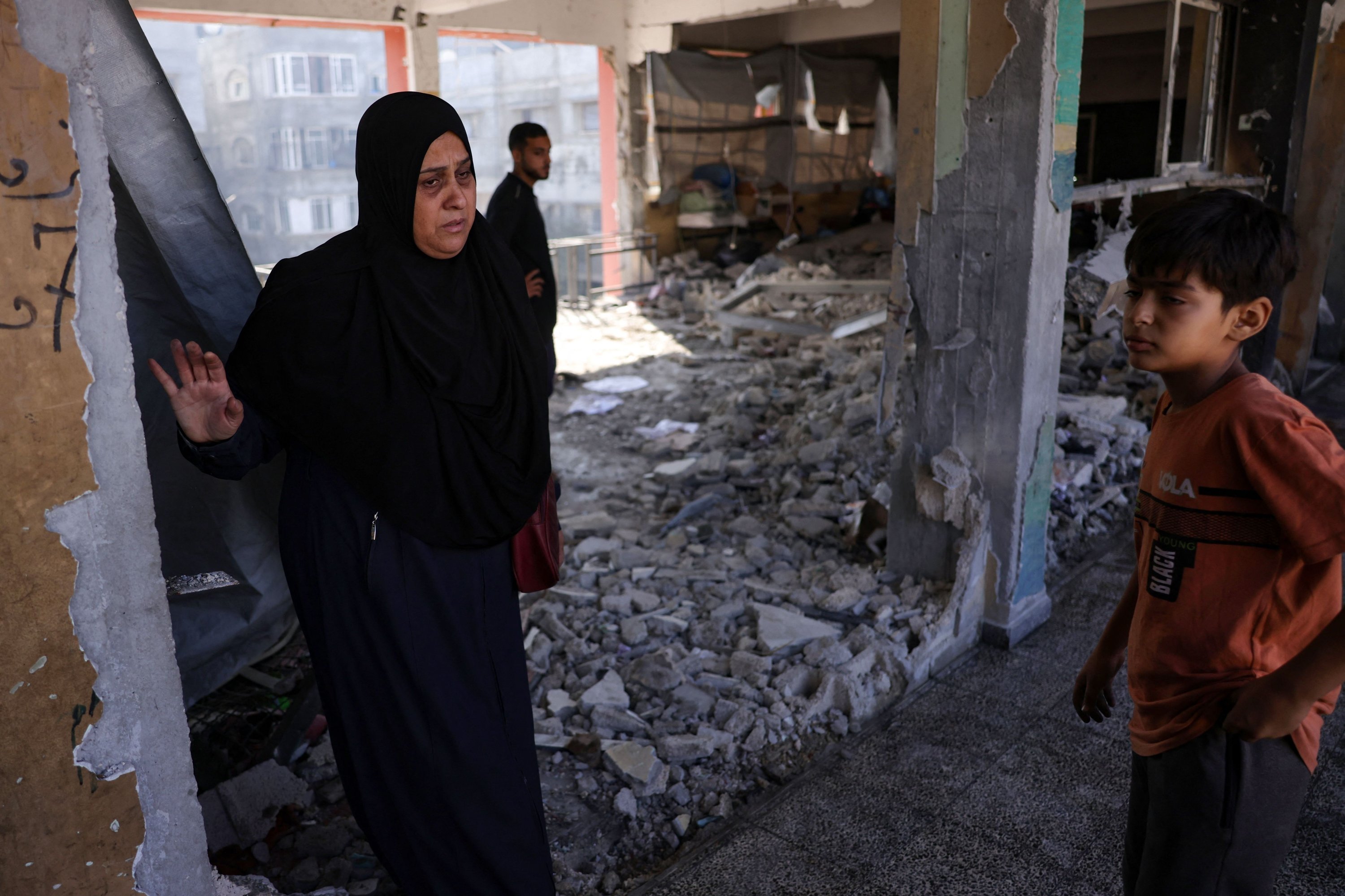
President Recep Tayyip Erdoğan reiterated his call to the international community to pay attention to the humanitarian catastrophe in Gaza as the conflicts rage on around the world. Answering reporters’ questions as he was returning from a trip to the Netherlands, where he attended an important NATO meeting, the Turkish leader underlined that nobody would be safe without an end to bloodshed in the Palestinian enclave that has claimed thousands of lives since 2023.
Erdoğan met heads of state and government during the summit in The Hague, which focused on hiking the defense budget of the alliance's members. The summit was the first in-person meeting between Erdoğan and U.S. President Donald Trump since the latter took office. Erdoğan also met other counterparts, including French President Emmanuel Macron. Although talks and the summit concentrated more on the Russia-Ukraine conflict and other challenges, Erdoğan was firm in raising Türkiye's voice against Israeli oppression targeting Palestinians, a stand he has adhered to since Iran and Israel targeted each other after Israel's inaugural attacks on Tehran earlier this month. The president warned earlier that the Iran and Israel conflict, which concluded in a fragile truce, should not divert attention from Israel's genocidal policies targeting Palestinians while noting that attacks on Iran were the latest instance of the Netanyahu administration's expansionism in the region. Ankara fears the Zionist regime may target it next, while authorities repeatedly assured that Türkiye's security measures are in place.
The president said he had fruitful talks with Trump that focused on bilateral relations as well as global and regional issues. "We discussed conflicts and tensions in our region. I told him that he should also exert efforts to end attacks on Gaza, just like he endeavored to ensure a cease-fire between Israel and Iran. We emphasized the urgency of ending the humanitarian crisis in Gaza. Türkiye has a historic responsibility and conscience on this matter. This brutality cannot prevail. Nobody can feel safe unless the bloodshed ends. My remarks may disturb some people, but we will never give up on telling the truth," he said.
Erdoğan said that adopting an approach oriented toward a solution can achieve lasting resolutions to issues affecting the region. "The dialogue channels should remain open. The region cannot tolerate any more tensions or conflicts," he said, while criticizing Israel for "even acting intolerant towards the Red Cross, blocking aid delivery to Gaza."
"Our region needs more peace, stability. We conveyed our approach to Mr. Trump, and we expect his support. He was positive on this matter," Erdoğan said.
"Even when people turned their attention elsewhere, we never let the situation in Gaza be ignored. We are always in contact with people in Gaza. We are witnessing systemic torture by Israel. They even strike aid distribution points. They don't allow Red Cross aid deliveries. We are witnessing a genocide unfolding before our eyes. This is a shame for humanity. People have to hear the voice of starving children. We have to stop Israel or we will be held accountable for our inaction. Israel tries to get people accustomed to this cruelty. We won't get used to it. It is the biggest mistake to tolerate Israel's cruelty. Gaza will be free one day," he said.
Erdoğan said he also talked about Gaza with Macron and asked him to contact Israel to stop its aggression toward Gaza. "We will be grateful to him if he acts," he said.
On the summit in The Hague, Erdoğan said Türkiye was one of the countries closest to achieving the goal of increasing its defense budget's proportion to gross domestic product to 5% as the alliance agreed upon on Wednesday.
"But it is essential to lift trade restrictions between the allies to achieve it. Moreover, involvement of non-EU member states in national defense and security initiatives for Europe should be secured," he said.
The president stated that recent developments showed countries should have multilayered systems for their defense. "Having missiles of diverse range and having them functioning in harmony like organs of the body is crucial. We are at this point and will go beyond that. We have to enhance our missile capabilities. We are building our Steel Dome, bringing together air defense systems of various ranges, sensors and electronic warfare systems. We have Sipers, Korkuts, Hisars, Sungurs and other distinguished locally made arms systems. If we counted on buying them elsewhere and relied on others, it wouldn't happen," he said.
On the other hand, Erdoğan said developing their own defense systems did not mean that they would withdraw F-35 program with the United States. "It is a technical and political process. Türkiye was unfairly excluded. We always criticized this step that contradicts the spirit of the alliance. We discussed this in our talks with Mr. Trump. We hope for progress," he said.
Touching upon the Iran-Israel conflict and Tehran's reported plan to shut down the Strait of Hormuz in response to Israel's attacks, Erdoğan said this would cause major problems for the world, although he added that he was confident Iran would not take such a step.
Hormuz connects the Persian Gulf to the Sea of Oman and is a crucial passage for the delivery of oil and LNG exports from the Middle East to world markets. Analysts say that Brent crude oil may rise to $110-130 per barrel if the Strait of Hormuz is closed, while its closure can also lead to a regional conflict, making price estimates all the more difficult. Iran's Parliament recently voted to close the strait, though a final decision would be made by the Supreme National Security Council. After the cease-fire, the issue seems to be shelved for now. Erdoğan said the latest developments showed the critical nature of energy supply security. On a question of whether the conflict would affect energy delivery from Iran, Erdoğan dismissed rumors that Iran had cut off gas supplies to Türkiye amid the conflict. “I also spoke with Iranian President (Masoud) Pezeshkian, and there is absolutely no indication that gas supplies to Türkiye would be interrupted. Our gas from Iran continues to flow. There is no problem at all.”
The president emphasized that Türkiye is working hard to boost its energy production, citing oil extraction on Gabar Mountain in eastern Türkiye and natural gas production in the Black Sea as examples. “We are making efforts to increase our production,” he said.
He added that Türkiye was determined to continue its oil and gas exploration activities. “Our goal is to reduce imports and increase production in line with our objective of full energy independence,” Erdoğan said. “Ultimately, we aim to make Türkiye an exporter of both energy resources and technology. Recent events have clearly shown that energy is a matter of national survival.”
Addressing a question about the Russia-Ukraine war, Erdoğan said: “We are firmly saying this war must end. The region cannot handle this any longer. A just and lasting peace must be established. Even if everyone else gives up on peace, we won’t. Türkiye prioritizes diplomacy in resolving conflicts.
“It is now necessary to build stability, open the gates to peace, and bring relief not only to our region but to the entire world. This is everyone’s expectation."
Erdoğan noted that both Ukraine and Russia trust Türkiye. “The talks held in Istanbul opened a door to peace,” he said. “We are aware that developments on the ground are narrowing the space for diplomacy, but even the smallest hope for peace is worth pursuing. In fact, in the case of Ukraine and Russia, there is more than a mere glimmer of hope.”
“We will continue our efforts to bring the parties back to the table,” Erdoğan said.
“Our ultimate goal is to hold a summit between the leaders in Türkiye and to build the long-desired peace," he said.
The president said he conveyed the same message to Trump. “He told me, ‘If Russian President Vladimir Putin comes to Istanbul or Ankara for a solution, I will also come,’” Erdoğan said. “We will hold the necessary talks and, hopefully, will make this meeting happen as soon as possible.”
Erdoğan said that Türkiye has opened a “new chapter” in its relations with the United States under President Trump. “Let me be clear. When it comes to phone diplomacy with Trump, it never took more than 24 hours for a response. Whenever we called, he got back to us within a day. The U.S. ambassador to Türkiye has also been particularly responsive in this regard.”
He said that they were working to take steps that would benefit both nations. “On regional issues, especially Syria, we have clearly conveyed our concerns at every level, particularly regarding (the YPG),” he said. The YPG, the Syrian wing of the PKK terrorist group, has benefited from vast U.S. support under the pretext of a joint fight against the terrorist group Daesh, to the chagrin of Ankara.
“Despite occasional differences, Turkish-American relations have always had strategic importance,” Erdoğan said. “Our constructive dialogue with President Trump has helped build bridges of understanding, even on tough issues.”
Erdogan stressed Türkiye's historical and cultural ties with Syria and said developments in Syria directly affect Türkiye because of their shared border.
“We have unfortunately suffered the consequences of instability and suffering in Syria in recent years,” Erdoğan said, referring to the civil war under the Assad regime, which collapsed last December. He noted that Türkiye's foreign affairs, defense and intelligence officials have maintained continuous contact with Syrian counterparts.
“We support the new administration in Syria for the reconstruction of stability and peace,” he said. “The indispensable condition for a unified and stable Syria is the protection of its territorial integrity.”
Erdoğan said that the Syrian government has taken steps to unite all armed groups under the Syrian army and work toward the country’s unity.
“It would be wise for (the YPG) to seize this opportunity,” Erdogan added. He also said he discussed the issue extensively with Macron.
“Macron emphasized that France will take a more active role regarding Syria. We also discussed what steps we could take together," he said.