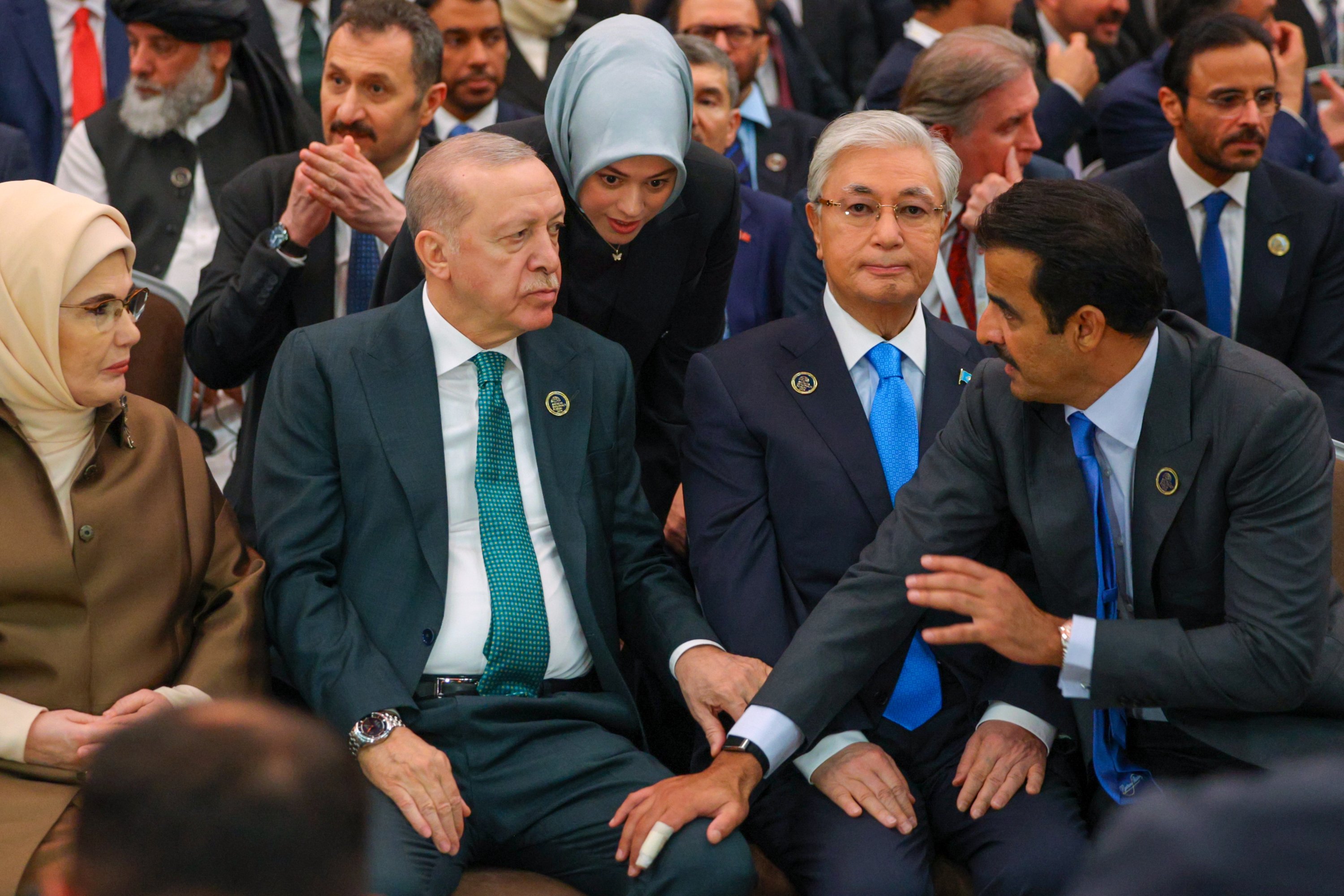
President Recep Tayyip Erdoğan will host Qatari Emir Sheikh Tamim bin Hamad Al Thani on Friday in Istanbul as the two leaders are scheduled to co-chair the Türkiye-Qatar High Strategic Committee meeting. The countries are expected to sign a string of important agreements and memoranda of understanding during the meeting.
Faisal bin Abdullah Al Hanzab, Qatar’s ambassador in Ankara, says the meeting will boost cooperation between the countries on the economy, defense industry, artificial intelligence and technology.
Speaking to Anadolu Agency (AA) on Wednesday, the ambassador said relations, based on deep-rooted historic bonds of brotherhood, further developed through mutual trust and joint political will and were now beyond conventional political coordination and expanded to many fields from economy to defense and technology.
Türkiye and Qatar established a strategic partnership in 2014, and their High Strategic Committee has met annually since 2015. The two countries have signed 115 agreements through 11 committee meetings.
Bilateral trade reached $1.15 billion in 2025, with both countries aiming to raise the volume to $5 billion. To that end, a trade and economic partnership agreement entered into force on Aug. 1, 2025.
The ambassador said that Friday’s meeting presented great opportunities. “This meeting reflects the determination of the two countries to further advance their strategic partnership and create new opportunities for cooperation in institutional, economic, defense and technology fields. We aim to turn our shared understandings into concrete steps and projects," he said.
He noted that, amid the prevailing uncertainties in the current international environment, coordination between Qatar and Türkiye serves as an important pillar in reducing tensions, resolving disputes through peaceful means and supporting diplomatic efforts to strengthen regional and international security and stability.
He stated that Qatar has numerous investments in Türkiye. "These investments reflect our strong confidence in Türkiye's economy and financial system. My visits to different Turkish cities and meetings with officials have allowed me to closely observe the country's economic diversity and extensive investment opportunities. Türkiye's potential often goes far beyond what indicators and figures reveal."
Noting that significant opportunities exist to increase trade volume between the two countries and expand mutual investments, the ambassador said industry, infrastructure, construction, technology and financial services were among the priority areas for cooperation. He added that artificial intelligence, digital transformation, advanced technology and industrial innovation also offered opportunities to expand bilateral cooperation.
He emphasized that the "Badr Memorandum of Understanding," signed by Türkiye, Qatar, Pakistan and Indonesia, offers significant opportunities for joint production, technical knowledge sharing and technology development in the defense industry.
Stating that the memorandum establishes a framework for cooperation in the defense industry, joint production, the sharing of technical expertise and research and development, Al Hanzab said, "This memorandum could enable each country to benefit from the industrial, engineering and technological advantages and expertise of the others. It could also help share research and development costs, increase knowledge transfer and expand access to new markets."
The quadrilateral defense cooperation agreement was signed in Doha last month and is aimed at boosting defense cooperation and strengthening the four countries' defensive capabilities. It will also support military exercises and training and cooperation on research and development (R&D) and contribute to joint efforts to improve their defense industries, Türkiye’s Ministry of National Defense said last month. Türkiye, which has NATO's second-largest army and a robust defense industry, has been helping Gulf nations, including Qatar, where it has a military base, bolster their defenses amid the Iran war. In August, it signed the Mecca Joint Defense Agreement with nuclear-armed Pakistan and Saudi Arabia, under which an attack on one party constitutes an attack on all. Ankara also has close ties with Indonesia, notably in the defense industry. Türkiye says that the Mecca partnership is meant to strengthen collective deterrence, enhance joint capabilities in the defense sector and safeguard security and stability in the region.
The Badr accord will strengthen ties between the countries' defense industries and bolster collaboration to promote security and achieve shared objectives, the Defense Ministry said.
Noting that Qatar continues its mediation efforts amid tensions between the United States and Iran and developments in Gaza, Al Hanzab stressed that diplomatic coordination with Türkiye is important for regional stability.
"Qatar's position on this matter is clear and unwavering. Our country has always invested in peace, diplomacy and bringing the positions of the parties closer together. We believe that wars do not provide lasting solutions to disputes and that the expansion of conflicts threatens the security and stability of the region, causing significant harm to its peoples and economies," he said.
He stated that Türkiye and Qatar's communication channels with numerous regional and international actors contribute to diplomatic efforts, adding: "The two countries are well-positioned to strengthen coordination on current developments thanks to their extensive regional and international relations, communication channels with different parties and experience in mediation."
Commenting on developments in the Gaza Strip and the occupied West Bank, Al Hanzab said Israel's violations and failure to fulfill its obligations under the cease-fire agreement were deepening the humanitarian crisis in the region.
Emphasizing that the cease-fire agreement must be fully implemented to ensure lasting stability in Gaza, he said: "Developments in Gaza and the West Bank cannot be considered separately from Israel's ongoing violations and the occupying forces' refusal to fulfill their obligations under the cease-fire agreement. This prevents the transition to recovery and reconstruction while prolonging the humanitarian suffering of civilians."
The ambassador emphasized that Qatar, in coordination with its partners, particularly Türkiye, continues its diplomatic efforts to make the cease-fire permanent, ensure the implementation of all provisions of the agreement, reopen border crossings and facilitate the safe, regular and unhindered delivery of humanitarian aid. He said they were also working to establish the necessary conditions for the launch of Gaza's reconstruction and revive a serious political process that would pave the way for a just and lasting peace.
Highlighting the importance of the partnership between Türkiye and Qatar in this regard, Al Hanzab stressed that the two countries' political and humanitarian coordination offers significant opportunities to mobilize international support and strengthen cooperation with international organizations.