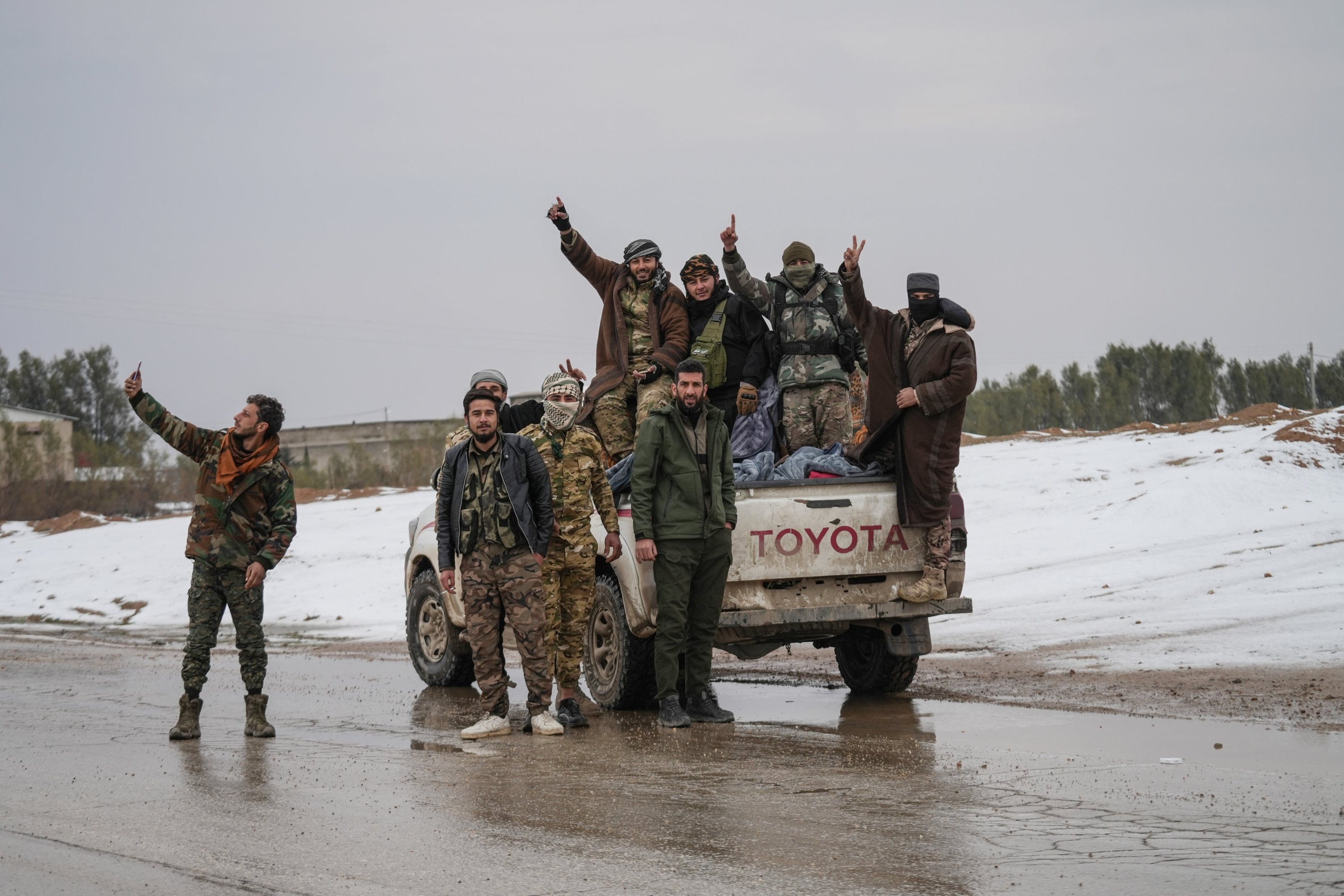
As tensions decline in Syria after days of clashes between the US-backed terrorist group YPG and the Syrian army, the Defense Ministry announced that the cease-fire with the group was extended for 15 days, starting Saturday night. The announcement came hours after the expiry of an initial cease-fire announced last Tuesday.
The extension aims to support a U.S. operation to evacuate Daesh detainees currently held in prisons run by the YPG and transfer them to Iraq.
The U.S. military's Central Command (CENTCOM) announced Tuesday that it launched a mission to transfer Daesh detainees from northeastern Syria to Iraq to ensure the terrorists remain in secure detention facilities.
The mission began with U.S. forces transporting 150 Daesh fighters from a detention facility in northeastern Hassakeh province to a secure location in Iraq, with plans for up to 7,000 detainees to eventually be transferred to Iraqi-controlled facilities.
The Syrian Presidency announced separately earlier this week that a "mutual understanding" had been reached with the YPG on the future of eastern Hassakeh province.
Under the understanding, the YPG was given four days to conduct consultations and prepare "a detailed plan for practical integration of the areas," the presidency said.
If an agreement is reached, Syrian forces will not enter the city centers of Hassakeh and Qamishli and will instead remain on their outskirts, the statement added.
The presidency said the two sides agreed to integrate all YPG military and security forces into the structures of the Defense and Interior Ministries, while consultations continue on technical details.
According to the statement, YPG head Ferhat Abdi Şahin will nominate a candidate for deputy defense minister, as well as one for Hassakeh governor. The group will also submit lists of nominees for representation in the People's Assembly and for employment in various state institutions.
Syrian forces will also not enter Kurdish villages, the presidency said, noting that no armed forces will be present there except for local security units drawn from the residents of those areas. The YPG claims to represent Syrian Kurds.
Though no all-out clashes have been reported since the cease-fire began, the Syrian army remains on alert. The army on Saturday said that the YPG was bringing reinforcements from Iraq to several areas of Hassakeh, specifically from the terrorist group PKK. The YPG is the Syrian wing of the group, which killed tens of thousands of people in Türkiye since the 1980s.
The command also said that the YPG committed "widespread violations" in those areas, including arrests, forced displacement and the torture of people who oppose its policies.
The military warned the terrorists against continued provocations, as well as the dissemination of false claims and selectively edited video footage.
On Saturday, Syrian security forces in the northeastern Raqqa province released 126 inmates from a prison that had been run by the YPG, all of them under the age of 18, Alikhbaria Syria TV said.
Quoting an unnamed security source, the channel said: "Internal security released 126 prisoners from Al-Aqtan prison in Raqqa, all of them under 18."
Information Minister Hamza al-Mustafa said on the U.S. social media company X that footage posted by the Syrian Arab News Agency (SANA) showed the detainees' release.
"These children are not merely detainees; they are sons and daughters whose childhoods were stolen. They should have been in schools and playgrounds, not behind prison walls. Every face among them carries a story of fear, separation and lost innocence," he added.
Al-Mustafa stressed that "there is no slogan, justification, or security reason that can explain the presence of a child in a prison cell," saying that their plight wounds the conscience of humanity.
On X, presidential spokesperson Ahmed Muaffaq Zaidan called the detention a "full-fledged scandal carried out by gangs outside the bounds of time and place."
On Friday, the Justice Ministry announced that it had officially taken over Al-Aqtan prison after YPG elements withdrew from it as part of extending state authority and restoring institutions to operate under the law. The Interior Ministry also began a review of the detainees' files.
On Friday, the Syrian Army announced that its units had begun transferring YPG elements from Al-Aqtan prison and its surroundings in Raqqa to the city of Ayn al-Arab, east of Aleppo, saying this represents the first phase of implementing the Jan. 18 agreement paving the way for the government to take over the facility.
The YPG faced a comprehensive offensive by the Syrian army earlier this month when the group failed to honor a deal with Damascus for its integration into the post-Assad army. Syrian forces first forced out the YPG from two neighborhoods in Aleppo that it occupied and then moved forward to clear out areas west of the Euphrates River, where the YPG maintained control thanks to a security vacuum during the Syrian civil war. The YPG still holds strongholds in the east of the Euphrates, including the so-called capital of a self-styled autonomous region, but lost several key areas, including oil hubs.
Türkiye supports Syria’s operations against the YPG, though it is not a direct support, unlike cross-border offensives the Turkish army carried out during the Syrian civil war, in order to end YPG occupation in towns near the Turkish border. The YPG is still a concern for Türkiye, which seeks to end the scourge of terrorism by the PKK through a new initiative. Under the new initiative, the PKK agreed to disarmament, but Ankara aims to expand this disarmament, now largely confined to terrorists in Iraq, to the YPG as well. The terror-free initiative emphasized Turkish-Kurdish unity in a bid to save Kurdish communities spread across Türkiye, Iraq and Syria from the grip of the terrorist group.
Foreign Minister Hakan Fidan said Friday that the YPG does not represent Syrian Kurds, as he spoke to Turkish news channel NTV.
"These are not independent actors. They are not actors that represent Syrian Kurds," he said. "This is a reality. These people are the Syrian branch of an illegal structure with political objectives spanning four parts."
Addressing possible different influence groups within YPG and the role of YPG leader Ferhat Abdi Şahin, Fidan stressed that Şahin is "a figure put on display," while underlining that the group is an extension of the PKK. The YPG avoided joining the PKK in the disarmament drive, insisting it should not be associated with the group, although PKK’s jailed ringleader Abdullah Öcalan acknowledged ties between the two.
Fidan noted that if there is goodwill, the process should start with the removal of non-Syrian PKK members from Syria. Pointing to the sensitivity of the situation on the ground, Fidan underscored that the presence of U.S. forces and Daesh prisoners made the dispute between the YPG and government forces more complex.
Commenting on the rapid advances made by the Damascus government against the YPG on the ground in the last two weeks, Fidan noted that developments came as no surprise to him.
"When Arabs in Arab-populated areas rise up against the occupying force, knowing that government forces are behind them and that the Americans have already withdrawn their support from this misguided practice, there is no meaning in staying there," he said.
He reaffirmed that President Donald Trump's foreign policy aimed at avoiding direct US involvement in regional problems and instead encouraged regional countries to take ownership of the issues, which overlaps with Türkiye's policy for the region.
"Türkiye's sensitivity in the fight against Daesh is already clear. When you also consider the importance we attach to Syria's unity and territorial integrity, as well as to the cultural identities of minorities, ethnic groups and religious communities, and put all of this together, there is frankly no other reason for America to remain there from its own perspective," he said.
Fidan also reiterated the need to properly understand the core assumptions of the "terror-free Türkiye" process.
"Saying ‘I will not carry out terrorist acts in Türkiye' does not mean you have reached a terror-free Türkiye. While tens of thousands of armed individuals remain across the border and have not abandoned their intent toward you, believing that you will remain terror-free here would be self-deception," he said.
The YPG’s withdrawal from occupied places prompted violent riots by supporters of the terrorist group in Europe throughout the week. The latest instance of the violence was in London. YPG supporters gathered at Trafalgar Square on Saturday to protest the Syrian army’s advances on YPG and marched to Downing Street. Along the route, YPG supporters attacked two women for an unknown reason. London police intervened and dispersed the crowd.
Belgium’s federal prosecutor said three people were arrested for injuring police officers during unrest in Brussels, involving supporters of the YPG.
In a written statement issued after an inquiry from an Anadolu Agency (AA) reporter, the federal prosecutor said the investigation was launched following disturbances caused by YPG supporters on Jan. 21.
The statement said protesters threw various objects at police, including stones, glass bottles and street furniture. Nine police officers were injured. Brussels Capital Region police detained four suspects between the ages of 19 and 47, the statement said, noting that three of them had prior records for assault and battery. Prosecutors decided to refer the case to an investigating judge on charges including intentional assault and battery, causing a police officer to be unable to perform their duties, as well as armed rioting.
An investigating judge issued arrest warrants for three of the four suspects, the prosecutor said.
A day earlier, supporters of the group had clashed with police during protests in front of European Union institutions in Brussels, prompting a forceful police response.
Separately, supporters of the YPG protesting in front of the United Nations’ Geneva office forced their way into the U.N. compound.
During the protest, some demonstrators suddenly ran toward the U.N. compound, jumping over fences and entering the premises while carrying banners bearing the group’s symbols.
Those who entered the compound without authorization were quickly removed by U.N. security officers, who then formed a barrier at the gate to prevent further breaches.
Geneva police later arrived at the scene and moved demonstrators away from the U.N. entrance, taking necessary security measures.
U.N. officials told AA that the protesters were removed from the premises before any damage could occur.