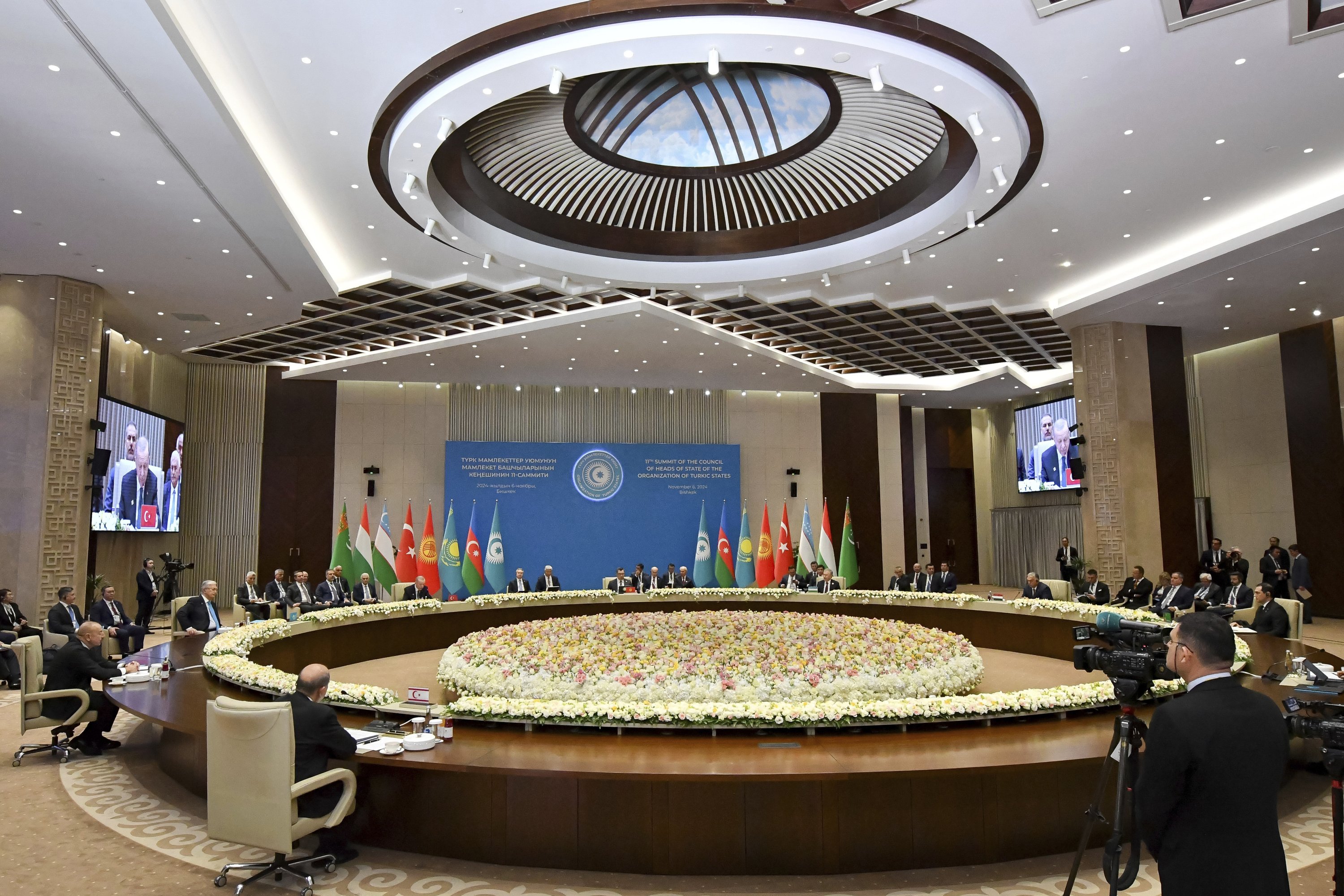
Azerbaijan will host heads of state from the Organization of Turkic States (OTS) on Oct. 7 in the city of Gabala for a summit themed “Regional Peace and Security.”
The OTS stated in a press release that the summit would host leaders and delegations from member states and observer states, and would “deliberate on pressing regional and international issues, enhance cooperation and adopt key documents aimed at further advancing unity, peace and prosperity across the Turkic World.”
“This landmark gathering in Azerbaijan’s historic city of Gabala symbolizes the convergence of history and modernity, and reflects the OTS’s collective vision of building stronger ties of friendship, solidarity and partnership among the Turkic States,” the body said in a statement on Monday.
Originally founded as the Cooperation Council of Turkic-Speaking Countries (the Turkic Council), the organization's foundations were laid by the Nakhchivan Agreement signed on Oct. 3, 2009, by Azerbaijan, Kazakhstan, Kyrgyzstan and Türkiye.
The OTS aims to integrate the Turkic world through shared historical and cultural values and cooperation in diverse fields, including economy, politics, education, culture, defense, security, transportation, customs, tourism and sports. It also serves to enhance the geopolitical position of the Turkic world, with its member countries covering a total area of 4.25 million square kilometers (over 1.6 million square miles) and a population of around 160 million, gaining considerable regional recognition over the past 15 years. The OTS originally emerged as a summit between the heads of Turkic states in 1992, when the countries of the former Union of Soviet Socialist Republics (USSR) began declaring independence.
Türkiye champions multilateral relations between member states, as well as with observers like Hungary, as Ankara seeks to diversify its partnerships, which have long been anchored in Western states.
The summit takes place at a time of improving stability in the region, particularly following a landmark peace deal between host Azerbaijan and its neighbor, Armenia. Brokered by the United States, the deal is viewed as a key step toward ending longstanding disputes in the wider Caucasus and will likely pave the way for the full normalization of ties between Türkiye and Armenia as well.
Regional uncertainty, however, also manifested itself in the Russia-Ukraine conflict. The Turkic states’ close proximity to the conflict and its global repercussions are likely to be discussed at the October summit. Türkiye is among the few countries in the OTS that has managed to maintain a somewhat neutral stance regarding the conflict, as it enjoys good relations with both sides of the conflict. This position also helped it to engage in diplomatic efforts to resolve the disputes. It brokered several deals between the sides during peace talks in Istanbul, though a complete solution to the conflict still appears far away.
Speaking at a gathering of think tanks in Baku ahead of the summit, Ömer Kocaman, deputy secretary-general of OTS, said that Azerbaijan plays a bridging role in the Turkic world, particularly in trade and transportation. Turhan Dilmaç, an official from the Turkish think tank Strategic Research Center (SAM), was quoted by Azerbaijani media as saying at the event that OTS should not be viewed as a “third bloc” but rather as a convention for stability on the broader region.