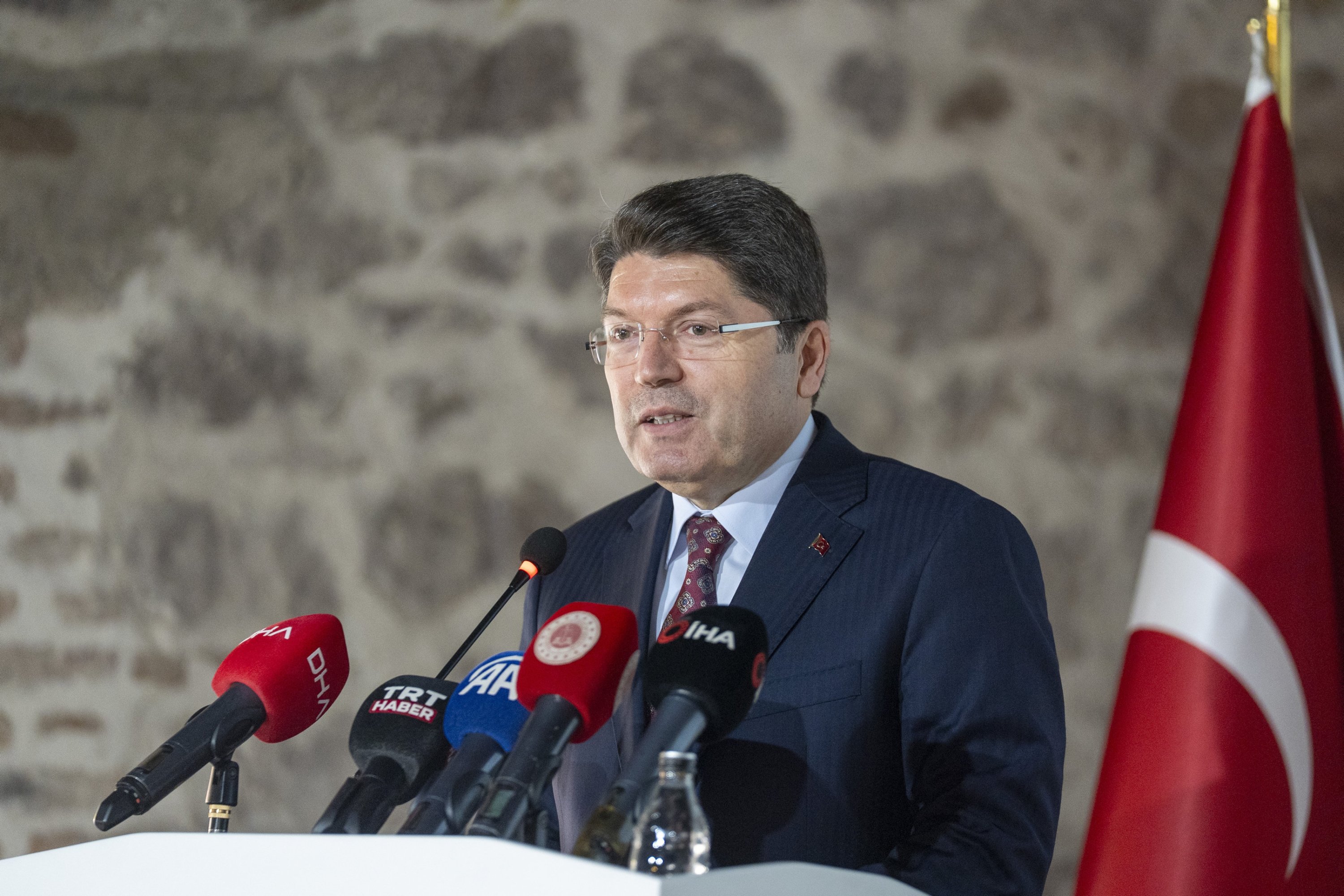
Justice Minister Yılmaz Tunç explained that new amendments will allow authorities to sentence convicts handed down the lowest sentences to serve a jail term.
Tunç’s statements on Wednesday were in response to the public perception of impunity in some crimes that was brought to the spotlight with several cases of offenders with long criminal histories slapped with relatively lenient sentences.
Speaking at an event on judiciary control held at a former prison turned into museum in the capital Ankara, Tunç said the latest amendments passed in Parliament will ensure that people convicted of crimes with one-year prison sentences will be required to remain incarcerated at least 18 days and the number of days required to be served will be proportionally increased based on prison terms. Under previous laws, convicted people were often spared from spending time in prison if they were handed prison terms varying between one and two years.
Tunç emphasized that the purpose of justice is to protect human dignity and rights, stressing that justice is the guarantee of social peace. Speaking about the importance of rehabilitation and reintegration, Tunç said that one of the most significant reflections of this understanding in practice is the probation system.
“Probation is not merely a method of execution but the living face of a justice philosophy centered on humanity,” Tunç said.
“The value of justice is not measured solely by the severity of punishment but by how much that punishment aligns with human dignity and rights.”
Tunç underlined that they do not view justice solely as punishment but as a mechanism that enables individuals to turn away from wrongdoing and reintegrate into society.
“Probation is a bridge that allows individuals who have committed a crime to reconnect with society,” he said. “It is a social rehabilitation initiative that repairs broken ties, revives shattered hopes and helps lost paths to be rediscovered. It reflects a high vision of justice that sees every person as having potential and every mistake as an opportunity for purification.”
The minister added that probation does not label offenders as irredeemably evil. Instead, it represents a comprehensive approach that still sees a human being, hope and the potential for change within the individual. “This system offers a path to recovery rather than leaving the offender in the whirlpool of social exclusion.”
Addressing misconceptions, Tunç stressed that probation is not a form of impunity but an effective method of execution that aims to help individuals live harmoniously within society.
“This system has impacted 5.6 million individuals over the past 20 years,” Tunç said. “Its success is measured not just by numbers but by lives filled with hope, restored family bonds and individuals reintegrated into society.”
Since its inception in 2005, the probation system has executed 8.46 million judicial decisions, conducted 3.63 million rehabilitation activities, carried out 1.48 million addiction intervention efforts and assigned 1.45 million individuals to community service. Additionally, 74,000 individuals received financial or material aid, 71,000 were monitored through electronic tracking, and environmental initiatives resulted in planting 2.4 million saplings.
Tunç also highlighted significant reforms enacted under the 10th Judicial Package passed by Parliament, which introduced critical changes to the probation system.
“With this amendment, offenders are now required to serve at least one-tenth of the time remaining until their conditional release in prison,” he said. “Previously, those sentenced to less than two years effectively avoided prison due to fixed probation periods, creating a perception of impunity.”