July 15 Democracy and National Unity Day will be marked for the ninth time on Tuesday. It is an occasion to remember the resistance to the 2016 coup attempt and celebrate democracy’s prevalence against military takeovers.
The day will be observed through nationwide events, from exhibitions to solemn commemorations. President Recep Tayyip Erdoğan, the primary target of the putschists who led military infiltrators of the Gülenist Terror Group (FETÖ), is scheduled to attend a commemoration ceremony at the site of the Special Operations Command of Turkish police in Ankara. The complex was heavily bombarded by putschists during the coup attempt, and 44 people inside were killed.
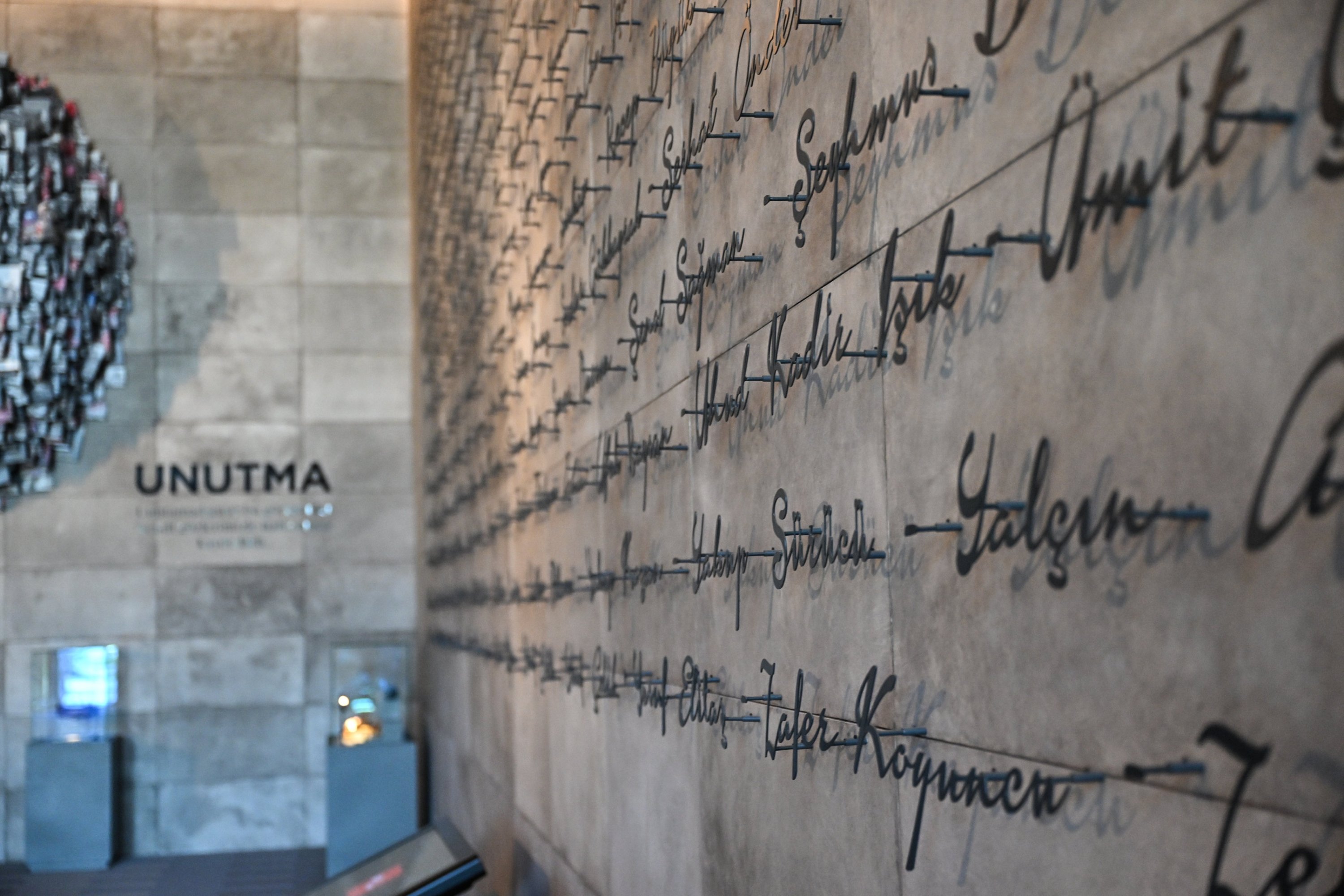
The Presidency’s Directorate of Communications will organize various events under the theme of “Name of Victory: Türkiye” to mark the day, highlighting unwavering resistance against putschists by the unarmed public and security forces opposing FETÖ’s military infiltrators at the cost of their lives. Between July 14 and July 18, the directorate will give a tour of the Presidential Complex and Parliament, two main targets of the putschists, to some 200 journalists from across Türkiye and the world. The commemoration will also include visits to museums in Ankara and Istanbul dedicated to victims of the coup and past coups in the country.
The coup attempt unfolded almost simultaneously across Türkiye on the evening of July 15, 2016, and was suppressed by noon the next day. Erdoğan, who narrowly avoided an assassination attempt by putschists while he was on vacation in southwestern Türkiye, traveled to Istanbul secretly. During and after his trip to the city, he issued several messages through video phone calls to TVs, mobilizing the nation to “reclaim democracy.” After his calls, more people took to the streets, braving heavily armed putschists. Unarmed people blocked the roads against tanks and legions of pro-FETÖ troops. Gunfire by putschists killed 253 people, while 2,740 others were injured.
For decades, FETÖ had secretly infiltrated state institutions, including the army. It sought to overthrow the government and conspired against top officials, from sham investigations to a plot targeting then intelligence chief Hakan Fidan. It also conducted two notorious coup attempts in December 2013 that targeted people close to the government, including an incident where pro-FETÖ officials stopped trucks belonging to the intelligence agency in a bid to portray the government in a negative light.
Their efforts repeatedly failed, and the government moved to weed out military officers linked to the group from the army in 2016. Upon learning the plans, FETÖ turned to mobilizing its infiltrators in the army to seize power.
On March 19, 2016, FETÖ ringleader Fetullah Gülen appeared on camera in a khaki robe – a color long interpreted by followers as a military signal, urging sleeper cells in uniform to move against the state in a cryptic speech. From December 2015 onward, senior civilian operatives of FETÖ were shuttled between Türkiye and the U.S. to receive Gülen’s blessing for the plot, as investigations after the coup attempt found out.
Days before the coup attempt, the masterminds of the attempt held a two-day meeting in Ankara. In attendance were Adil Öksüz, a civilian who is accused of orchestrating the plot, and several generals.
On July 11, Öksüz and another “civilian handler,” Kemal Batmaz, flew to the U.S., presenting their plan to Gülen at his Pennsylvania compound. Two days later, they returned, setting 3 a.m. on July 16 as the hour that the coup would be launched.
Hours before the launch, a FETÖ‑linked army major was assigned to visit the headquarters of the National Intelligence Organization (MIT), revealing a scheme to kidnap intelligence chief Hakan Fidan. MIT alerted then‑Deputy Chief of General Staff Yaşar Güler, who informed Chief of General Staff Hulusi Akar. Akar ordered all aircraft to return to base and closed national airspace. Tanks at Etimesgut Armored School in Ankara were confined to barracks, while Land Forces Commander Gen. Salih Zeki Çolak rushed to the Army Aviation Command to halt helicopter sorties. The putschists panicked, rescheduling the timetable of the coup to 8:30 p.m. on July 15.
At General Staff headquarters, putschist Maj. Gen. Mehmet Dişli confronted Akar, demanding he endorse a takeover. When Akar refused, Dişli’s team, including aide Lt. Col. Levent Türkkan, physically restrained Akar. Sgt. Maj. Bülent Aydın, a member of Çolak’s detail, became the first martyr when he resisted the assailants.
In the meantime, F‑16s roared low over the capital while putschist troops blocked the Bosporus and Fatih Sultan Mehmet bridges in Istanbul. As the coup attempt was unfolding in a live broadcast, people were confused about the nature of the military’s unprecedented movement. It was only after the country’s leaders, including Prime Minister Binali Yıldırım, announced that a coup attempt was underway that the general public became aware of FETÖ’s actions. Before that, several people had already rushed to the bridges to confront the troops and urge them to return to their bases.
At 12:24 a.m. on July 16, President Erdoğan spoke to broadcaster CNN Türk via FaceTime, urging citizens to “fill the squares.” The public response proved decisive to quell the coup, but not before sacrifices. Minutes later, jets controlled by putschist officers struck police headquarters in Ankara.
The coup attempt took another turn thanks to the heroics of Ömer Halisdemir, a non-commissioned officer stationed at the headquarters of the Special Forces Command of the Turkish army. Special Forces, an elite military unit, was key to the success of the coup. When putschist Gen. Semih Terzi tried to capture it, Halisdemir shot him dead at the entrance of the headquarters, before Terzi’s entourage sprayed him with bullets. Halisdemir died at the scene, while Terzi succumbed to his wounds moments later.
About one hour later, the putschists dropped bombs on Parliament. Lawmakers braving gunfire had arrived at Parliament earlier and declared a message of opposition to the putschists. Elsewhere, putschists seized public broadcaster TRT and forced a presenter at gunpoint to announce that their “Peace At Home Council” had seized power in Türkiye. Anti-junta public and police officers later managed to seize the broadcaster’s offices back from the putschists.
In the early hours of July 16, prosecutors started issuing arrest warrants for putschists. But they continued their attacks. In the morning of July 16, they launched an airstrike on a crowd gathered to protect the Presidential Complex against putschists, killing 15 people. Around the same time, resistance grew, and finally, security forces liberated Akıncı, a military base that served as the headquarters of the putschists, from FETÖ infiltrators. Twenty-one hours after it started, the coup attempt was declared over.
Mustafa Çalışkan, deputy head of the Turkish National Police, was the police chief of Istanbul at the time of the coup attempt. He spoke about that night and its aftermath ahead of the coup attempt’s anniversary. “It was a day when we defended our country. You can’t think about anything else while doing your job,” he told Ihlas News Agency (IHA).
Çalışkan was coordinating a usual citywide security operation against other crimes when he and other police officers noticed something unusual.
“Calls began coming in saying that soldiers were setting up checkpoints on the Bosporus Bridge,” he recounted. “Then a final call came in – police officers were being disarmed. That’s when I realized this was an extraordinary situation.”
Çalışkan issued his first command: No officer was to surrender their weapon, and if needed, they were to use them. He and his team headed directly to the bridge.
“Our order was clear: not a single step backward. We would act within the framework of the law,” he said.
Çalışkan said the moment they arrived on the bridge, they recognized what was unfolding as a full-scale coup attempt orchestrated by FETÖ.
“We gave all the necessary orders. Those violating the law, whoever they were, would be detained.”
According to Çalışkan, armed confrontations took place in 27 different locations across Istanbul. “In all 39 districts, our local chiefs were on duty. Our forces battled against putschist soldiers who had been given orders to shoot.”
Çalışkan noted that around 5,000 officers were on active duty that night as part of an unrelated operation.
“We had units stationed all across the city. From that moment until 7 a.m., an unbelievable fight took place. I gave the order to die multiple times to my officers.”
He described a pivotal moment when President Erdoğan asked about the situation at Atatürk Airport, which had been taken over by coup plotters. Çalışkan promised to retake the control tower within 20 minutes.
“I called our Special Operations and Airport Branch chiefs and told them: ‘Friends, die if necessary, kill if necessary, but I want to hear in 15 minutes that the tower has been taken back.’ I gave similar orders throughout the night,” he added.
Reflecting on the uncertainty of the night, Çalışkan said he didn’t think about the consequences.
“I knew that by morning, I might be hailed a hero or I might be executed. That’s how coups work. If they succeed, everything changes. But Allah didn’t allow that to happen. We were sincere, and Allah rewarded that.”
Such was the intensity of the moment, Çalışkan said, that for nearly five hours he didn’t even think of his own family.
“Bullets were raining down on us, tanks were firing, helicopters were overhead. It was a war zone. I only remembered my family hours later. It was a defense of the homeland where you forgot everything.”
Çalışkan recalled that Erdoğan’s call for people to resist the putschists gave him hope. “Seeing the nation stand united and the state respond firmly gave us peace of mind.”
Çalışkan said he personally witnessed harrowing scenes. “One of my guards was martyred in front of me, another seriously wounded. I saw dozens of civilians lose their lives.”
He described how he climbed on top of a vehicle, fully aware he was becoming an open target, just to address the crowd and lead them without putting them in harm’s way. “I told them I was wearing a bulletproof vest and that I was the police chief. I asked them to move behind me. The people shouted back, ‘Protect our chief!’ and shielded me with their own bodies. Some of those people were martyred. Others were severely injured.”
Despite the chaos, Çalışkan emphasized the professionalism of the police force: “We were always mindful that we would work with the same institutions the next day. Everyone we detained was a guest in our custody until brought before prosecutors. We collected all the evidence and made lawful arrests. Looking back, there wasn’t a single act we regret and that preserved trust between the police and military.”
Çalışkan credited the coup’s failure to President Erdoğan’s leadership and the people’s resolve.
“Had the president been late, or something happened to him, we would’ve faced great difficulties. But he took control at the right moment. The people stood up for their democracy and homeland. So did the police and other institutions. The result was an example to the world.”
Referring to recent failed coups around the world, Çalışkan said: “Over the last decade, more than 10 coup attempts globally have failed. Türkiye was the one that set that precedent. Our president, our nation and our state showed that coups can be defeated. July 15 was a rebirth, a moment of reckoning and renewal.”