Daily Sabah logo

Politics
Diplomacy Legislation War On Terror EU Affairs Elections News Analysis
TÜRKİYE
Istanbul Education Investigations Minorities Expat Corner Diaspora
World
Mid-East Europe Americas Asia Pacific Africa Syrian Crisis Islamophobia
Business
Automotive Economy Energy Finance Tourism Tech Defense Transportation News Analysis
Lifestyle
Health Environment Travel Food Fashion Science Religion History Feature Expat Corner
Arts
Cinema Music Events Portrait Reviews Performing Arts
Sports
Football Basketball Motorsports Tennis
Opinion
Columns Op-Ed Reader's Corner Editorial
PHOTO GALLERY
JOBS ABOUT US RSS PRIVACY CONTACT US
© Turkuvaz Haberleşme ve Yayıncılık 2026

Daily Sabah - Latest & Breaking News from Turkey | Istanbul

  • Politics
    • Diplomacy
    • Legislation
    • War On Terror
    • EU Affairs
    • Elections
    • News Analysis
  • TÜRKİYE
    • Istanbul
    • Education
    • Investigations
    • Minorities
    • Expat Corner
    • Diaspora
  • World
    • Mid-East
    • Europe
    • Americas
    • Asia Pacific
    • Africa
    • Syrian Crisis
    • Islamophobia
  • Business
    • Automotive
    • Economy
    • Energy
    • Finance
    • Tourism
    • Tech
    • Defense
    • Transportation
    • News Analysis
  • Lifestyle
    • Health
    • Environment
    • Travel
    • Food
    • Fashion
    • Science
    • Religion
    • History
    • Feature
    • Expat Corner
  • Arts
    • Cinema
    • Music
    • Events
    • Portrait
    • Reviews
    • Performing Arts
  • Sports
    • Football
    • Basketball
    • Motorsports
    • Tennis
  • Gallery
  • Opinion
    • Columns
    • Op-Ed
    • Reader's Corner
    • Editorial
  • TV

Japanese scientist Yoshinori Ohsumi wins Nobel medicine prize

by Associated Press

STOCKHOLM Oct 03, 2016 - 12:00 am GMT+3
AFP Photo
|AFP Photo
by Associated Press Oct 03, 2016 12:00 am

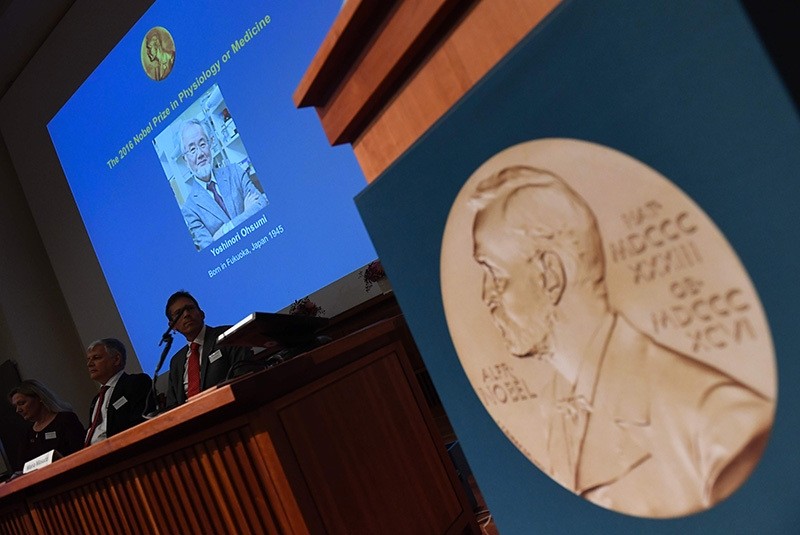
Japanese scientist Yoshinori Ohsumi was awarded this year's Nobel Prize in medicine on Monday for discoveries on how cells break down and recycle parts of themselves in an internal garbage disposal process.

The Karolinska Institute honored Ohsumi for "brilliant experiments" in the 1990s on autophagy, a phenomenon that literally means "self-eating" and describes how cells gobble up damaged content and provide building blocks for renewal.

Disrupted autophagy has been linked to several diseases including Parkinson's, diabetes and cancer, the institute said.

"Intense research is now ongoing to develop drugs that can target autophagy in various diseases," Karolinska said in its citation.

Ohsumi, 71, from Fukuoka, Japan, is a professor at the Tokyo Institute of Technology. In 2012, Ohsumi won the Kyoto Prize, Japan's highest private award for global achievement.

"As a scientist, I'm extremely honored," Ohsumi said in a live telephone interview with Japanese broadcaster NHK.

Speaking in Japanese about his work, he said the "human body is always repeating the auto-decomposition process, or cannibalism, and there is a fine balance between formation and decomposition. That's what life is about."

Nobel committee secretary Thomas Perlmann said Ohsumi seemed surprised when he was informed he had won the Nobel Prize.

"The first thing he said was 'ahhh.' He was very, very pleased," Perlmann said.

Nobel judges often award discoveries made decades ago, to make sure they have stood the test of time.

Though autophagy has been known for more than 50 years, its fundamental significance was only recognized after Ohsumi's "paradigm-shifting research" on yeast in the 1990s, Karolinska said.

"Thanks to Ohsumi and others following in his footsteps, we now know that autophagy controls important physiological functions where cellular components need to be degraded and recycled," it said.

It was the 107th award in the medicine category since the first Nobel Prizes were handed out in 1905.

Last year's prize was shared by three scientists who developed treatments for malaria and other tropical diseases.

The announcements continue with physics on Tuesday, chemistry on Wednesday and the Nobel Peace Prize on Friday. The economics and literature awards will be announced next week.

Each prize is worth 8 million kronor ($930,000). The awards will be handed out at prize ceremonies in Stockholm and Oslo on Dec. 10, the anniversary of prize founder Alfred Nobel's death in 1896.


  • shortlink copied
  • Last Update: Oct 03, 2016 2:24 pm
    KEYWORDS
    life
    The Daily Sabah Newsletter
    Keep up to date with what’s happening in Turkey, it’s region and the world.
    You can unsubscribe at any time. By signing up you are agreeing to our Terms of Use and Privacy Policy. This site is protected by reCAPTCHA and the Google Privacy Policy and Terms of Service apply.
    No Image
    China's Henan hit by heaviest rains in 1,000 years, dozens killed
    PHOTOGALLERY
    • POLITICS
    • Diplomacy
    • Legislation
    • War On Terror
    • EU Affairs
    • News Analysis
    • TÜRKİYE
    • Istanbul
    • Education
    • Investigations
    • Minorities
    • Diaspora
    • World
    • Mid-East
    • Europe
    • Americas
    • Asia Pacific
    • Africa
    • Syrian Crisis
    • İslamophobia
    • Business
    • Automotive
    • Economy
    • Energy
    • Finance
    • Tourism
    • Tech
    • Defense
    • Transportation
    • News Analysis
    • Lifestyle
    • Health
    • Environment
    • Travel
    • Food
    • Fashion
    • Science
    • Religion
    • History
    • Feature
    • Expat Corner
    • Arts
    • Cinema
    • Music
    • Events
    • Portrait
    • Performing Arts
    • Reviews
    • Sports
    • Football
    • Basketball
    • Motorsports
    • Tennis
    • Opinion
    • Columns
    • Op-Ed
    • Reader's Corner
    • Editorial
    • Photo gallery
    • DS TV
    • Jobs
    • privacy
    • about us
    • contact us
    • RSS
    © Turkuvaz Haberleşme ve Yayıncılık 2021