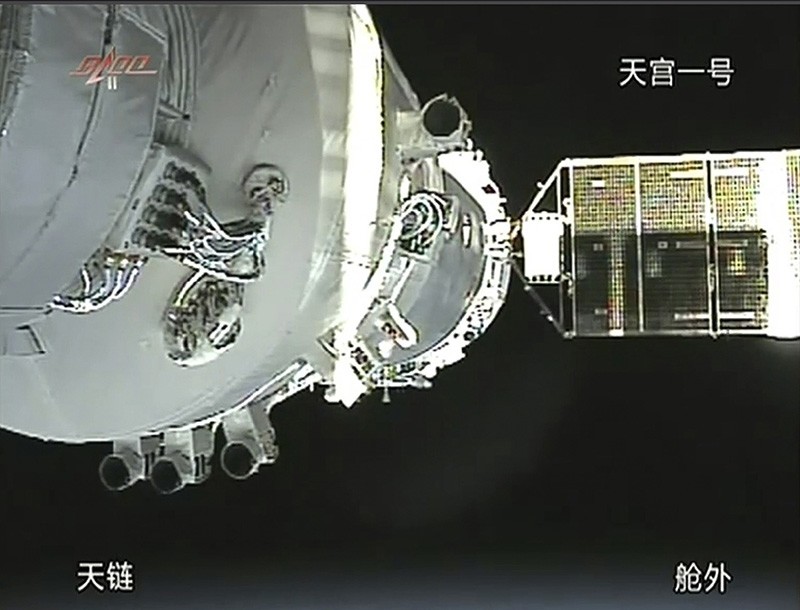
Skywatchers will need sharp eyes and a lot of luck to catch a glimpse of China's Tiangong-1 space lab when it falls to Earth this weekend, a space expert said Thursday.
The craft is expected to re-enter Earth's atmosphere on Saturday or Sunday, but no one knows for sure where it will come down, Holger Krag, head of European Space Agency's Space Debris Office, told Reuters TV.
"It is very rare to see something like this," he said.
"It is the upper atmosphere that will create a drag that will eventually bring down the station. That drag is very, very hard to understand and to predict," he said.
Anyone lucky enough to be looking at the right part of the sky when Tiangong-1 starts its fiery descent will likely see a glowing object moving for several minutes, like a shooting star but slower.
The craft is expected to hit speeds of 27,000 km (16,777 miles) per hour and partly burn up during re-entry. The rest will break up into fragments that could cover thousands of square kilometers, though the risk to people will be very small, experts promise.
"There have been 13,000 tons of space hardware coming down in the whole history of space flight and there has not been a single casualty reported," Krag said.
The 10.4-meter-long (34.1-foot) Tiangong-1, or "Heavenly Palace 1," China's first space lab, was launched into orbit in 2011 to carry out docking and orbit experiments as part of China's ambitious space program, which aims to place a permanent station in orbit by 2023.
It was originally set to be decommissioned in 2013 but China has repeatedly extended the length of its mission, leading some scientists to believe that it has gone out of control.
It will come down somewhere between the 43rd north and south parallels, roughly between the latitudes of London in Britain and Wellington in New Zealand, but it is impossible to be any more specific, ESA's Krag said.
Debris from satellites, space launches and the International Space Station enters the atmosphere every few months, but only one person is known to have been hit by any of it: American woman Lottie Williams, who was struck but not injured by a falling piece of a U.S. Delta II rocket while exercising in an Oklahoma park in 1997.
Most famously, America's 77-ton Skylab crashed through the atmosphere in 1979, spreading pieces of wreckage near the southwestern Australia city of Perth, which fined the U.S. $400 for littering.
The breakup on re-entry of the Columbia space shuttle in 2003 killed all seven astronauts and sent more than 80,000 pieces of debris raining down on a large swath of the Southern United States. No one on the ground was injured.
In 2011, NASA's Upper Atmosphere Research Satellite was considered to pose a slight risk to the public when it came down to Earth 20 years after its launching. Debris from the 6-ton satellite ended up falling into the Pacific Ocean, causing no damage.
Since China conducted its first crewed mission in 2003 — becoming only the third country after Russia and the U.S. to do so — it has taken on increasingly ambitious projects, including staging a spacewalk and landing its Jade Rabbit rover on the moon.
Advancing China's space program is a priority for President Xi Jinping, who has called for Beijing to become a global space power with both advanced civilian space flight and capabilities that strengthen national security.
China now operates the Tiangong 2 precursor space station facility, while the permanent station's 20-ton core module is due to be launched this year. The completed 60-ton station is set to come into full service in 2022 and operate for at least a decade.
China was excluded from the 420-ton International Space Station mainly due to U.S. legislation barring such cooperation and concerns over the Chinese space program's strong military connections. China's space program remains highly secretive and some experts have complained that a lack of information about Tiangong 1's design has made it harder to predict what might happen upon its re-entry.
A mission to land another rover on Mars and bring back samples is set to launch in 2020. China also plans to become the first country to soft-land a probe on the far side of the moon.