Daily Sabah logo

Politics
Diplomacy Legislation War On Terror EU Affairs Elections News Analysis
TÜRKİYE
Istanbul Education Investigations Minorities Expat Corner Diaspora
World
Mid-East Europe Americas Asia Pacific Africa Syrian Crisis Islamophobia
Business
Automotive Economy Energy Finance Tourism Tech Defense Transportation News Analysis
Lifestyle
Health Environment Travel Food Fashion Science Religion History Feature Expat Corner
Arts
Cinema Music Events Portrait Reviews Performing Arts
Sports
Football Basketball Motorsports Tennis
Opinion
Columns Op-Ed Reader's Corner Editorial
PHOTO GALLERY
JOBS ABOUT US RSS PRIVACY CONTACT US
© Turkuvaz Haberleşme ve Yayıncılık 2025

Daily Sabah - Latest & Breaking News from Turkey | Istanbul

  • Politics
    • Diplomacy
    • Legislation
    • War On Terror
    • EU Affairs
    • Elections
    • News Analysis
  • TÜRKİYE
    • Istanbul
    • Education
    • Investigations
    • Minorities
    • Expat Corner
    • Diaspora
  • World
    • Mid-East
    • Europe
    • Americas
    • Asia Pacific
    • Africa
    • Syrian Crisis
    • Islamophobia
  • Business
    • Automotive
    • Economy
    • Energy
    • Finance
    • Tourism
    • Tech
    • Defense
    • Transportation
    • News Analysis
  • Lifestyle
    • Health
    • Environment
    • Travel
    • Food
    • Fashion
    • Science
    • Religion
    • History
    • Feature
    • Expat Corner
  • Arts
    • Cinema
    • Music
    • Events
    • Portrait
    • Reviews
    • Performing Arts
  • Sports
    • Football
    • Basketball
    • Motorsports
    • Tennis
  • Gallery
  • Opinion
    • Columns
    • Op-Ed
    • Reader's Corner
    • Editorial
  • TV

New close-up shots of mini-moons in Saturn's rings unveiled

by

WASHINGTON Mar 28, 2019 - 11:07 pm GMT+3
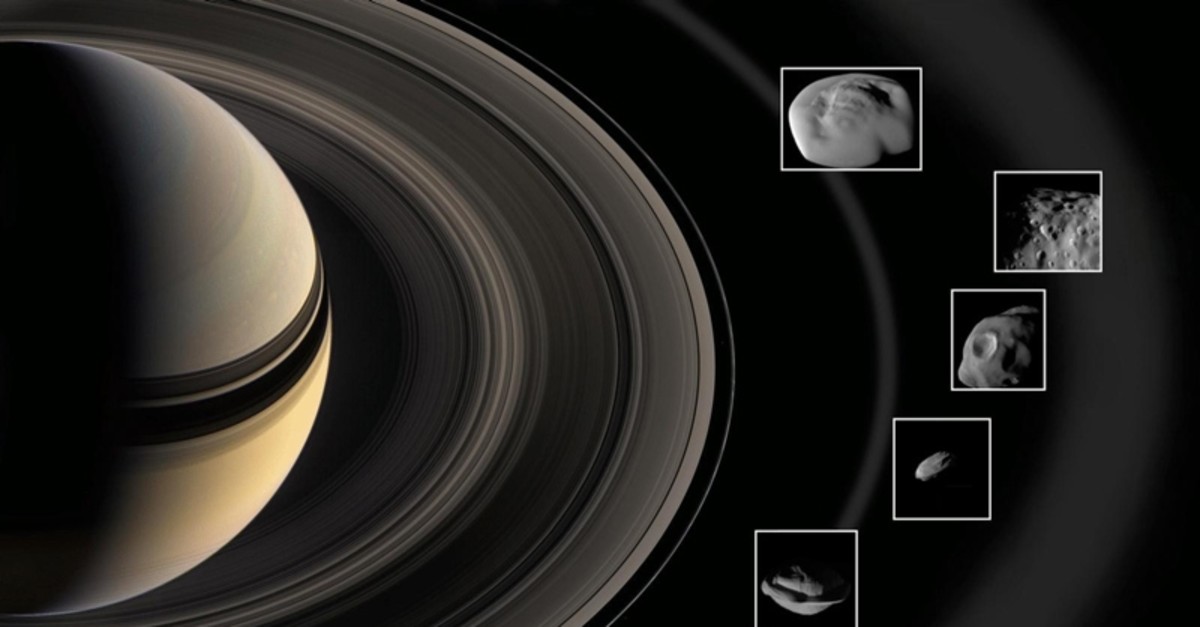
NASA image released March 28, 2019 shows how during super-close flybys of Saturn's rings, NASA's Cassini spacecraft inspected the planetu2019s mini-moons. (Nasa via AFP Photo)
by Mar 28, 2019 11:07 pm

Nestled between Saturn's rings are a collection of mini-moons that NASA's Cassini spacecraft skimmed past in 2017.

On Thursday, for the first time, astronomers and scientists are detailing their findings about the moons in the U.S. journal Science.

Pan, Daphnis, Atlas, Pandora and Epimetheus each measure between eight and 116 kilometers (five to 72 miles) in diameter. They are either round, shaped like flying saucers or resemble potatoes.

They are wedged in the gaps separating the planet's rings.

Cassini spent 13 years near Saturn.

In its final year of operation, it inserted itself between the rings, sending data back to Earth until it went dark on September 13, 2017, 20 years after its launch.

Some 4,000 scientific articles have been published about Cassini's findings, and the well of knowledge is nowhere near dry.

"I want to work for at least another decade on this stuff," Bonnie Buratti, a planetary astronomer at the U.S. space agency's Jet Propulsion Laboratory in California, told AFP.

The data captured by Cassini's instruments are still being assessed. The study published on Thursday is only one preview of the discoveries yet to come.

But the study reinforces the dominant theory that Saturn's rings and moons stem from the same celestial body, which shattered as a result of some kind of collision.

"The largest fragments became the core of these ring moons," explained Buratti, a 33-year veteran of NASA.

"And what happened was the moons continued to accumulate particles from the rings — this is what we saw close up, the accumulation of the ring material onto the moon."

This would explain the gaps left behind the moons.

More than three dozen co-authors from the U.S., Britain Germany and Italy worked on the study published Thursday — a rather remarkable collaboration, according to Buratti.

"It's all in flux, science driven by disagreements," she said.

The question gnawing at astronomers is to figure out how old the rings are.

A study published in January, based on Cassini data, concluded that they were relatively young — somewhere between 100 million and one billion years old.

But other models and methods suggest a different answer.

"Science is never cut and dried — you never have your final answer," Buratti said.

  • shortlink copied
  • KEYWORDS
    life
    The Daily Sabah Newsletter
    Keep up to date with what’s happening in Turkey, it’s region and the world.
    You can unsubscribe at any time. By signing up you are agreeing to our Terms of Use and Privacy Policy. This site is protected by reCAPTCHA and the Google Privacy Policy and Terms of Service apply.
    No Image
    Muslims around the world ring in Ramadan 2022
    PHOTOGALLERY
    • POLITICS
    • Diplomacy
    • Legislation
    • War On Terror
    • EU Affairs
    • News Analysis
    • TÜRKİYE
    • Istanbul
    • Education
    • Investigations
    • Minorities
    • Diaspora
    • World
    • Mid-East
    • Europe
    • Americas
    • Asia Pacific
    • Africa
    • Syrian Crisis
    • İslamophobia
    • Business
    • Automotive
    • Economy
    • Energy
    • Finance
    • Tourism
    • Tech
    • Defense
    • Transportation
    • News Analysis
    • Lifestyle
    • Health
    • Environment
    • Travel
    • Food
    • Fashion
    • Science
    • Religion
    • History
    • Feature
    • Expat Corner
    • Arts
    • Cinema
    • Music
    • Events
    • Portrait
    • Performing Arts
    • Reviews
    • Sports
    • Football
    • Basketball
    • Motorsports
    • Tennis
    • Opinion
    • Columns
    • Op-Ed
    • Reader's Corner
    • Editorial
    • Photo gallery
    • DS TV
    • Jobs
    • privacy
    • about us
    • contact us
    • RSS
    © Turkuvaz Haberleşme ve Yayıncılık 2021