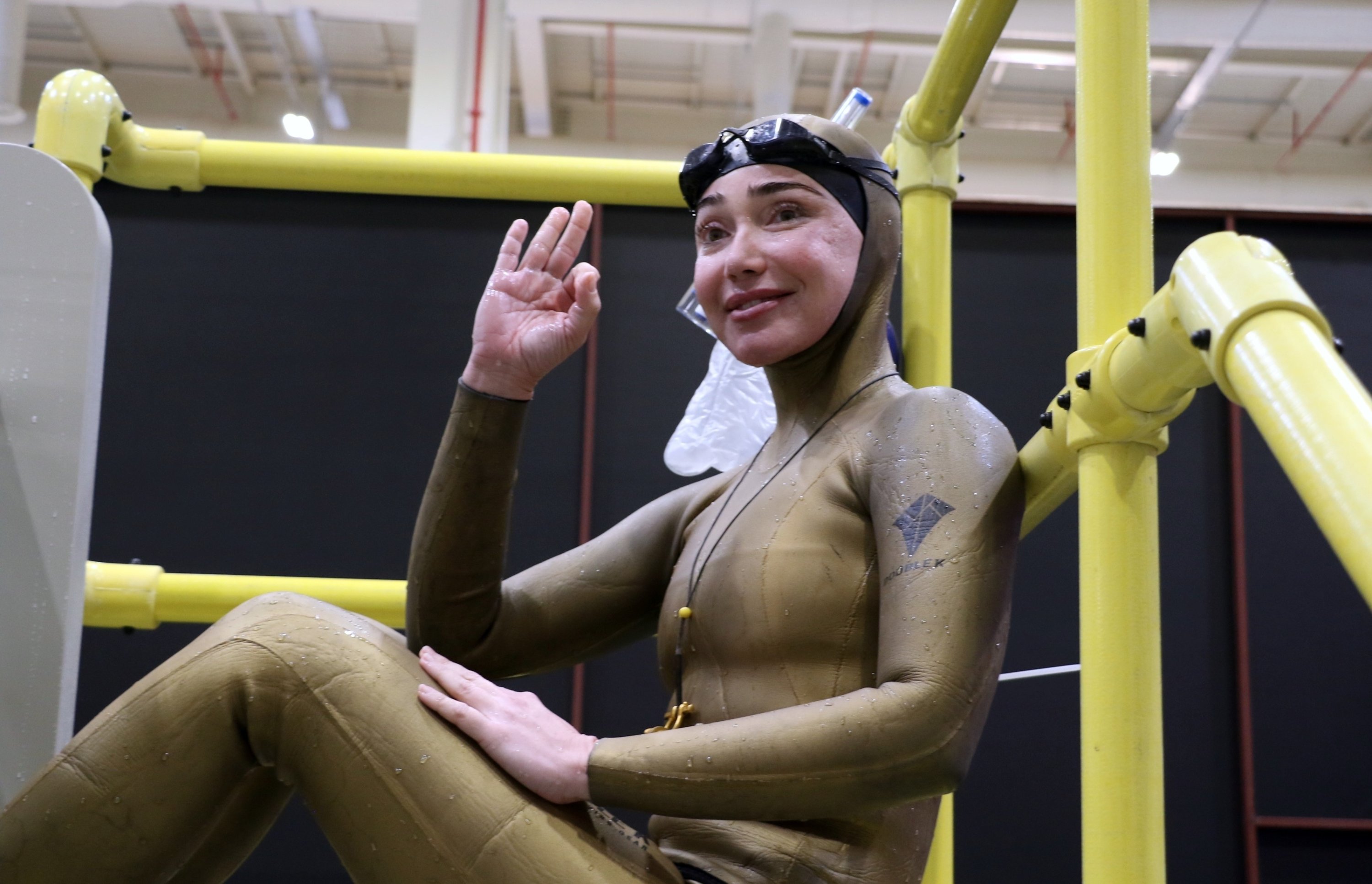
Turkish freediving world record holder Şahika Ercümen held her breath underwater at the COP31 climate summit in Antalya to draw attention to marine pollution and the urgent need to protect the world's oceans.
The national athlete entered a water-filled aquarium at the COP31 Blue Zone, where she staged a silent underwater tribute to the seas and oceans, highlighting the growing threats facing marine ecosystems. Ercümen had successfully completed a practice dive ahead of the event.
Speaking to Ihlas News Agency (IHA), Ercümen said the initiative was designed to deliver an environmental message through action rather than words, expressing pride that Türkiye is hosting one of the world's largest climate gatherings.
"We wanted to hold our breath to send the message that the seas should be able to breathe," she said.
Ercümen, who serves as a United Nations advocate for underwater life and a zero-waste ambassador, said she hoped the performance would encourage governments to translate their environmental commitments into concrete measures.
Having attended previous COP summits, she said she had witnessed numerous pledges but stressed that their implementation and enforcement were what mattered most.
"At previous COP summits I attended, there were many commitments, but seeing them turn into enforceable measures and concrete action is extremely important to us. I believe COP31 in Türkiye will also be such a summit," she said.
"We wanted to deliver our message through action, staging a silent tribute to the seas underwater to reinforce our commitment."
Drawing on her experience as a freediver, Ercümen warned that marine pollution extends far beyond the waste visible on the surface, with significant amounts of debris accumulating on the seabed.
She said some of her dives had taken her into heavily polluted waters where visibility was almost completely obscured.
"What lies beneath the surface is facing serious pollution, particularly on the seabed, where large amounts of waste have accumulated. We usually see what floats on the surface, but once you dive deeper, you realize that much of the pollution is hidden underwater, like the submerged part of an iceberg," she said.
Ercümen also pointed to her recent dives in waters affected by marine mucilage, a thick, slimy substance caused by excessive phytoplankton activity under certain environmental conditions.
She described the experience as particularly disturbing, saying the pollution had severely restricted visibility and illustrated the pressure facing marine ecosystems.
"During a mucilage dive in recent months, visibility was already completely blocked. It has a very unusual structure. In a way, it is the sea's silent cry, its way of expressing what it is going through," she said.
The athlete added that she had encountered several polluted marine environments where the accumulation of waste was so severe that she could barely see underwater.
Ercümen stressed that nature has a capacity to regenerate but warned that continued exploitation of natural resources was undermining that ability.
She urged individuals, businesses and governments to take greater responsibility for protecting the environment, starting with everyday habits and extending to holding authorities accountable for their environmental policies.
"Nature is interconnected, and we are only guests in it. It has its own ability and opportunity to clean and renew itself, but unfortunately, we are exhausting those resources," she said.
"We need to give nature a chance to breathe and recover. Each of us must play a part, starting with our daily habits and, where necessary, by holding governments accountable for the decisions they make."