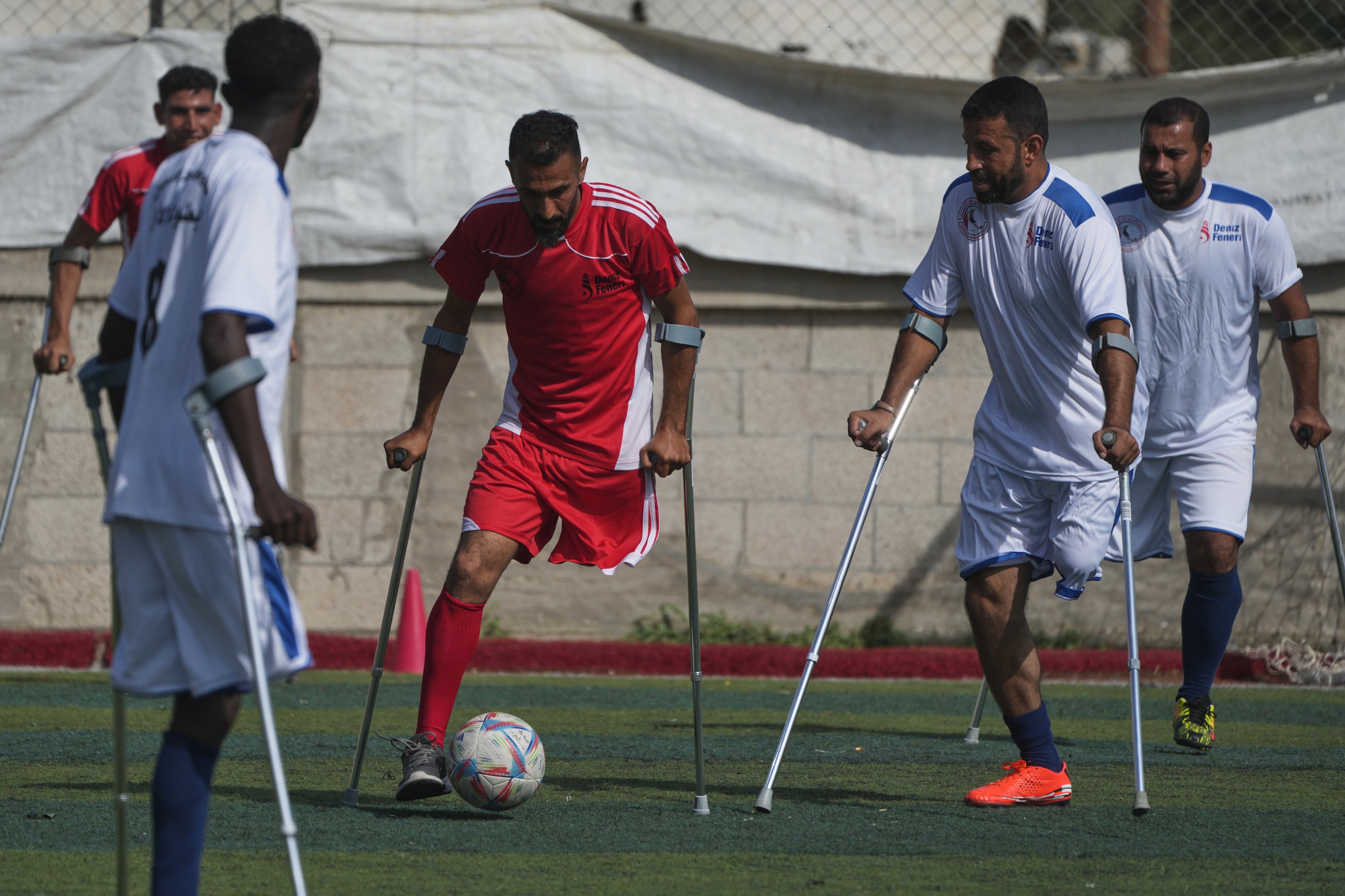
In a Gaza Strip battered by years of war, amputee footballers gathered this week on a dusty field in Deir al-Balah, turning crutches into lifelines and the game into a rare source of joy, identity and defiance.
The four-day Hope Football Championship brought together dozens of male and female athletes who lost limbs in conflict – some during the 2018-19 Great March of Return demonstrations, others in the two-year war that began on Oct. 7, 2023, following Hamas' incursion into southern Israel, killing around 1,200 people and taking roughly 250 hostages.
Gaza health officials say nearly 70,000 Palestinians have been killed since.
On Monday, players lined up at the touchline, many balancing on one leg, gripping their crutches as they waited for the whistle.
When it sounded, they surged forward, swinging across the turf, pivoting sharply, firing quick passes and testing each other’s endurance under a blazing sun.
Near one goalpost, the goalkeeper’s prosthetic arm rested on the ground beside him as he guarded the net.
For many, simply appearing on the field is an act of persistence.
Madi Nawasra was a rising footballer before losing his leg when his house was hit last year. “Now that my leg is amputated, I am still determined to continue playing football,” he said.
Among the players was Farah, who returned to the sport despite profound personal loss.
Standing amid rubble, she sees football not only as a game but as a fresh beginning. “I came here to practice sport so I can be as I was in the past, to reclaim memories,” she said. “My message is simple: don’t give up. Despite your injury, insist on being like everyone else.”
The tournament – organized by the Palestine Amputee Football Association at Ittihad Shabab Deir al-Balah Club Stadium – was born from disappointment and hope in equal measure.
The national team had been preparing to travel to Jakarta for World Cup qualifiers but was blocked by war and the closure of border crossings.
“We launched this championship to revive hope after two years of war against our children and families,” said Captain Ali Abu Armanah, coach of the Palestinian National Amputee Football Team. “At this moment, we were supposed to be in Indonesia representing Palestine.”
The team narrowly missed qualification for the 2026 Amputee Football World Cup in Costa Rica by one point, drawing their final group match in June as fighting continued around them.
Stories of resilience stretch beyond this tournament.
Mohammad Abu Jufail, who lost his leg in the 2014 war, quit football for five months before discovering an amputee squad.
“The beginning was difficult,” he said. “I had played with two legs, then suddenly with one and crutches. But we trained continuously for two years. We resumed our lives.”
Yet the need is immense. Player Abdullah Abu Mukhaimer said nearly 60,000 amputees now live in Gaza – an overwhelming number for the small, under-resourced sporting community. “We are sending a message that we are still contributing through football,” he said. “We call on authorities to support amputee football because the numbers are extremely high.”
Local health organisations report more than 6,000 amputations in the last two years alone, with children making up a quarter of cases and women nearly 13%. Assistive devices remain scarce, deepening the hardship for those trying to rebuild their lives.
Still, on this modest pitch, beneath a fragile cease-fire and the weight of loss, players refuse to surrender their game – or their hope.