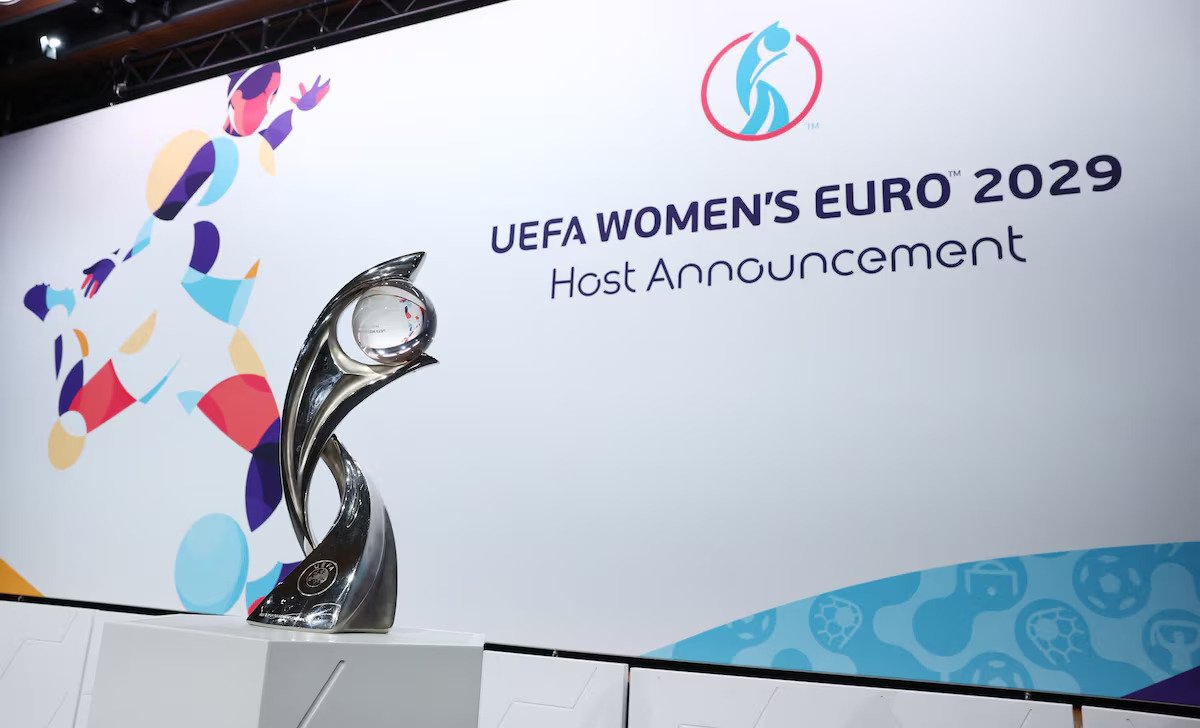
Germany will host the 2029 Women’s European Championship after securing an overwhelming vote of confidence from UEFA on Wednesday, promising record revenue, packed stadiums and a major boost to the sport’s growth on and off the field.
UEFA’s executive committee backed Germany’s bid in decisive fashion, favoring its strong financial projections and proven fan base, with the national team expected to fill major venues in Munich and Dortmund.
Germany’s eight-city plan for a 16-team, 31-match tournament beat out Poland and a joint Denmark-Sweden proposal.
Committee members awarded Germany 15 votes, with the Scandinavian bid receiving two and Poland none.
UEFA President Aleksander Ceferin called it “heartbreaking” that any of the three contenders had to miss out before announcing Germany as the winner.
A large German football federation delegation posed for team photos at UEFA headquarters, then all pulled on white national team jerseys with the number 29 on the front.
“With all the stadiums we have now, I think it is very exciting to see and to play there,” Germany goalkeeper Ann-Katrin Berger said. She traveled to Switzerland to back the bid directly from Madrid, where she played Tuesday evening in the Women’s Nations League final.
This latest German win means that within a generation, from 2006 to 2029, the country will have hosted men’s and women’s World Cups for FIFA and men’s and women’s Euros for UEFA.
Switzerland set a tournament record for attendance while hosting a popular and successful Euro 2025 in July, drawing total crowds of more than 650,000 at an average of 21,000 per game.
Germany expects to draw more than 1 million spectators in its larger stadiums in Cologne, Düsseldorf, Frankfurt, Hanover, Leipzig and Wolfsburg.
“We think we can fill the stadiums because women’s football has had such a great development in the last few years,” German bid leader Heike Ullrich said.
A German-hosted Women’s Euros can aim to make a profit after UEFA budgeted to subsidize the more intimate Swiss-hosted tournament with 25 million euros ($29.1 million).
“It is a tournament of a massive scale in ’29 that Germany can offer,” UEFA director of women’s football Nadine Kessler told The Associated Press. “That is exactly what we want to take advantage of – to properly put women’s football globally on the map.”
Euro 2029 will slot between the last 32-team Women’s World Cup, hosted by Brazil in 2027, and the first 48-team edition in 2031, hosted mostly in the United States.
“We will be on par with World Cups,” said Kessler, a former Germany national team standout. “Financially but also sportingly, all these prejudices we have been facing for many, many years, I think they will be wiped away by ’29.”
The Denmark-Sweden bid offered a similar level of sold-out smaller stadiums, while Poland aimed to accelerate its progress toward becoming a women’s football power in Europe.
With the Women’s Euros expected to be a 24-team tournament in the future, Germany also was seen as a safe bet for hosting after expansion – a greater challenge for the other bidders Wednesday.
Sweden and Denmark narrowly lost a hosting vote for the 2025 edition to a surprise Swiss win, when their bid had been joined by Finland and Norway in a more scattered four-nation Nordic project.
“It is hard to think about that right now,” Swedish football federation president Simon Åström said about a possible third straight bid for 2033, which likely will be a 24-team event. “We believed we had a very strong bid, but we also know the competition this time was very tough.”
It is unclear if UEFA could fast-track that expansion for the 2029 edition in Germany.