As Israel’s devastating war on Gaza stretches into its second year, the world of sport – long considered a neutral arena – has become an unlikely but powerful front in the global demand for justice.
From the roar of Spanish football crowds to the quiet resolve of Norwegian officials, from Formula One circuits to grassroots fan movements, a growing coalition of athletes, clubs and federations is refusing to look away from what many have described as genocide.
When the bombs began falling on Gaza in October 2023, the initial response from international sports bodies was muted.
FIFA, UEFA and the International Olympic Committee avoided political statements, maintaining the age-old claim of “neutrality.”
But as civilian deaths mounted – including hundreds of children – silence became untenable.
By late 2024, the outcry within the sports community had grown into a coordinated movement.
Clubs across Europe began boycotting Israeli teams, while athletes used their platforms to demand an end to what humanitarian organizations have called one of the gravest human catastrophes of the 21st century.
Türkiye’s sports community was among the first to take a stand.
The country’s federations and top athletes publicly condemned the attacks, echoing public outrage.
Banners supporting Palestine have become a common sight in Turkish stadiums, while fans chant in solidarity with Gaza at domestic league matches.
In Europe, Spain has emerged as the epicenter of sporting resistance.
The country’s leading clubs and institutions have taken tangible actions – rejecting Israeli participation and aligning sport with a moral cause.
FC Barcelona refused to allow Israeli basketball team Hapoel Bank Yahav Jerusalem to use its facilities for training ahead of their EuroCup clash with Baxi Manresa on Oct. 15.
The decision drew global attention, symbolizing a bold refusal to normalize Israel’s participation in European competitions.
Elsewhere, in the Canary Islands, local authorities requested the postponement of the La Laguna Tenerife-Bnei Herzliya Basketball Champions League match set for Oct. 14.
The move came amid mounting calls for Spanish sports bodies to freeze all games involving Israeli sides.
Spanish Prime Minister Pedro Sanchez added political weight to the movement, calling for Israel’s exclusion from all international sporting events – mirroring sanctions imposed on Russia after its invasion of Ukraine.
The Supreme Council for Sports (CSD), a state-affiliated body, accused cycling’s world governing body, the UCI, of “whitewashing genocide” by allowing an Israeli team to compete in La Vuelta.
The Basque women’s basketball team Bizkaia Gernika became the first club in Spain to officially refuse matches against Israeli sides.
Its president, Gerardo Candina, declared, “We are completely against the brutal genocide in Gaza.
We will not fall for this trick.” His team forfeited both of its scheduled EuroCup group-stage matches against Elitzur Ramla, citing moral grounds.
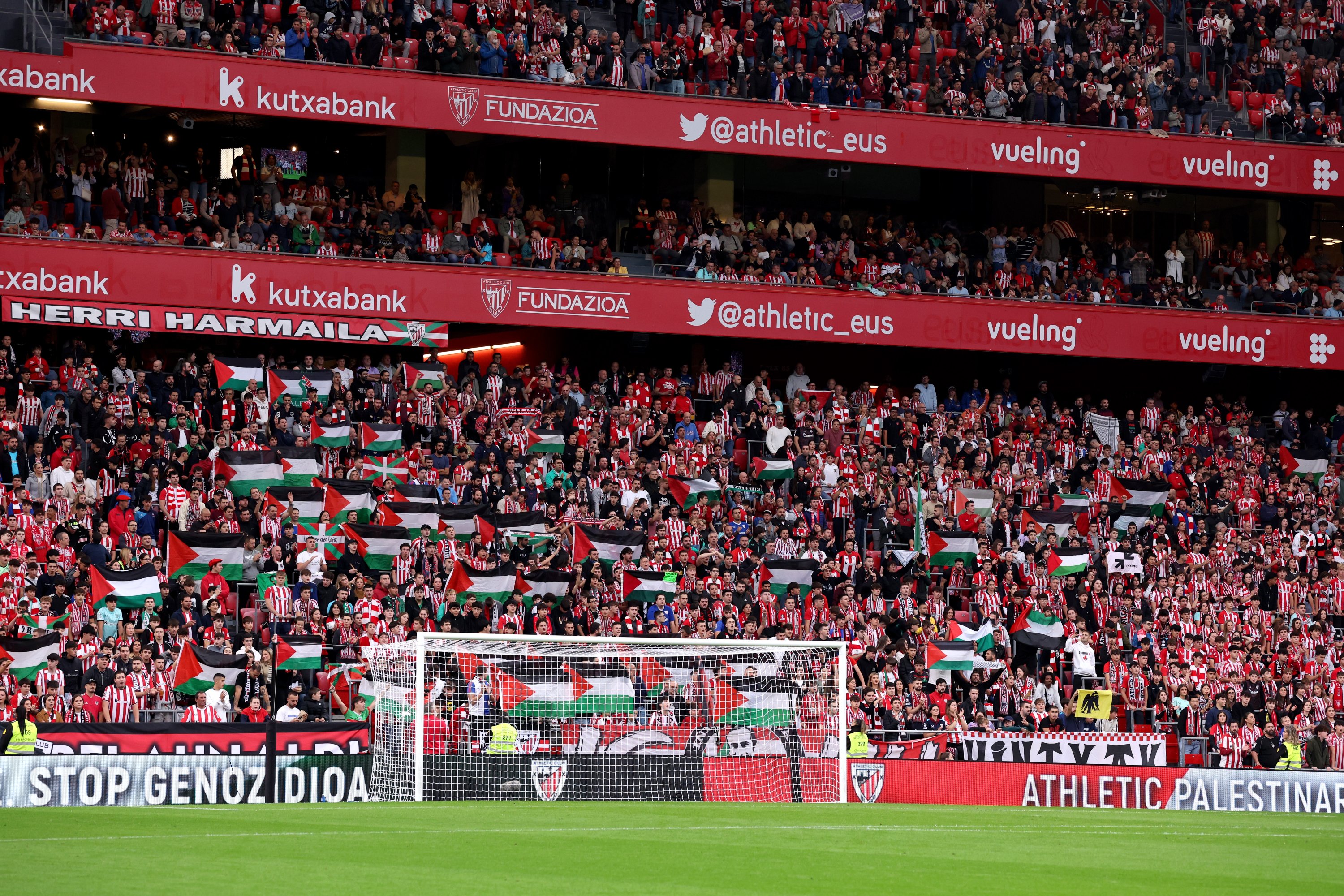
In September, protests swept La Liga stadiums.
Fans of Athletic Bilbao, Osasuna and Alaves filled stands with Palestinian flags and banners reading, “End the genocide.” For many Spaniards, football – a national obsession – became a rallying ground for human conscience.
Beyond club decisions, several of the world’s most influential athletes have spoken out.
Seven-time Formula One world champion Lewis Hamilton issued one of the strongest statements yet, declaring: “We can no longer remain silent.”
He cited UNICEF figures showing over 100 children killed in Gaza during the first week of July alone, warning that moral silence equaled complicity.
French legend Eric Cantona, known for blending sport and activism, showed his solidarity by wearing the jersey of Lajee Celtic Club, a team from the Aida refugee camp in Bethlehem.
The campaign, launched by Celtic FC fan groups in Scotland, channels proceeds from jersey sales directly to Palestinian refugees.
Former Galatasaray forward Dries Mertens condemned Israel’s blockade, posting: “Gaza is being left to starvation.”
Egyptian star Mohamed Salah publicly rebuked UEFA after its posthumous tribute to former Palestinian football icon Suleiman Al-Obaid, who was killed by Israeli forces in Gaza while waiting for humanitarian aid.
“Can you tell us how, where and why he died?” Salah asked.
Al-Obaid, dubbed the “Palestinian Pele,” was just 41.
A father of five, he had given hope to countless young players in Gaza.
The Palestinian Football Federation later confirmed that he was killed by occupation forces.
UEFA’s vague tribute, stripped of context, became emblematic of what critics call Europe’s selective morality in sports.
In Scandinavia, Norway turned symbolism into action.
The Norwegian Football Federation announced that ticket revenues from its Oct. 11 World Cup qualifier against Israel would be donated to Gaza’s humanitarian relief efforts.
“We cannot remain indifferent to the suffering of civilians,” said federation president Lise Klaveness, a former international player known for her human rights advocacy. “We want to channel the proceeds toward those saving lives in Gaza every day.”
Israel’s football federation reacted angrily, urging Norway to also “condemn Hamas” and ensure funds would not reach “terrorist groups.” The Norwegian side remained firm.
Earlier this year, Bodo/Glimt, one of Norway’s leading clubs, donated the entire ticket revenue from its Europa League match against Maccabi Tel Aviv – NOK 735,000 ($73,000) – to the Red Cross, specifically for Gaza aid.
“We will not be unaffected by the suffering,” the club said. “Our conscience demands this.”
The call for action has spread globally, led by grassroots movements.
The “Show Israel the Red Card” campaign, initiated by Celtic’s Green Brigade, has united supporters from Scotland to Chile, Türkiye to Indonesia.
Fans from across faiths and languages now display Palestinian flags and banners reading “Boycott Israel” and “Justice for Gaza” in stadiums worldwide.
In the Netherlands, Amsterdam’s city council unanimously adopted a proposal declaring that sports clubs from countries engaged in occupation or racism are unwelcome.
Germany’s Fortuna Düsseldorf canceled the signing of Israeli striker Shon Weissman in August following fan protests.
In Italy, supporters turned their backs to the field during Israel’s national anthem before a 2026 World Cup qualifier.
And outside Wembley Stadium in London, thousands rallied with slogans like “Kick Israel out of FIFA” and “Long live free Palestine.”
Even cycling – rarely a political arena – has seen resistance. Israel’s Premier Tech team was expelled from the Giro dell’Emilia race in Italy after protests erupted from riders and local organizations demanding a ban.
While international voices grow louder, the reality in Gaza’s sports world is catastrophic.
According to the Palestinian Football Association, more than 800 athletes have been killed since Israel began its offensive – including 420 footballers, nearly half of them children.
The infrastructure that once nurtured Palestinian dreams has been obliterated.
Ninety percent of Gaza’s sports facilities have been destroyed – 288 stadiums, gyms and clubs in total. Among them is the PFA’s own headquarters, leveled by airstrikes.
Some of Gaza’s largest stadiums have been converted into makeshift shelters or mass graves. Training fields lie under rubble. Referees, coaches and entire youth teams have been wiped out.
“The sports community has been decimated,” said a PFA official. “It’s not just athletes who are dying – it’s the future of Palestinian sport itself.”
Humanitarian agencies warn of famine and total collapse under Israel’s blockade, which has cut off fuel, food and medicine.
With much of the population displaced, even the concept of organized sport has become a memory of a freer, safer time.