Turkey successfully evacuates Tomb of Süleyman Shah
by Ali Ünal
ANKARAFeb 22, 2015 - 12:00 am GMT+3
by Ali Ünal
Feb 22, 2015 12:00 am
In an operation that abided by international law and was executed under intense secrecy, the Turkish military successfully evacuated the Tomb of Süleyman Shah and the soldiers guarding it before relocating it to a more defensible spot within Syria
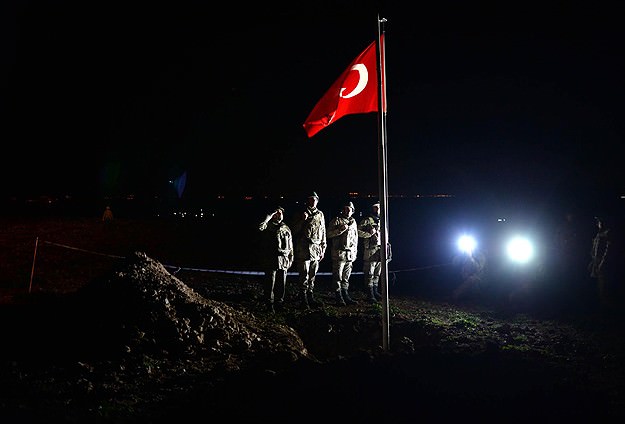
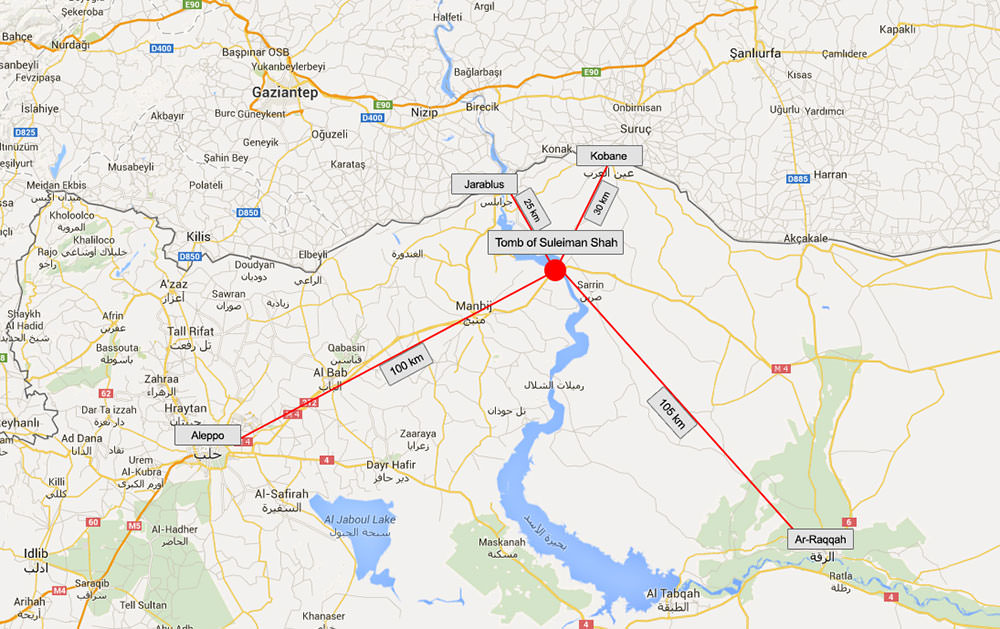
In an operation that began late on Saturday, the Turkish military successfully extracted 40 soldiers who had been guarding the Tomb of Süleyman Shah in Syria, the grandfather of the founder of the Ottoman Empire. The military force entered the site that is considered sovereign territory by Ankara with 39 tanks, 57 armored cars, 100 vehicles and 572 personnel. Without encountering any skirmishes, they completed the mission, which was carried out some 30 kilometers inside Syrian territory in an area controlled by the Islamic State of Iraq and al-Sham (ISIS).
The operation came a few days after reports suggested that the tomb was being besieged by ISIS militants. After successfully completing the mission, Turkish forces returned to Turkey on Sunday morning. However, one soldier lost his life in an accident during the mission. At a press conference Prime Minister Ahmet Davutoğlu said: "Operation Shah Euphrates was extremely successful. Turkey did not violate any rights under international law. In terms of sentimental value, we have secured all rights inside Syrian territories." He underlined that Turkey did not need to request permission from any authority whatsoever.
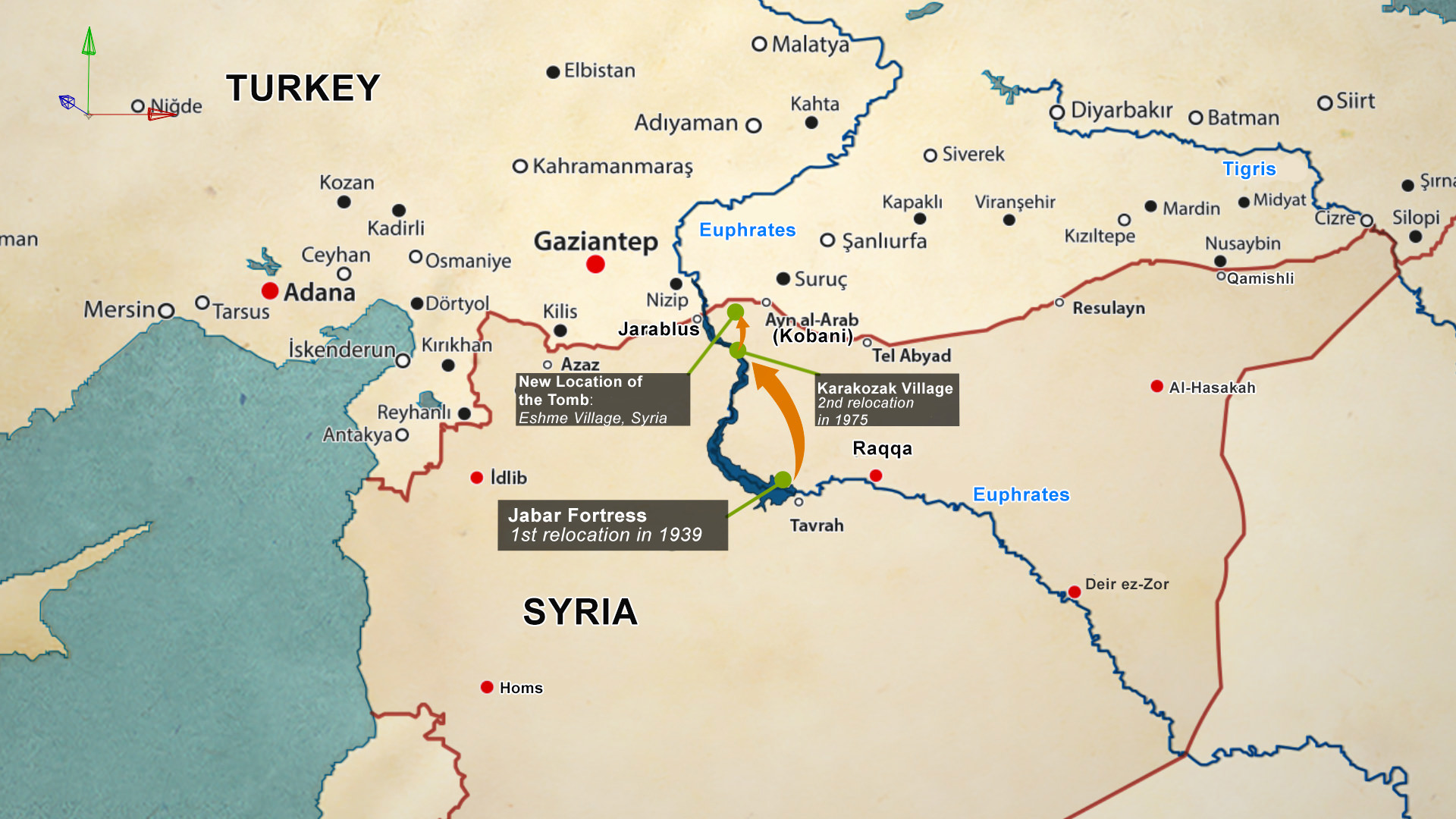
Meanwhile, the remains of Süleyman Shah were transferred to Ashmeh, an area located 200 meters south of the Turkish-Syrian border in Syria. "The Tomb of Süleyman Shah and Memorial Outpost, which had been relocated twice in previous years, will continue to fly the Turkish flag and keep the memory of our ancestors alive in accordance with international law and agreements," President Recep Tayyyip Erdoğan said in written statement on Sunday.
Erdoğan also congratulated the government and the Armed Forces "for conducting this successful and praise-worthy operation."
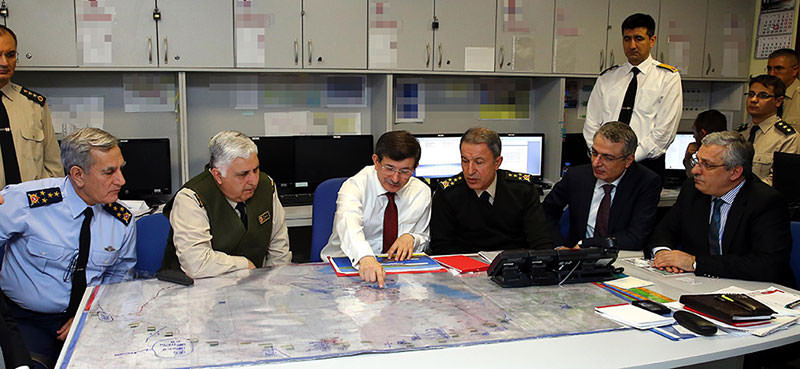
The operation by the Turkish Armed Forces (TSK) has been widely considered successful. According to Mete Yarar, who is a former member of the TSK, it was a very well-detailed, timely operation. "Every detail in the operation was planned so well that there were no openings that could be exploited. They were non-existent. From the team sent to the tomb to the team that planted the flag, everything indicates that this operation was well-planned and every related state institution played their role in its coordination." As a former member of the Special Forces Command, Yarar added that maintenance of the operation's confidentiality indicates cooperation between institutions in Turkey. Yarar believes that in this context the operation can be seen as one of the first of its kind in Turkey. "The most important feature of this operation was that it was done in an environment that was full of uncertainties, because of those who were in possession of the territory and from whom we could expect an assault."
According to Can Acun, a Middle East expert at the SETA Foundation, the operation's importance is due to successfully getting in and out of a region where many actors are in conflict without encountering resistance, and in an era when many countries are not able to rescue hostages from ISIS, while Turkey was successful in both Mosul and the Tomb of Süleyman Shah. Asserting that the evacuation of the tomb to Ashmeh meant that Turkey was using its rights under international law, Acun said that besides choosing Ashmeh, which is to the west of Kobani, it is also important to state that the operation passed through territories under control of a Syrian Kurdish militia, considered part of the Democratic Union Party's (PYD) People's Protection Units (YPG).
Meanwhile, YPG sources claimed that Turkey asked permission to conduct the operation they claimed they jointly conducted with the Turkish forces. However, sources from the Prime Ministry strongly denied such allegations. Experts believe that these discrepancies and the relocation of the tomb will not cause a clash between the Turkish army and the YPG. "Despite various Kurdish groups claiming sovereignty over this region, Turkey decided to relocate the tomb there. Therefore, I do not think there will be a reaction toward the presence of the tomb. Neither the YPG nor the PYD has the manpower nor the political clout to oppose Turkey," the expert said. The president of the Center for Middle Eastern Strategic Studies (ORSAM), Şaban Kardaş, shared similar sentiments by underlining that the new location of the tomb will not cause any conflict between Kurds in the area and Turkey. "The Kurdish actors in the region are aware of their limits, and therefore they will refrain from any action that may cause conflict directly with Turkey," Kardaş said. He also emphasized the fact that the close ties between the Kurds in the region and Turkey was an important factor in the process of identifying a new location and transferring the tomb to the assigned location. Yarar also believes that there is no risk. "The tomb's new location is near the Turkish border. This location is in the right place in the sense of logistics and security. For these reasons, it will not be an issue."
Besides these issues, Kardaş believes that the situation that triggered the operation has proven once again that the advancement of ISIS in Syria and Iraq is harming Turkey. "The fact that the Kurdistan Regional Government and the Turkmens in Iraq are targeted by ISIS confirms that they are targeting elements that Turkey has established cooperation with," Kardaş said. Acun drew attention to another point: "Not being part of the military wing of the international coalition against ISIS does not mean Turkey is not part of the fight against ISIS. Turkey is not taking part in the military actions of the coalition because Turkey is searching for the removal of factors that led to the existence and rise of ISIS. However, Turkey is still part of the fight against ISIS. The extensive operation involving the Tomb of Süleyman Shah that aimed at removing possible ISIS threats is a reflection of this fight."
About the author
Beijing-based senior journalist at CGTN's Turkish desk, former press counselor at the Embassy of the Republic of Türkiye in Beijing and Daily Sabah's former Ankara bureau chief
Keep up to date with what’s happening in Turkey,
it’s region and the world.
You can unsubscribe at any time. By signing up you are agreeing to our Terms of Use and Privacy Policy.
This site is protected by reCAPTCHA and the Google Privacy Policy and Terms of Service apply.