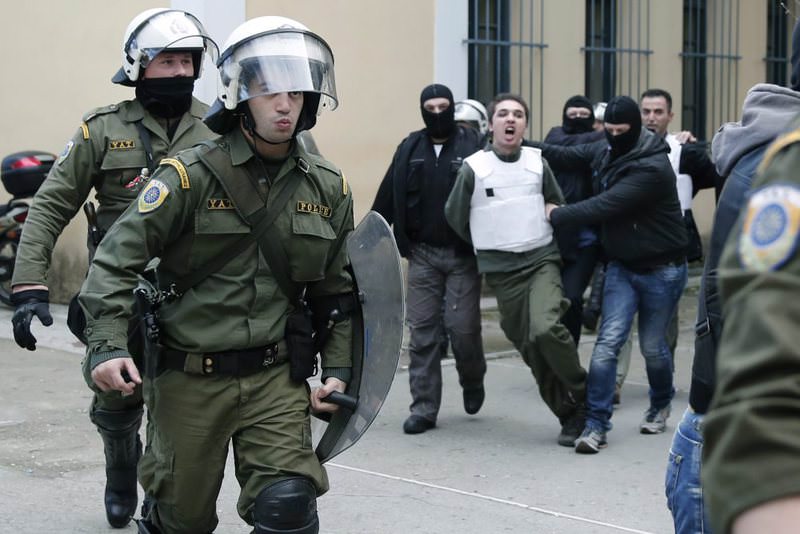
A Greek court released a member of the DHKP-C terrorist organization accused of being involved in the killing of a Turkish businessman after it refused Turkey's extradition request
Greece released İsmail Akkol, a member of the Revolutionary People's Liberation Party-Front (DHKP-C) terrorist organization, who was accused of being one of the assassins of Özdemir Sabancı, a prominent businessman killed in his office in 1996, Turkish media reported.
Akkol was captured last year in Athens along with other prominent members of the terrorist organization in an operation by Greek police. Turkey has requested his extradition for his role in the murder of Sabancı, but it was denied, while Akkol was sentenced to eight years. To the chagrin of Turkey, Akkol was tried on charges of possessions of firearms and explosives rather than terrorism charges that would lead to a tougher sentence. Earlier this week, Akkol was released on parole and is reported to be still in Greece.
The court also ordered the release of Hüseyin Fevzi Tekin, a senior leader of the DHKP-C who was captured along with Akkol. Like Akkol, he was convicted on charges of possessions of firearms and explosives, but his imprisonment will continue as he is also charged with involvement in a bomb attack in Athens in 2010. Three other DHKP-C members tried along with Akkol were also released.
Hasan Biber, another DHKP-C member charged with carrying out attacks against the headquarters of the Justice and Development Party (AK Party) and the Justice Ministry in 2013, was also captured in Greece after he fled Turkey following the attacks. Biber may be released as well, as media reports said he was diagnosed with a severe illness while in prison.
Greece has long been a favorite hideaway for terrorists from the DHKP-C and the Kurdish PKK. Terrorists fleeing Turkey took shelter in refugee camps in Lavrion under the guise of asylum seekers, especially in the 1980s.
The country, which had strained ties with neighboring Turkey, changed its much-criticized policy of tolerance for supporters of the terrorist organization and a number of militants were arrested last year in several operations, including high-ranking members of the group. The move was seen as improving the counter-terrorism cooperation between Turkey and Greece, although the refusal of Greek courts to extradite several suspects overshadowed the efforts.
The DHKP-C, in addition to attacks against Turkish security forces, are responsible for the suicide bombing at the U.S. Embassy in the capital Ankara that killed a Turkish security guard and injured a journalist in February 2013.
The group is an offshoot of a Marxist-Leninist movement that was established in the 1970s. It was founded in the 1990s after it splintered off from a larger group of far-left organizations responsible for a string of attacks that include the assassination of two politicians in 1980, several intelligence officials and Özdemir Sabancı, a member of the Sabancı family, one of the richest families in Turkey owning a large conglomerate of companies.
Mustafa Duyar, another DHKP-C member who was convicted of Sabancı's killing, had said in his testimony that he carried out the murder of Sabancı, a company executive and businessman's secretary together with Akkol. Duyar, who surrendered months after the murder, was killed in prison. Fehriye Erdal, a woman accused of aiding Akkol and Duyar in the murders, was captured in Belgium. She disappeared after a Belgian court released her pending trial.
Keep up to date with what’s happening in Turkey,
it’s region and the world.
You can unsubscribe at any time. By signing up you are agreeing to our Terms of Use and Privacy Policy.
This site is protected by reCAPTCHA and the Google Privacy Policy and Terms of Service apply.