The military's ultimatum on Feb. 28, 1997 ushered an era of repression and coercion for the conservative majority in Turkey, with women wearing headscarves denied their right to education. Despite the leaders of the so-called ‘post-modern coup' believing the system they imposed would last a thousand years, it collapsed due to its own internal contradictions. However, its consequences linger in lives of many
The seeds of the process that led to the wholesale attack on the conservative sections of the society which began after Feb. 28, 1997, were planted on June 28, 1996, when the Welfare Party (RP) succeeded in forming a coalition government with the center-right True Path Party (DYP) and RP Chairman Necmettin Erbakan became prime minister.
Soon afterward, mainstream media organs, supported by the top echelons of the military, started attacking the government, accusing it of threatening secularism and Kemalism. The pressure culminated in a military ultimatum issued by top generals at the National Security Council, which at the time was dominated by the military.
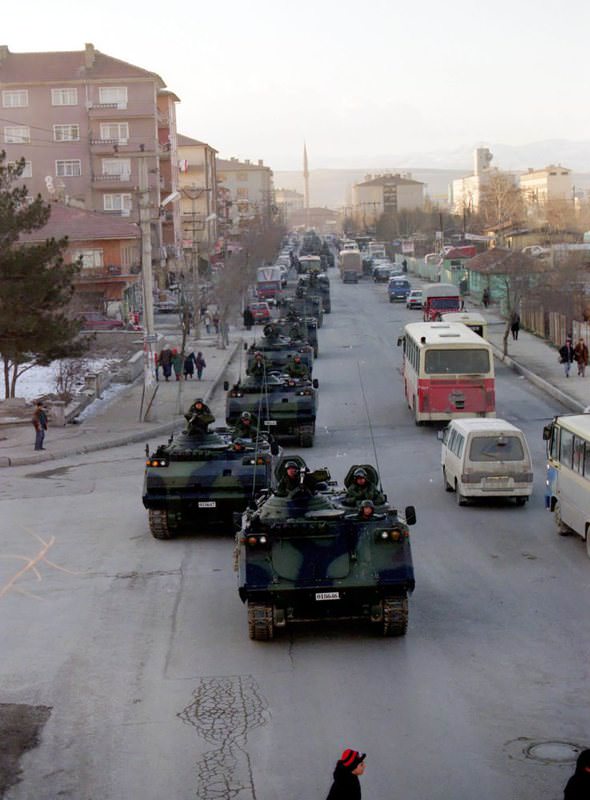
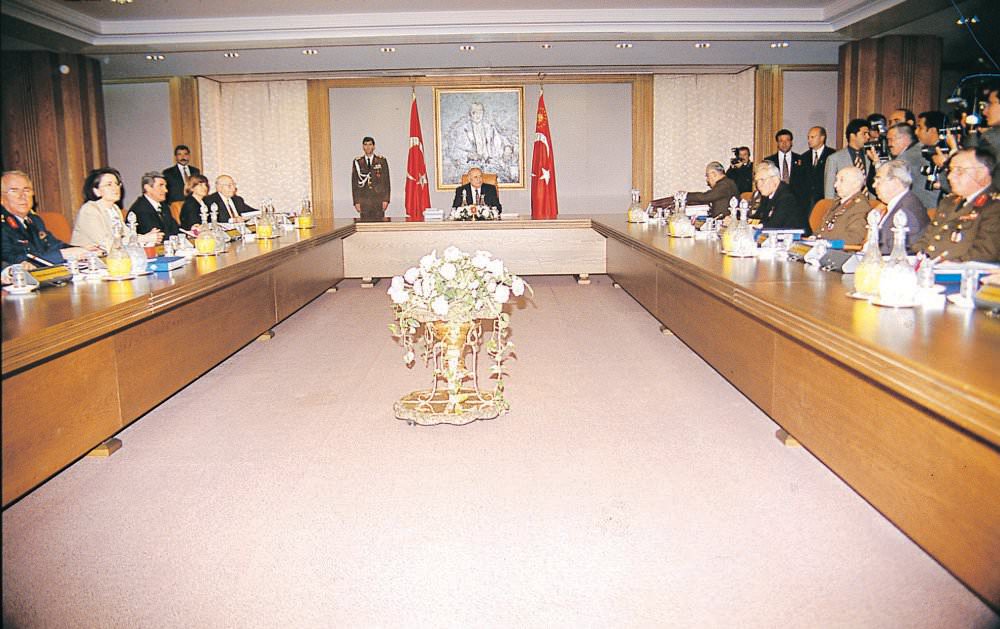
The National Security Council meeting on Feb. 28, 1997, (above) saw the government led by Prime Minister Necmettin Erbakan presented with a list of ultimatums. Significant pressure, coupled with a media campaign and military threats, including tanks on the streets (right), resulted in Erbakan's resignation before he was banned from politics and his party shut down.
Having received a vote of confidence from parliament on July 8, 1996, Erbakan, who had never before served as the prime minister during his long political career, led the new cabinet. What followed was visible anger from the military, the self-styled guardians of the Republic's secularism, against the RP and all Muslims, whether they were or were not linked to the party. The generals repeatedly denounced what they perceived as the onset of a sharia regime. The media, judiciary and bureaucracy joined the military in a defamation campaign against conservatives. On Feb. 4, 1997, 20 tanks and 15 armored vehicles passed through the streets of Sincan, Ankara in a clear warning against the government.
Soon the media was awash with reports disparaging Muslims, such as a woman caught in bed with "the leader of a religious group," or almost daily coverage of news about "Muslims calling for sharia law to be implemented." Finally on Feb. 28, 1997, the Turkish Armed Forces, in a scathing ultimatum presented to the government , said secularism was the assurance of democracy and law in Turkey, and called on the government to approve certain measures, including the introduction of the eight-year compulsory education and strict enforcement of the headscarf ban at state institutions. The eight-year compulsory education clause and extra limitations especially targeted Imam-Hatip schools, where conservative families preferred to send their children. New rules imposed strict guidelines that disenfranchised Imam-Hatip graduates in university entrance examinations.
The then-chief of the general staff Gen. Hüseyin Kıvrıkoğlu is said to have remarked, "Feb. 28 will last a thousand years." His deputy, Çevik Bir, sent a series of letters to the top courts, including the Constitutional Court, telling them what was expected of them.
On May 21, 1997, the Chief Prosecutor's Office at the Supreme Court of Appeals filed a complaint at the Constitutional Court that called for the closure of the RP, accusing it of being "the center of illegal activities, with some members threatening the secular regime." A few weeks later, all the members of the Constitutional Court were taken to the Office of the Chief of General Staff for a briefing on the dangers of fundamentalism. While at first Erbakan resisted the pressure, he was eventually forced to step down in June 18, 1997. Erbakan, in submitting his resignation to President Süleyman Demirel, made his intention clear that he wanted True Path Party (DYP) Chairwoman Tansu Çiller to take over. However Demirel rejected the appeal and appointed Motherland Party (ANAP) Chairman Mesut Yılmaz as prime minister, who proceeded to form the next coalition government which implemented the list of demands laid by the military.
After an eight-month trial, the Constitutional Court shut down the RP and banned from politics Necmettin Erbakan and senior RP members Şevket Kazan, Ahmet Tekdal, Şevki Yılmaz, Hasan Hüseyin Ceylan and İbrahim Halil Çelik for five years.
The former Şanlıurfa deputy from the RP, Çelik, described the system formed after the Feb. 28 process as a system of theft. "Politicians, media and the military were its chief instigators. Politicians were led by Süleyman Demirel. Some said it would last a thousand years, but it didn't take too long for them to collapse. However the vision of Erbakan produced two presidents and many prime ministers. It is strong enough to produce many more."
After the party's closure, many of the party members returned to politics by founding the Felicity Party (FP) and entered parliamentary elections in 1999. While it secured 11 seats in Parliament, the huge reaction caused by Istanbul deputy Merve Kavakçı's decision to be sworn in with her headscarf on May 2, 1999, resulted in complaints leading to the party's closure. The FP was shut down on June 22, 2001. It was Recep Tayyip Erdoğan, the current president, who mobilized the reformist wing of the FP to form the Justice and Development Party (AK Party), and successfully led it to government in the 2002 elections.
Keep up to date with what’s happening in Turkey,
it’s region and the world.
You can unsubscribe at any time. By signing up you are agreeing to our Terms of Use and Privacy Policy.
This site is protected by reCAPTCHA and the Google Privacy Policy and Terms of Service apply.