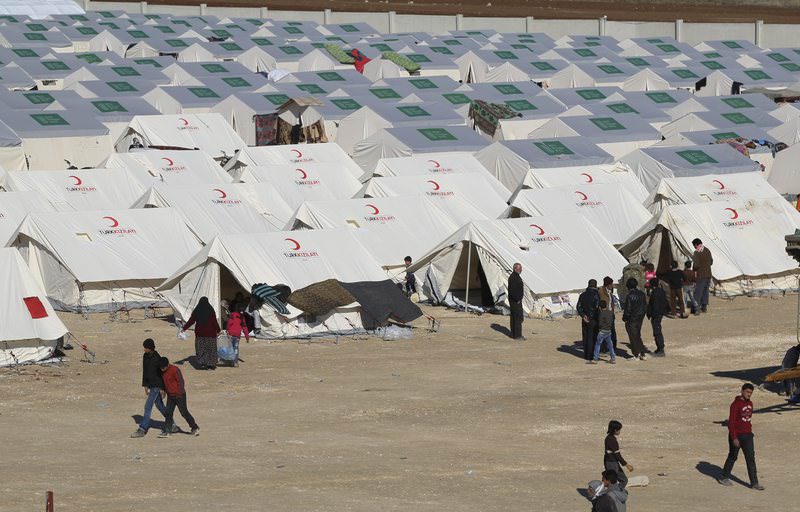
The Turkish Red Crescent continues to lend a helping hand to the millions of refugees in Turkey. The institution plans to open new community centers for refugees and will host the first ever World Humanitarian Summit in May
Turkish Red Crescent General Vice President Kerem Kınık has said that the number of community centers geared toward Syrian refugees will increase in the near future. Currently, the Turkish Red Crescent continues its operations in three community facilities in the southeastern province of Şanlıurfa, the central Anatolian city of Konya and Istanbul. The institution is expected to establish 13 more community centers for Syrian refugees with the 40 million euros of funding that Ankara will receive from European Union.
The Thrace and Istanbul branch presidents of the Turkish Red Crescent met in Istanbul ahead of the general assembly of the institution, which will convene in April. Kınık offered insights about the operations of the Turkish Red Crescent to Anadolu Agency (AA) during his speech before the assembly kicked off. He said that they conducted 14 regional assemblies across Turkey and they will conclude their effort with their last meeting in Istanbul. "There are 670 branches of the Turkish Red Crescent throughout Turkey and we need to study our goals for the 2016 to 2020 season with all these branches and their presidents. We also asked branch presidents to evaluate our practices according to the action plan. We will also discuss the Turkish Red Crescent Action Plan on April 4 at the general assembly," Kınık said.
The Turkish Red Crescent, which was founded in 1868, is one of the rooted establishments of Turkey with over 5,000 employees. The instruction sets new goals every year and set the bar for other institutions thanks to their innovative goals for blood donations, natural disaster aid and social, women's and adolescent aid. In his speech, Kınık said that World Humanitarian Summit will take place in Turkey for the first time on May 23-24. "This is a United Nations summit that will take place in Istanbul and we expect to host nearly a hundred heads of state and high ranking ministers. The summit will take place for the first time with the initiative of U.N. General-Secretary Ban Ki-moon," Kınık said. At the summit, new humanitarian aid models will be discussed as part of sustainable development goals set for post-2015.
According to the information provided by the Office of the United Nations High Commissioner for Refugees (UNHCR), there are 65 million people who are forced to leave their houses and homelands at gunpoint. Some 230 million people are living as refugees in countries other than their own. Moreover, 42,500 people become refugees every day and a Syrian child becomes a refugee every 30 seconds. "We are facing one of the biggest humanitarian tragedies with the Syrian civil war, which broke off about six years ago," Kınık said, adding that 11 million Syrians have been forced to leave their homes, 300,000 people have been killed and 1.5 million have been injured. "Humanitarian aid cannot reach their destinations in Syria. We will talk about the necessity of opening a humanitarian aid corridor at the summit," Kınık added. He stressed that Turkey has developed various initiatives and has been following a humanitarian policy on Syrians since the day the civil war broke out and Turkey is the country that has taken in the most Syrian refugees, as it opened its doors to people in need.
The Turkish Red Crescent has been working hard to help Syrian refugees in Turkey. To increase the help that is provided to refugees, the Turkish Red Crescent is planning to increase the number of community centers intended for Syrians with the funding the European Union offered to Ankara. At these community centers, the organization teaches Turkish to refugees and holds vocational courses especially for women. Psychological support for Syrian children is also offered at the community centers. "We are also teaching young adults how to live in Turkey, the rights of citizens and help them with their homework. These community centers will reduce the social tension and enable these people to maintain their lives without needing anyone else's help in the future," Kınık said.
Keep up to date with what’s happening in Turkey,
it’s region and the world.
You can unsubscribe at any time. By signing up you are agreeing to our Terms of Use and Privacy Policy.
This site is protected by reCAPTCHA and the Google Privacy Policy and Terms of Service apply.