
Daily Sabah logo

Politics
Diplomacy Legislation War On Terror EU Affairs Elections News Analysis
TÜRKİYE
Istanbul Education Investigations Minorities Expat Corner Diaspora
World
Mid-East Europe Americas Asia Pacific Africa Syrian Crisis Islamophobia
Business
Automotive Economy Energy Finance Tourism Tech Defense Transportation News Analysis
Lifestyle
Health Environment Travel Food Fashion Science Religion History Feature Expat Corner
Arts
Cinema Music Events Portrait Reviews Performing Arts
Sports
Football Basketball Motorsports Tennis
Opinion
Columns Op-Ed Reader's Corner Editorial
PHOTO GALLERY
JOBS ABOUT US RSS PRIVACY CONTACT US
© Turkuvaz Haberleşme ve Yayıncılık 2026

Daily Sabah - Latest & Breaking News from Turkey | Istanbul

  • Politics
    • Diplomacy
    • Legislation
    • War On Terror
    • EU Affairs
    • Elections
    • News Analysis
  • TÜRKİYE
    • Istanbul
    • Education
    • Investigations
    • Minorities
    • Expat Corner
    • Diaspora
  • World
    • Mid-East
    • Europe
    • Americas
    • Asia Pacific
    • Africa
    • Syrian Crisis
    • Islamophobia
  • Business
    • Automotive
    • Economy
    • Energy
    • Finance
    • Tourism
    • Tech
    • Defense
    • Transportation
    • News Analysis
  • Lifestyle
    • Health
    • Environment
    • Travel
    • Food
    • Fashion
    • Science
    • Religion
    • History
    • Feature
    • Expat Corner
  • Arts
    • Cinema
    • Music
    • Events
    • Portrait
    • Reviews
    • Performing Arts
  • Sports
    • Football
    • Basketball
    • Motorsports
    • Tennis
  • Gallery
  • Opinion
    • Columns
    • Op-Ed
    • Reader's Corner
    • Editorial
  • TV

Turkey's Zero Waste Project aims to increase recycling rate to 35% by 2023

by Anadolu Agency

ISTANBUL Jul 02, 2019 - 4:17 pm GMT+3
No Image
by Anadolu Agency Jul 02, 2019 4:17 pm

The zero waste project, which emerged as a waste management philosophy, envisages the most efficient use of resources by preventing waste or minimizing the amount of waste when it is generated.

If waste generation is unavoidable, it aims to separate the waste at its production point and to recover it as raw material or energy.

Turkey's zero waste project, led by First Lady Emine Erdoğan, aims to reduce the volume of non-recyclable waste. The project is also listed in the Environmental Performance Review of the Organization for Economic Co-operation and Development (OECD).

If no waste is produced at the end of a day at home, it is called a "red apple" -- a difficult goal to achieve. However, the effort for this goal will push people to produce as little waste as possible and devise methods to recycle disposable items.

In recent years, schools and municipalities in Turkey have expanded the number of competitions that encourage children to find creative solutions using waste materials.

This will lead the generations that will shape the future to be more prone to recycling than the middle-aged and elderly.
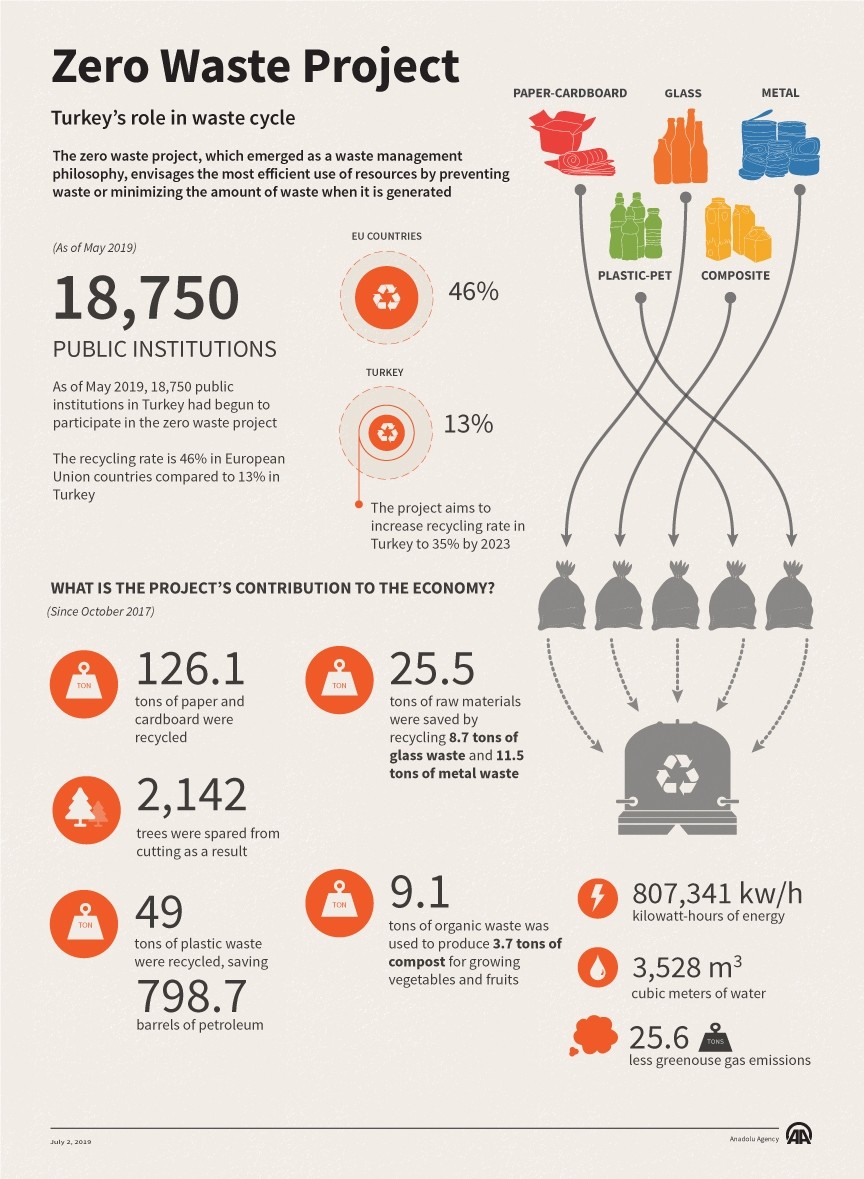
How wide-ranging is the Zero Waste Project?

The recycling rate is 46% in the European Union countries compared with 13% in Turkey. The project aims to increase that ratio to 35% in Turkey by 2023.

As of May 2019, 18,750 public institutions in Turkey had begun to be included in the zero waste project, separating their waste at its source.

In order to achieve success in the zero waste project and increase the waste recycling rate, household wastes should also be separated at their source and collected with this system.

What is the project's contribution to the economy?

Within the framework of this project, which has been running for 19 months, 126.1 tons of paper and cardboard were recycled, preventing the cutting of 2,142 trees, while 49 tons of plastic waste were recycled, saving 798.7 barrels of petroleum. A total of 25.5 tons of raw materials were saved by recycling 8.7 tons of glass waste and 11.5 tons of metal waste, while 3.7 tons of compost were produced from 9.1 tons of organic waste and used for growing vegetables and fruits.

Moreover, biodiesel was produced by recycling waste vegetable oil, mineral oil was produced by recycling waste motor oil, and raw materials were produced by recycling electronic waste. According to the data available, the return from the first 19 months of the project was 807,341 kilowatt-hours of energy, 3,528 cubic meters of water, 1,490 cubic meters of storage space, and the reduction of greenhouse gas emissions by 25.6 tons.


The views and opinions expressed in this article are solely those of the author. They do not necessarily reflect the editorial stance, values or position of Daily Sabah. The newspaper provides space for diverse perspectives as part of its commitment to open and informed public discussion.
  • shortlink copied
  • KEYWORDS
    türkiye
    The Daily Sabah Newsletter
    Keep up to date with what’s happening in Turkey, it’s region and the world.
    You can unsubscribe at any time. By signing up you are agreeing to our Terms of Use and Privacy Policy. This site is protected by reCAPTCHA and the Google Privacy Policy and Terms of Service apply.
    No Image
    Shiite Muslims commemorate Ashura Day
    PHOTOGALLERY
    • POLITICS
    • Diplomacy
    • Legislation
    • War On Terror
    • EU Affairs
    • News Analysis
    • TÜRKİYE
    • Istanbul
    • Education
    • Investigations
    • Minorities
    • Diaspora
    • World
    • Mid-East
    • Europe
    • Americas
    • Asia Pacific
    • Africa
    • Syrian Crisis
    • İslamophobia
    • Business
    • Automotive
    • Economy
    • Energy
    • Finance
    • Tourism
    • Tech
    • Defense
    • Transportation
    • News Analysis
    • Lifestyle
    • Health
    • Environment
    • Travel
    • Food
    • Fashion
    • Science
    • Religion
    • History
    • Feature
    • Expat Corner
    • Arts
    • Cinema
    • Music
    • Events
    • Portrait
    • Performing Arts
    • Reviews
    • Sports
    • Football
    • Basketball
    • Motorsports
    • Tennis
    • Opinion
    • Columns
    • Op-Ed
    • Reader's Corner
    • Editorial
    • Photo gallery
    • DS TV
    • Jobs
    • privacy
    • about us
    • contact us
    • RSS
    © Turkuvaz Haberleşme ve Yayıncılık 2021