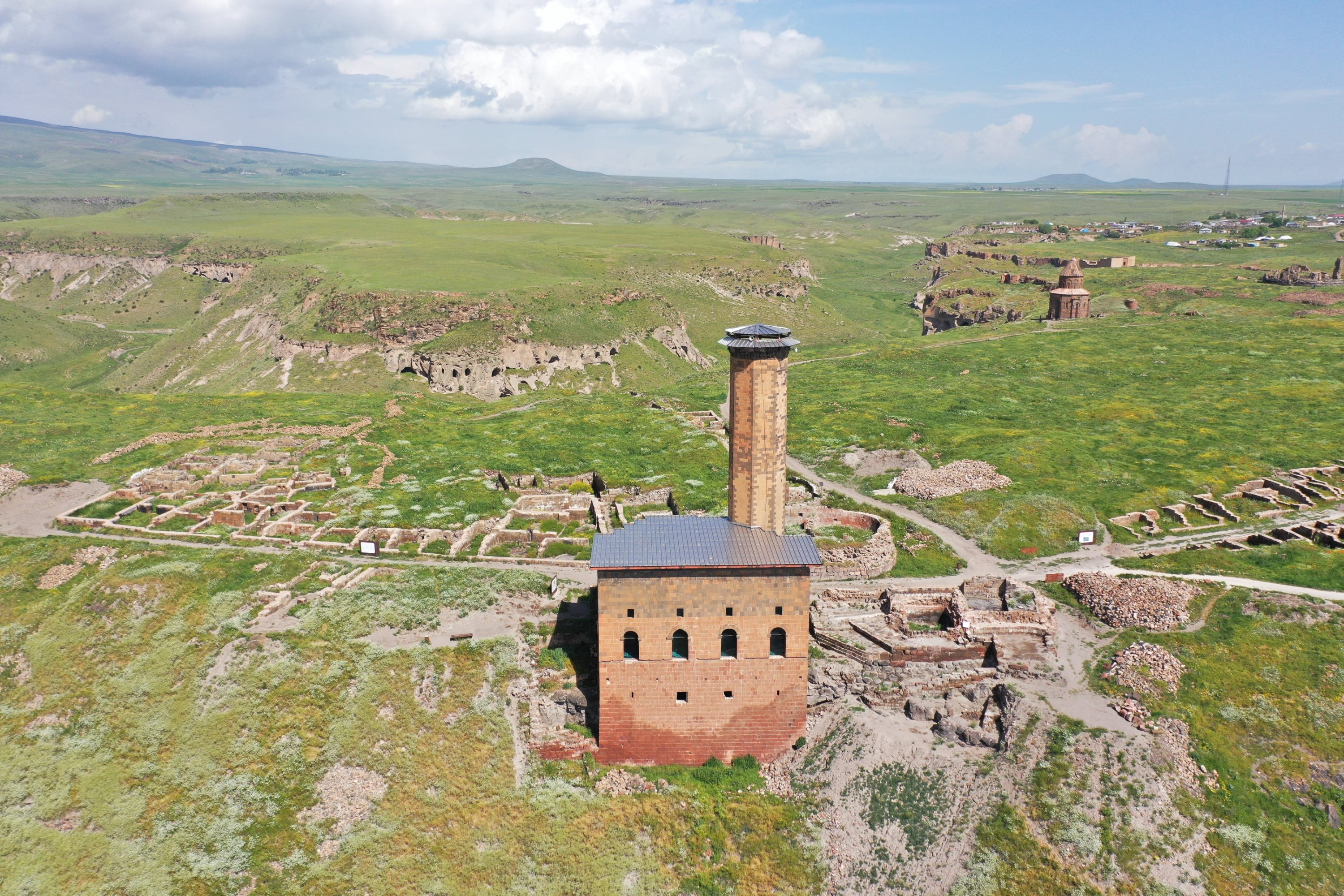
Standing for nearly a thousand years on the windswept plains along the Türkiye-Armenia border, the Ebu’l Menuçehr Mosque – the first Turkish-built mosque in Anatolia – continues to bear the marks of history.
Located in the UNESCO World Heritage-listed Ani archaeological site in eastern Kars, the mosque was constructed between 1072 and 1092 by Ebu’l Menuçehr under the orders of Seljuk Sultan Melikşah, shortly after the city fell to Sultan Alparslan in 1064. Ani, once ruled by the Bagratids and later the Byzantines, became a gateway for the Turks into Anatolia and went on to host 23 civilizations.
The mosque reflects the early Turkish-Islamic architectural tradition in Anatolia, said Muhammet Arslan, head of the Ani excavations. “Its deep, three-aisled plan was first seen in pre-Anatolian Seljuk lands and was applied here for the first time in Anatolia,” he told Anadolu Agency (AA).
Arslan described the mosque as a prototype for later masterpieces, including the Great Mosque of Divriği, which follows the same design principles with some variations in scale and detail.
The mosque fell into disuse after suffering damage during the 1877-78 Ottoman-Russian War. In 2022, a restoration initiative led by the Serhat Development Agency made it functional again by securing its doors and windows and furnishing it for worship. Five daily calls to prayer have since echoed from its walls.
Under the Ministry of Culture and Tourism’s "Legacy for the Future" program, detailed restoration plans are being prepared. “We hope to begin comprehensive restoration soon,” Arslan said.