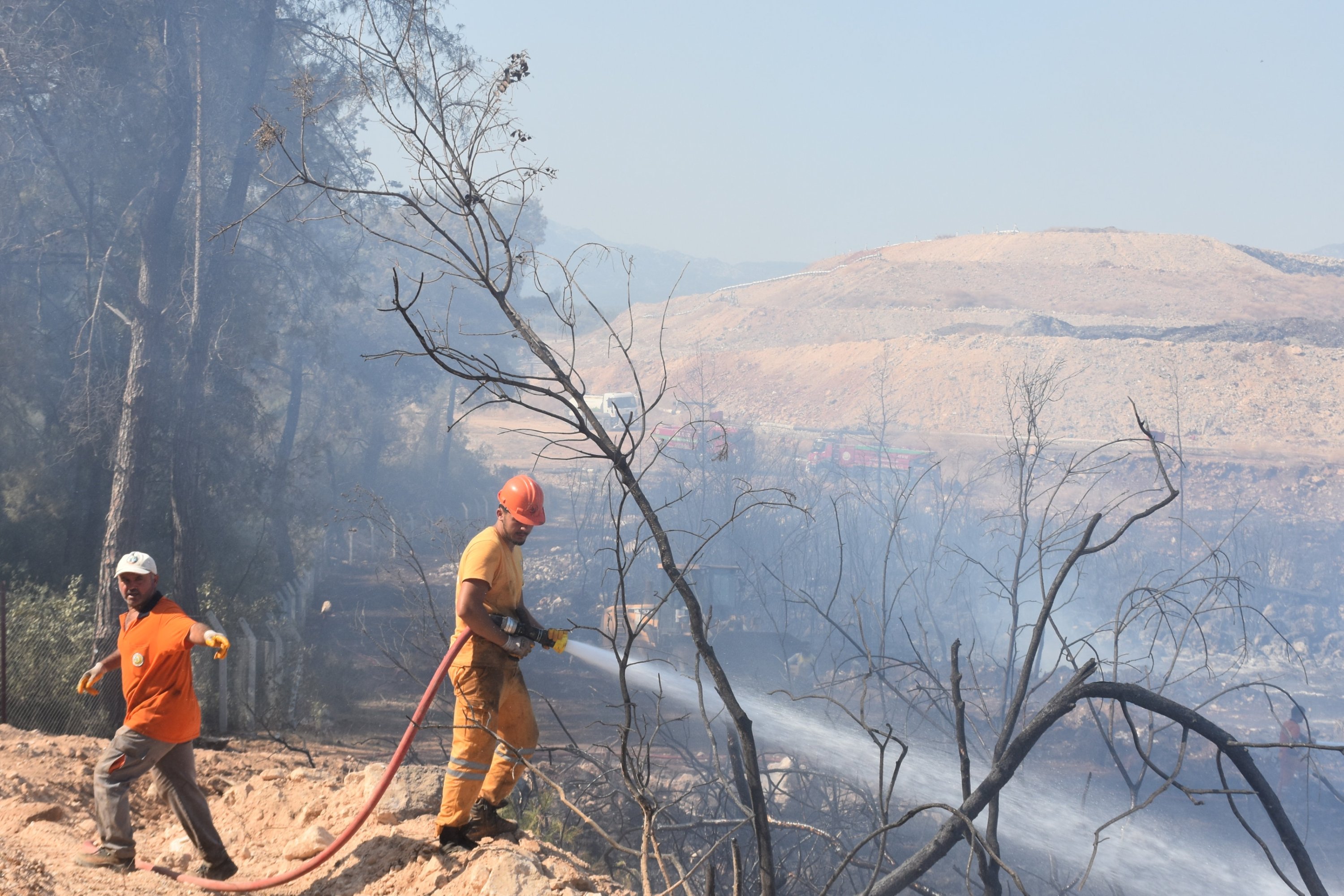
Türkiye faces mounting wildfire threats as climate change, drought and shifting social dynamics combine to increase risks across the Mediterranean basin and beyond. Experts warn that the danger is no longer confined to the country’s Aegean and Mediterranean coasts; it is steadily spreading northward, threatening regions historically less affected by large-scale fires.
Istanbul University-Cerrahpaşa Faculty of Forestry Watershed Management Department lecturer Prof. Dr. Yusuf Serengil said the wildfire danger in Türkiye and the wider Mediterranean region remains critical. Both climatic factors, such as rising temperatures, low humidity and strong winds, and social factors, including rural depopulation, are fueling the risk, he said.
“Strong winds, temperature and humidity conditions, and the amount of combustible material in forests directly affect fires. Therefore, the risk of forest fires in the Mediterranean geography is far from over,” Serengil said.
Serengil highlighted that some forest types in the western Black Sea region of Türkiye share similar structures with those in the Aegean and Mediterranean, making them more prone to wildfires. Tree species such as red pine and black pine heighten vulnerability, whereas deciduous forest ecosystems remain comparatively less exposed. He explained that this year’s northward shift of wildfire-prone zones is no coincidence.
“Drought and rising temperatures have expanded fire-sensitive areas. Villages and towns in northern Türkiye, which previously had little firefighting experience, are now at greater risk,” he warned.
On peak days, Türkiye experiences 40 to 50 fire outbreaks daily. While most are extinguished quickly, some spread rapidly, covering several hectares and turning into large-scale wildfires. According to Serengil, the rise in wildfire risks is linked not only to climate change but also to social transformations.
“Migration from rural areas to cities has eroded traditional fire prevention knowledge. Villagers used to understand how to manage risks and often helped put out fires. Now, with fewer people remaining in rural areas, vulnerability has grown — not just in Türkiye, but also in countries like Portugal, Spain and France,” he noted. He stressed that, in the Mediterranean basin, social factors are increasingly as critical as climatic ones in amplifying wildfire risks.
Serengil warned that Türkiye’s fire season now lasts longer than in previous decades. “Wildfire risks can persist well into October and November. Under dry and windy conditions, fires can even occur as early as March and April,” he said. He also noted that the timing and severity of wildfire outbreaks shift across Europe from year to year.
“Some years, fire activity peaks in Greece, other years in Italy, and sometimes in Türkiye. Years with fewer fires allow combustible material to build up, setting the stage for more intense fires later on,” he explained. This year, the Iberian Peninsula suffered weeks-long wildfires, while in Türkiye, fires continue to break out even though villagers claim they avoid stubble burning.
Serengil pointed out that Türkiye’s forests are structurally more fragile compared with those in Germany, Canada or the U.S. “Our forests are smaller, more fragmented and intersected by roads and settlements. While this sometimes limits fire spread, the risk of northward expansion is rising. Over the next five to 10 years, we may face more frequent wildfires in Artvin and nearby regions,” he cautioned.
Rainfall and nighttime humidity, which begin in northern Türkiye from mid-September, provide some relief, slightly reducing fire risks. However, Serengil stressed that Türkiye’s current fire management strategies must shift focus. “Extinguishing fires is not enough. We must strengthen preventive measures and aim to stop fires before they start,” he said.
The European Union’s Copernicus satellite monitoring system, which analyzed wildfire conditions between Sept. 2 and 8, revealed high fire risks across multiple regions, including Türkiye’s western and central Black Sea areas, the Aegean and Mediterranean coasts, the Iberian Peninsula, Italy, Greece, Morocco, Algeria, Bulgaria, Romania and Ukraine. These findings show that much of southern and southeastern Europe remains highly vulnerable to destructive wildfires.
A report by World Weather Attribution, or WWA, concluded that climate change has made severe wildfires 10 times more likely in Türkiye and Greece. Key findings include a drop of about 14% in total rainfall in Türkiye during the October–April pre-fire period, creating drier spring conditions and more combustible summer environments.
The report also warned that without a rapid transition from fossil fuels to renewable energy, Türkiye, Greece and Cyprus will face harder-to-control and more destructive wildfires. Global temperatures are projected to rise by 2.6 degrees Celsius (36.7 degrees Fahrenheit) under current policies, which would make future wildfires 18% more intense, increase the probability of wildfires nearly sixfold, and make controlling active fires 25% more difficult once they begin.
Experts stress that Türkiye, along with other Mediterranean countries, has entered a new era of heightened wildfire risks. As climate change, rural depopulation and fragile forest structures converge, the need for preventive strategies has become urgent. “We must recognize that the conditions driving wildfires are changing,” Serengil warned. “If Türkiye and other Mediterranean countries fail to adapt quickly, the coming years could bring far more severe and uncontrollable wildfires.”