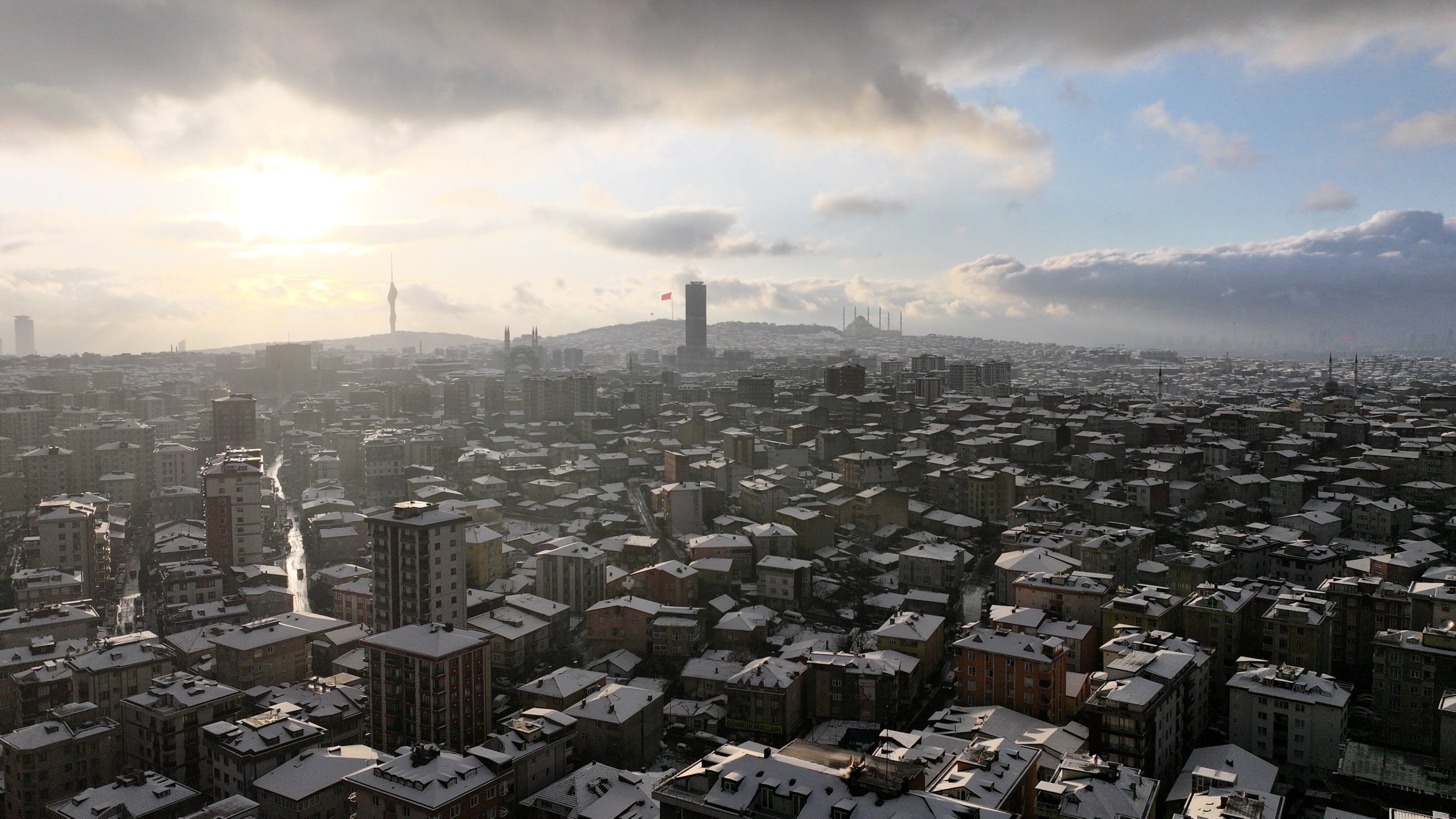
A study conducted under Istanbul Technical University (ITU) has identified a mixed trend in Istanbul’s air pollution levels in 2025, with particulate matter concentrations declining compared with the previous year, while nitrogen dioxide levels increased.
The research was carried out by Hüseyin Toros, a faculty member of the Department of Meteorological Engineering at ITU’s Faculty of Aeronautics and Astronautics, focusing on a comparative analysis of air pollution data recorded in 2024 and 2025.
Within the scope of the study, particulate matter (PM10) and nitrogen dioxide measurements obtained from air quality monitoring stations operated by the Ministry of Environment, Urbanization and Climate Change and the Istanbul Metropolitan Municipality were examined in detail.
According to the findings, the average particulate matter concentration across 26 monitoring stations in Istanbul measured 35.8 micrograms per cubic meter in 2024, while in 2025 this figure declined to 34.7 micrograms per cubic meter. As a result, particulate matter–related air pollution in the city decreased by approximately 3% compared with the previous year.
In 2024, the highest particulate matter concentration was recorded at the Kağıthane 1 monitoring station, where levels reached 63 micrograms per cubic meter. This was followed by the Sultangazi 3 station with 57.1 micrograms and the Tuzla station with 56.3 micrograms.
During the same period, the lowest particulate matter levels were measured at the Sarıyer station, with an annual average of 17.8 micrograms per cubic meter. This was followed by Büyükada, where PM10 levels stood at 19.3 micrograms, and Arnavutköy, which recorded 21.8 micrograms per cubic meter.
Across Istanbul, particulate matter pollution levels increased at 12 monitoring stations, declined at 13 stations, and remained unchanged at one station, indicating uneven distribution of air quality improvements across the city.
In contrast to the decline observed in particulate matter, nitrogen dioxide pollution showed an upward trend in 2025.
Data indicates that in 2024, the average nitrogen dioxide concentration across 21 monitoring stations stood at 35.7 micrograms per cubic meter. In 2025, this figure rose to 37.2 micrograms per cubic meter, reflecting an approximate 4% increase compared with the previous year.
The highest nitrogen dioxide concentration in 2025 was recorded at the Aksaray station, where levels reached 74.9 micrograms per cubic meter. Aksaray was followed by the Beşiktaş station, which measured 51 micrograms, and the Bağcılar station, where concentrations reached 48 micrograms per cubic meter.
At the lower end of the scale, the Kumköy station recorded the lowest nitrogen dioxide concentration in 2025, with an annual average of 13.2 micrograms per cubic meter. This was followed by Beylikdüzü, with 23.8 micrograms, and Avcılar, with 24.6 micrograms per cubic meter.
Citywide, nitrogen dioxide pollution levels increased at nine monitoring stations, while 12 stations recorded a decrease, again highlighting location-based differences in air quality dynamics.
Toros emphasized that airborne dust particles and nitrogen compounds originating from industrial activity and transportation represent major risks to public health.
He said that air quality measurements in Istanbul are currently conducted at 37 locations by both the Ministry of Environment, Urbanization and Climate Change and the Istanbul Metropolitan Municipality.
“We obtained hourly data for both 2024 and 2025 from these monitoring stations and subjected the datasets to quality control procedures. We examined whether each station had at least 75 percent data coverage over a 10-year period,” Toros said.
He noted that urban activity patterns and meteorological conditions play a decisive role in determining pollution levels, explaining that high-pressure systems can cause pollutants to become trapped over the city for extended periods.
Assessing the annual averages, Toros underlined that both particulate matter and nitrogen dioxide concentrations remain below the European Union’s annual limit value of 40 micrograms per cubic meter.
However, he cautioned that when evaluated against World Health Organization (WHO) guideline values, both pollutants continue to exceed recommended thresholds.
Highlighting the importance of collective responsibility, Toros stressed that achieving cleaner air requires sustained societal engagement.
“In order to protect public health in Istanbul and other cities, we must work together to make the air cleaner. Each individual should consider how they can reduce atmospheric pollution within their own capacity,” he said.
Toros pointed out that avoiding road travel during peak traffic hours or choosing public transportation can significantly reduce emissions.
He noted that Istanbul currently has approximately 6 million vehicles, a figure that exceeds the city’s road infrastructure capacity.
As traffic congestion intensifies, vehicles remain operational for longer periods and frequent stop-and-go movement increases fuel consumption, leading to higher pollutant emissions.
Toros further warned that air pollution remains a global public health challenge, stating that pollution and smoking-related exposure result in an annual population loss worldwide equivalent to the population of Istanbul.
He added that environmental pollution not only contributes to premature deaths but also reduces work capacity, lowers productivity and leads to rising health care expenditures.