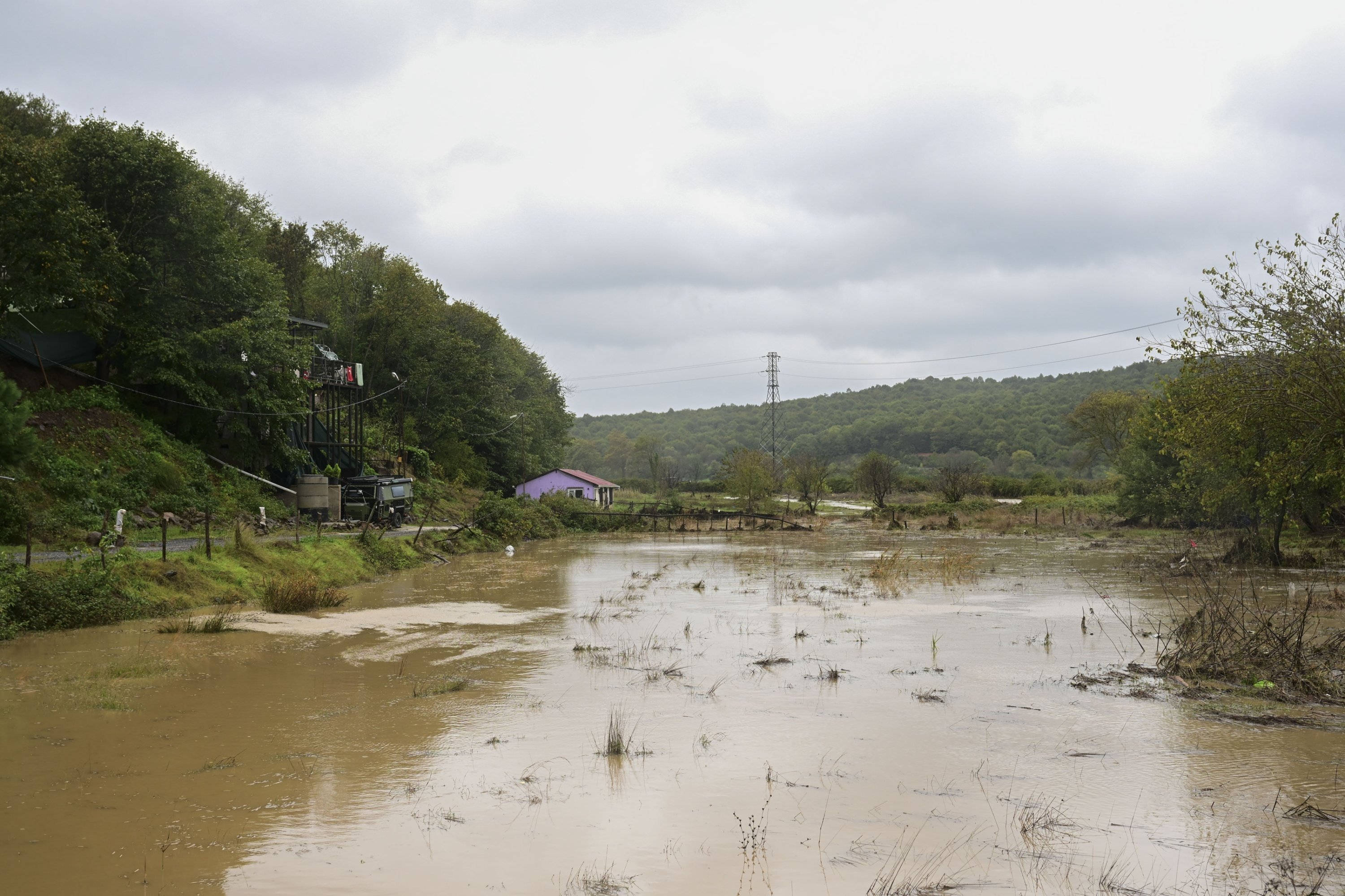
Istanbul’s dam occupancy rate has climbed to 61.5%, the highest level for the same period in a decade, following weeks of heavy rainfall, official data showed Friday.
The average fill rate rose from 38.06% on Oct. 14 to 61.5% on Nov. 6, gaining 23.44 percentage points in 23 days, according to the Istanbul Water and Sewerage Administration (ISKI).
The increase follows rainfall that began on Oct. 13 and intensified the following day, boosting water reserves across the city’s dams.
The current occupancy rate is significantly higher than the 22.19% recorded on the same date last year. It also surpasses levels recorded on Nov. 6 in each of the previous nine years, when rates ranged from 17.01% in 2023 to 56.21% in 2017.
Among Istanbul’s 10 main dams, Istrancalar has the highest occupancy rate at 98.04%, followed by Darlık at 95.19% and Ömerli at 83.11%. Alibey stands at 79.68%, while Elmalı is at 80.84%.
However, water reserves remain critically low at some reservoirs. Pabuçdere’s occupancy rate stands at 7.74%, while Kazandere is at 11.55%. Büyükçekmece is at 39.81% and Sazlıdere at 40.75%.
The city’s dams and reservoirs have a combined storage capacity of 868.68 million cubic meters, with stored water reaching 533.75 million cubic meters as of Friday. Istanbul’s daily water consumption stood at 3.014 million cubic meters on Thursday.
Istanbul also received 587.09 million cubic meters of water from the Melen and Yeşilçay systems this year, including 463.54 million cubic meters from Melen and 123.55 million cubic meters from Yeşilçay. Drinking water treatment plants supplied 976.09 million cubic meters to the city over the same period.
The increase in Istanbul’s dam levels comes as Türkiye records exceptionally high rainfall nationwide.
Adil Tek, a meteorological engineer at the Meteorology Laboratory of Boğaziçi University’s Kandilli Observatory and Earthquake Research Institute, said rainfall was expected to remain above average through the end of the year, potentially raising dam levels further.
Tek attributed the recent precipitation to atmospheric circulation patterns and rising water temperatures in the Central Mediterranean, Marmara and Black Sea, which have supported the movement of cold polar air and increased rainfall across the Eastern Mediterranean.
According to Kandilli Observatory’s records, Türkiye received 1,029.5 kilograms of precipitation per square meter (40.5 inches of precipitation) between Jan. 1 and Nov. 5, 2026, making it the second-wettest year for that period in the observatory’s 115-year record.
The highest total was recorded in 2010, when precipitation reached 1,059.1 kilograms per square meter. Other notably wet years included 1997, with 911.7 kilograms per square meter, 1981, with 899.7 kilograms per square meter, and 1951, with 858.1 kilograms per square meter.
Tek said rainfall had increased in Türkiye and parts of the eastern Mediterranean while declining in some European regions, where heat and drought had contributed to a significant drop in the Danube River’s flow.