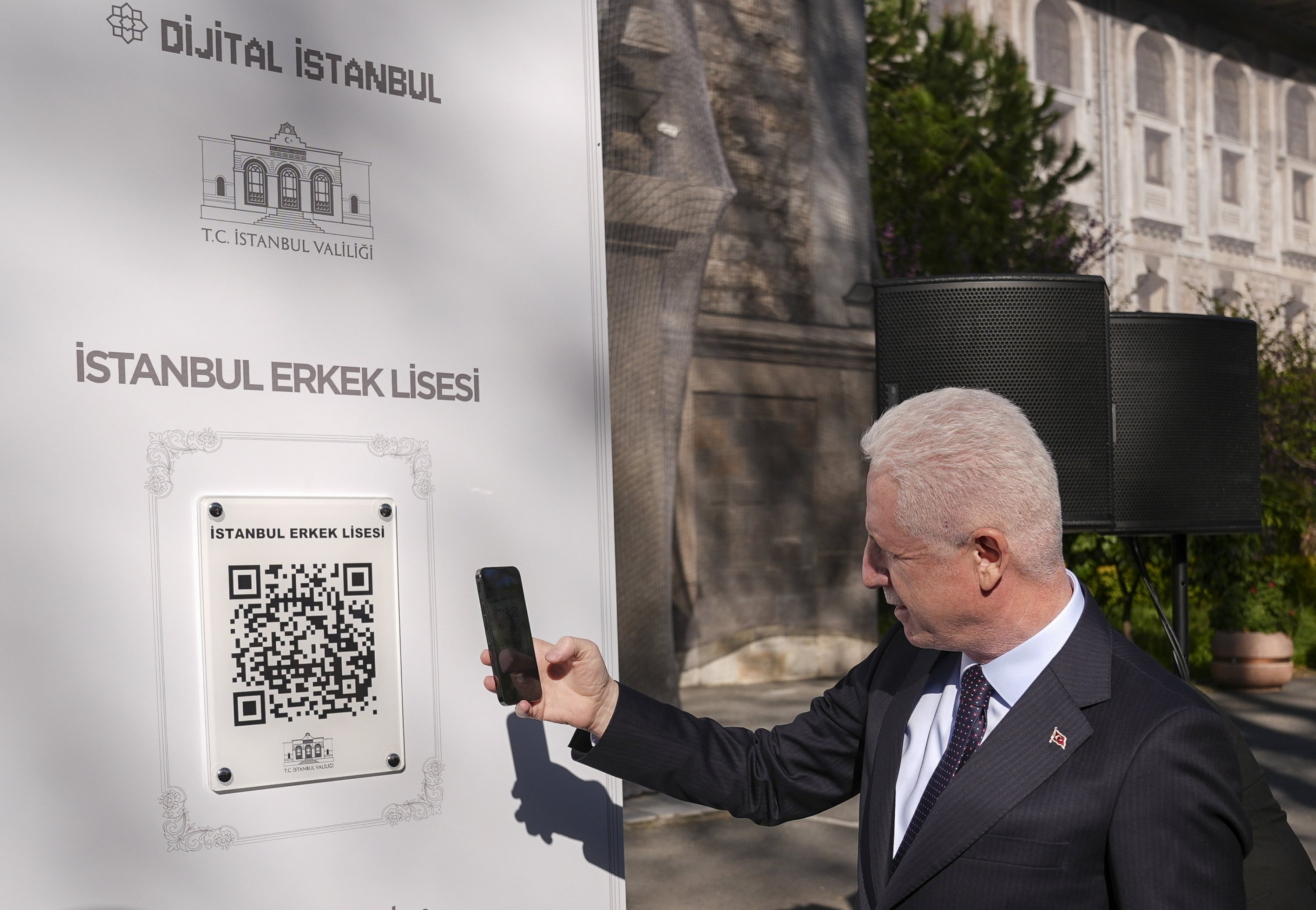
The fourth phase of the “Digital Istanbul” project, which enables the digital promotion of the city’s historical sites in five languages, has been launched in schools by the Istanbul Governor’s Office.
The launch of the fourth phase of the smart city initiative “Digital Istanbul” was held at Istanbul Boys High School on Wednesday.
Within the scope of the project, QR codes have been installed not only in historical mosques and tombs, but also in historical schools, madrasas, lodges, churches, and synagogues across the city.
After scanning the QR codes, visitors are directed to a page where they can access written and audio information about the historical, cultural, and architectural features of the sites in five languages: Turkish, English, German, Russian and Arabic.
The project provides digital guidance for anyone wishing to explore cultural heritage, enabling fast, accurate, and accessible information about registered cultural assets in the city.
Speaking at the launch ceremony, Istanbul Governor Davut Gül stated that digital content has been prepared in five languages for 1,337 historical sites.
Gül said, “When these 1,337 sites are scanned with a QR code, the entire past comes to our phones. More importantly, we gain access to accurate information. We can also listen to it live. In this living school, we are also guided. We try to improve by learning from the field, our shortcomings, what needs to be done, satisfaction levels, and how things can be better.”
He noted that nearly all registered cultural assets have been digitized, adding, “In Istanbul, a city visited by nearly 20 million foreign tourists annually and home to 16 million residents, as well as visitors from across Anatolia, it is important to properly explain restored buildings carried out in accordance with their original structure.”
Istanbul provincial director of National Education professor Murat Mücahit Yentür said the project also contributes to building culture, identity, and awareness.
He stated that schools have been included in the fourth phase of the project, adding, “One of the most important aspects of Türkiye’s education model is out-of-school learning environments. Historians say Istanbul is a large open-air museum. As educators, we now say Istanbul is perhaps the world’s largest open-air classroom. There are meaningful lessons and deep traces for students in every street and every corner of this city.”
He added that students can now access accurate information simply by scanning QR codes while completing assignments within Istanbul’s historic environment, which will leave a lasting impact on their cultural memory.