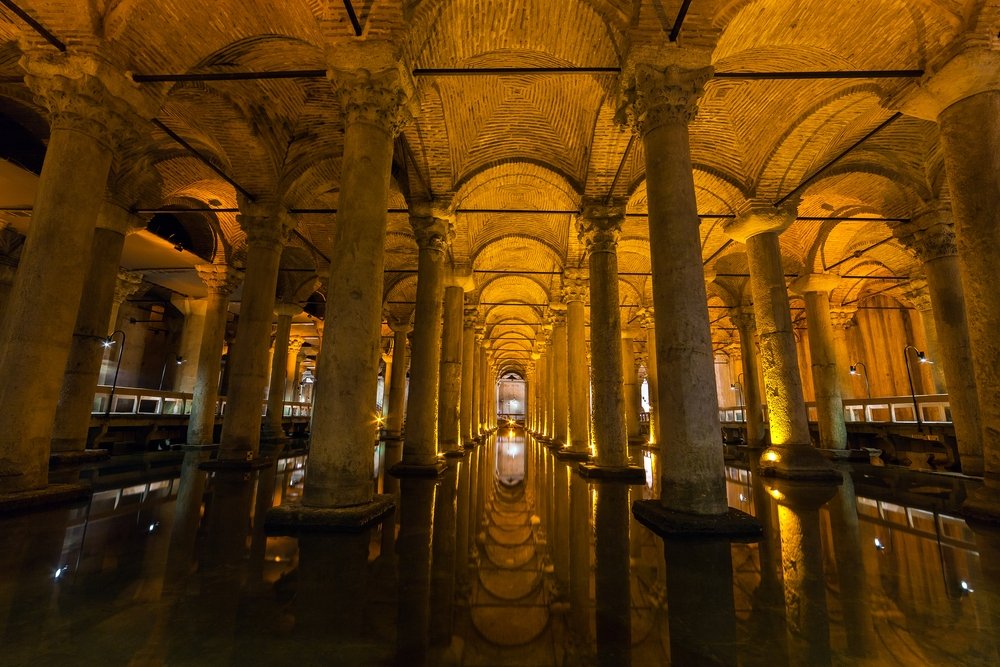
The Basilica Cistern, one of Istanbul’s most prominent historical landmarks, preserves traces of the Byzantine, Ottoman and Republican periods, reflecting the city’s layered cultural heritage through its centuries-old architecture.
Built between 532 and 542 under Eastern Roman Emperor Justinian I, the underground structure once served as a major water storage facility. Today, it operates as a museum attracting large numbers of domestic and international visitors.
Known in Turkish as Yerebatan Sarnıcı, the cistern is popularly called the “Sunken Palace” because of its hundreds of marble columns rising from the ground, creating the impression of an underground palace. Its Latin name, “Cisterna Basilica,” reflects the presence of the Stoa Basilica, which previously stood at the site.
Associate professor Yunus Uğur, a faculty member at Marmara University’s Faculty of Humanities and Social Sciences and director of its Digital Humanities Research Center, said that the cistern represents one of the clearest examples of Istanbul’s layered urban history.
Uğur said the city’s urban history dates back approximately 2,600 years, while archaeological findings suggest that human settlement in the area stretches back 8,000 years.
The cistern, located within an area on the UNESCO World Heritage List, reflects the cultural contributions of successive civilizations, he said.
“Today, Istanbul contains layers of Byzantine, Ottoman and Republican history. The Basilica Cistern is rare in that it reflects all three periods,” Uğur said.
During the Ottoman era, the approximately 10-decare area above the cistern housed several important structures, including the Esad Efendi Library, Üsküplü Mehmet Ağa Mosque and the Turşucuzade Ahmet Muhtar Efendi Mansion.
The site was later officially registered and restored during the Republican period, eventually acquiring its current identity as a major cultural attraction.
“This site conveys a message to the world: Although people come and go and historical periods change, this place remains a shared heritage of humanity to which every civilization has contributed in its own way,” Uğur said.
The cistern underwent several restoration projects over the centuries. Its first restoration during the Ottoman period took place under Sultan Ahmed III, with architect Kayserili Mehmet Ağa overseeing the work. A second restoration followed during the reign of Sultan Abdülhamid II.
Uğur said thick layers of mud and silt once created significant challenges for maintaining and using the structure. During Abdülhamid II’s reign, a section containing 41 columns was sealed off with a wall for safety reasons.
Efforts to clean the cistern resumed in the early 20th century, partly because local residents needed access to water, but the accumulated mud made the work difficult.
German archaeologist Eckhard Unger conducted a detailed examination of the site by boat in the early 1900s. During and after World War I, the cistern became increasingly known as a place that visitors could explore by boat.
Electrical installations were recorded at the site in 1921, while the entrance areas were expropriated in the 1940s. A building belonging to the Special Provincial Administration was subsequently constructed above the cistern in 1960.
The discovery of the Million Stone in the surrounding area in 1957 further increased interest in the site, which was officially registered in 1974.
A major restoration project began in 1985, based on joint reports prepared by the municipality and foundations. The work removed the thick layers of accumulated mud and introduced the cistern’s first walkways.
The famous Medusa heads were identified in 1986. Although officials considered transferring them to other archaeological museums, they ultimately remained in their original location.
The cistern opened to the public in 1987. A second major restoration process, launched in 2014, helped bring the structure to its current modern and protected condition. Following its latest restoration, the site reopened on July 22, 2022.
The Basilica Cistern has a water storage capacity of approximately 100,000 tons and contains 336 columns, each measuring 9 meters (30 feet) in height, Uğur said.
Around 80 columns feature carved capitals, while the remaining columns have plain capitals.
The two Medusa heads are among the structure’s most recognizable features. Used as column bases, one is positioned upside down and the other on its side.
The cistern’s Weeping Column, also known as the Tear Column, is another architectural feature that attracts considerable interest from visitors.