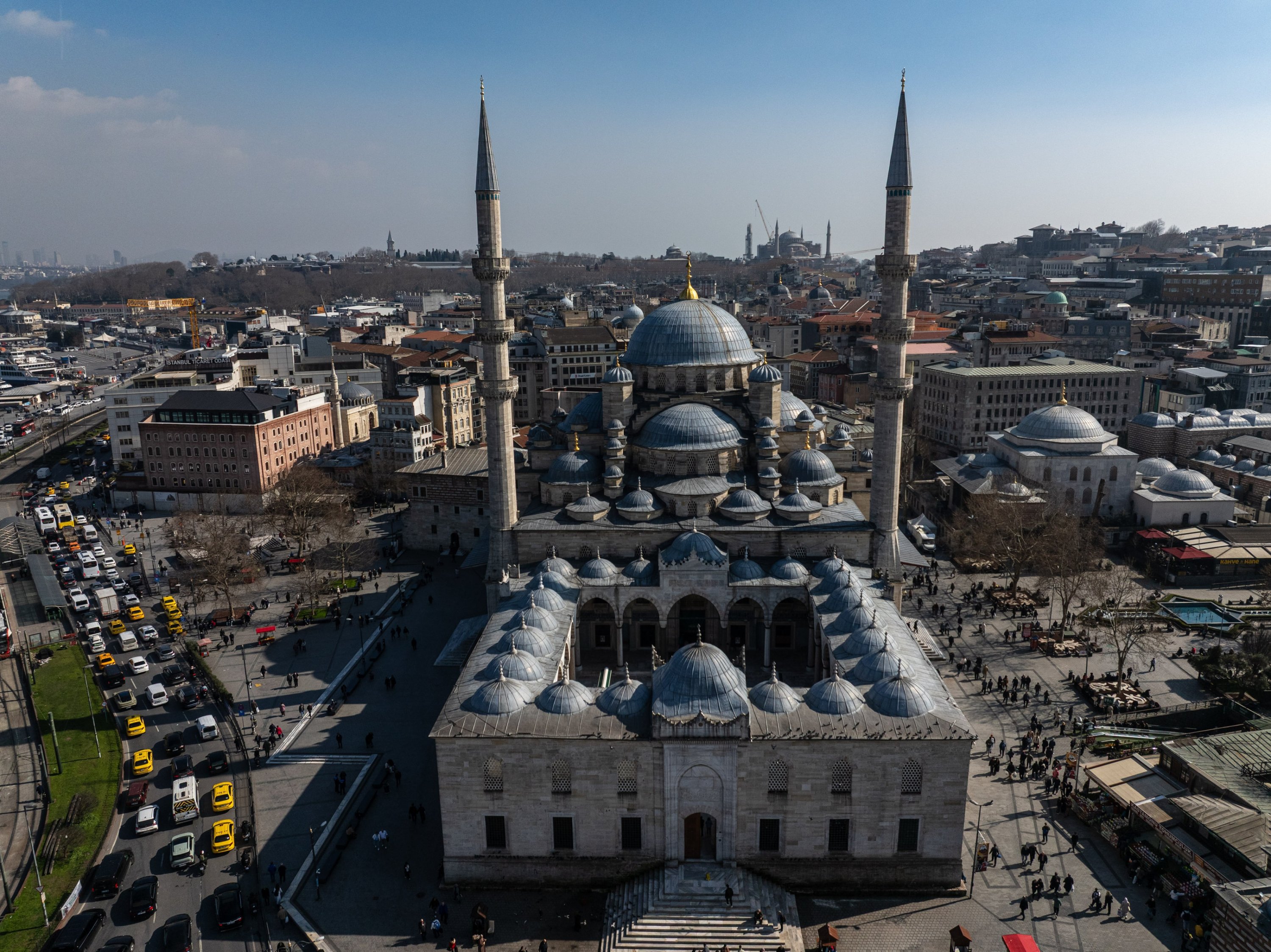
The Yeni Mosque in Istanbul, which is one of the city’s historic religious landmarks located in the busy Eminönü district, continues to draw attention with its unique history, architecture and prominent position in the urban landscape.
Known as the mosque with the longest construction period in Ottoman history, the structure was first commissioned in 1598 and was completed 67 years later in 1665.
Situated in one of Istanbul’s historic commercial hubs near the Golden Horn, the mosque has long served not only as a place of worship but also as a central element in the city’s social, economic and architectural life.
Construction of the mosque began in 1598 under the patronage of Safiye Sultan, the mother of Ottoman Sultan Mehmed III. The foundations were laid by Chief Architect Davut Ağa, one of the leading architects of the period.
However, the project soon faced interruptions due to political developments and financial constraints.
Following the death of Sultan Mehmed III, Safiye Sultan was moved to the Old Palace, which led to the suspension of the project. For decades the unfinished structure remained in the heart of the city, with attempts to revive the construction failing due to economic limitations.
The project was eventually revived in the 1660s by Turhan Hatice Sultan, the mother of Sultan Mehmed IV. The task of completing the mosque was entrusted to architect Mustafa Ağa, who resumed construction and finalized the structure in 1665, making the mosque one of the longest-running architectural projects of the Ottoman era.
The mosque reflects the characteristics of classical Ottoman mosque architecture, with a central dome supported by semi-domes arranged in a cascading system, two slender minarets and a spacious courtyard.
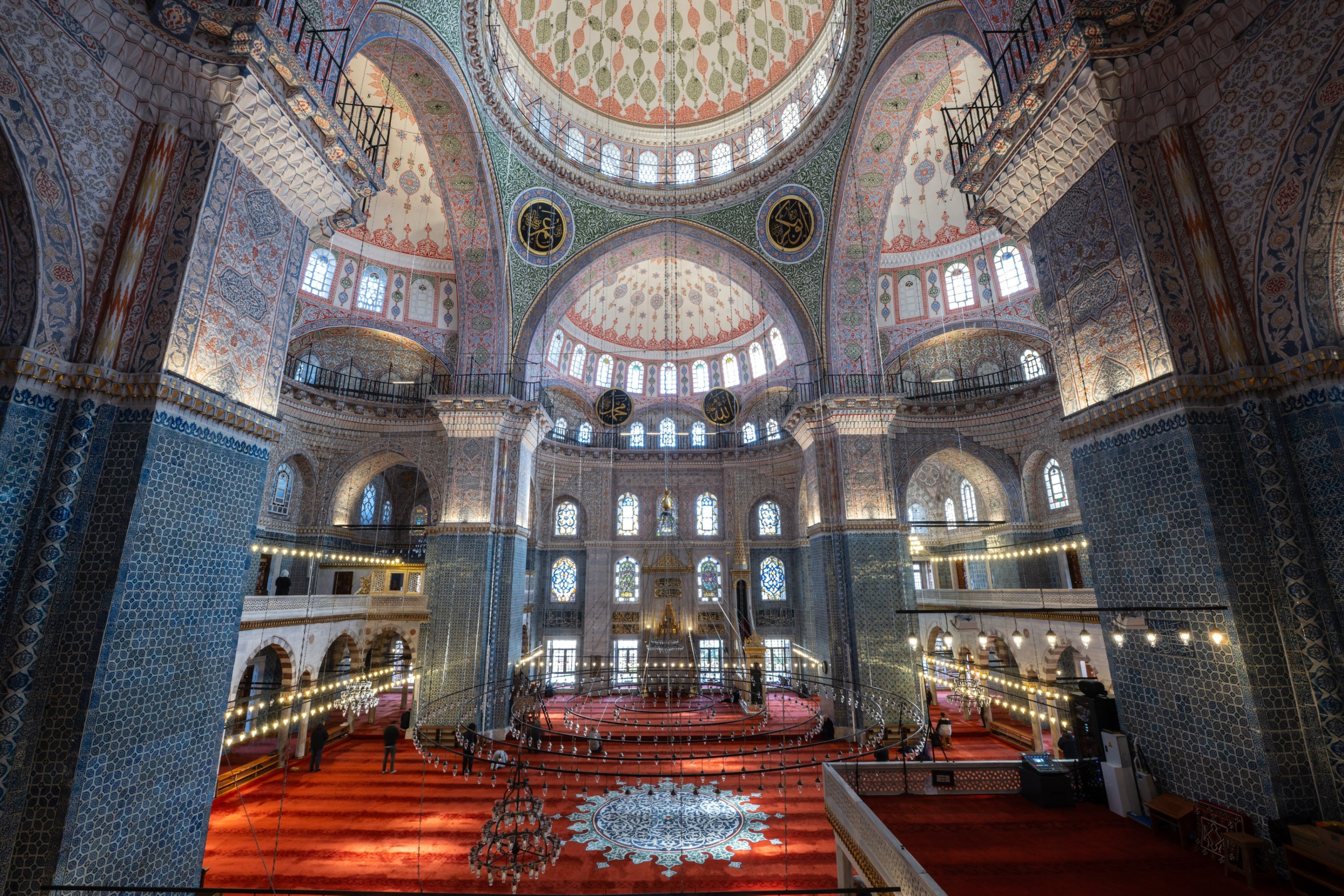
Inside the structure, visitors encounter Iznik tiles, intricate marble craftsmanship and painted ornamental decorations, all of which illustrate the artistic traditions of the Ottoman period. The decorative elements demonstrate a refined aesthetic while maintaining the classical architectural style.
The mihrab, made of marble and decorated with intricate motifs, stands out as one of the most striking architectural elements in the mosque. The minbar, also carved from marble, features delicate craftsmanship resembling lace-like patterns.
Another notable part of the mosque is the "hünkar mahfili," a specially designed elevated section where the sultan and high-ranking state officials once prayed. This section was decorated with detailed tile work, wooden craftsmanship and gold-leaf ornaments.
The Yeni Mosque was designed as the central structure of a "külliye," a complex of buildings serving religious, social and economic functions.
The complex includes structures such as a mausoleum, fountains, a public water kiosk, a Quranic recitation school and the Spice Bazaar.
The Spice Bazaar, located adjacent to the mosque, was constructed to generate financial income for the maintenance of the külliye, reflecting the Ottoman practice of linking religious institutions with commercial activity.
According to Prof. Dr. Aziz Doğanay from the Department of Turkish-Islamic Arts History at Marmara University's Faculty of Theology, imperial mosques played a key role in the urban planning of Ottoman cities.
He explained that sultans typically built külliye complexes in the most visible and populated parts of a city, placing the mosque at the center and surrounding it with institutions designed to meet the social needs of the population.
Around such complexes were facilities including madrasas, hospitals, soup kitchens, libraries, inns, baths and caravanserais, creating integrated urban centers that served both religious and social purposes.
“These structures provided nearly all services needed by people living in the city,” Doğanay said, noting that commercial spaces such as bazaars and markets were also organized around the mosque to encourage economic activity.