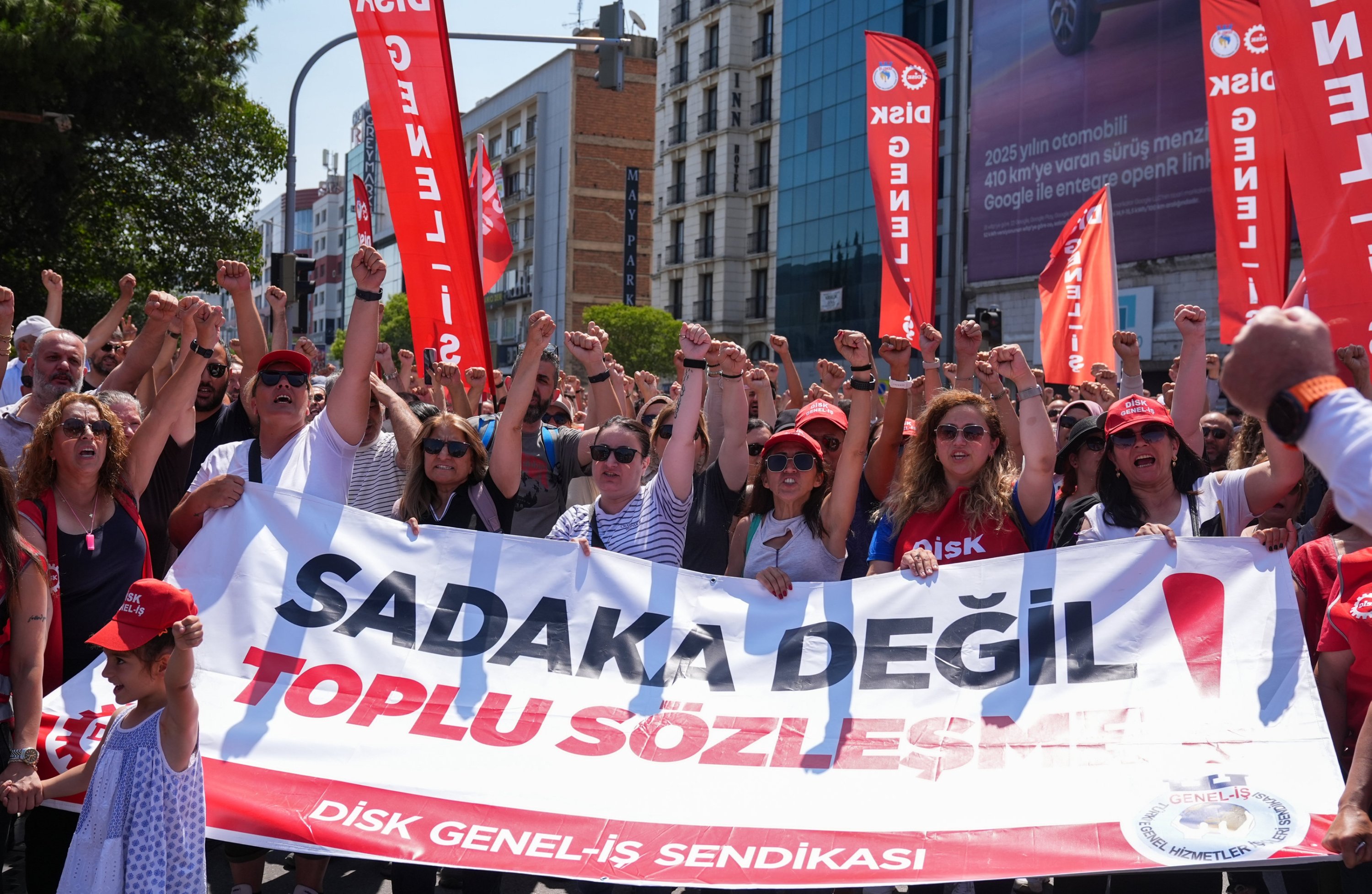
About 23,000 municipal workers in Türkiye’s western Izmir province returned to work after halting services for a week due to unresolved contract negotiations.
The week-long strike by approximately 23,000 workers employed under companies affiliated with the Izmir Metropolitan Municipality – including Izelman, Izenerji and Egeşehir – officially ended on its seventh day following a resolution between the municipality and the workers' union. The strike, led by the Confederation of Progressive Trade Unions of Türkiye (DISK)-affiliated General Services Workers’ Union (Genel-Iş), was launched on the night of May 28 after collective bargaining talks failed to yield an agreement.
Union leaders and workers had been protesting what they described as discrepancies between the terms discussed at the bargaining table and the statements later made publicly by municipal officials. The main point of contention involved the effective date for wage increases and inflation adjustments, whether the changes would begin in June or July. This uncertainty triggered concern among workers, who felt the municipality’s public narrative differed from what was discussed during negotiations.
On the morning of the strike’s seventh day, workers gathered at Kültürpark in central Izmir, where union leaders addressed the crowd. Engin Topal, chair of the General-Iş Izmir No. 1 Branch, emphasized that there had been miscommunication regarding the implementation date of the new terms.
“We met with the mayor to clarify whether this was a slip of the tongue or a deliberate statement. He insisted on July 1 as the start date, which contradicted earlier discussions,” said Topal.
Similarly, Ercan Gül, another senior union representative, stated that although the last proposal suggested that the inflation difference would be applied starting June 1 with an additional 19% raise, the mayor’s remarks cast doubt on the matter. Gül expressed frustration that verbal commitments made at the table were not being upheld in public statements.
“We have acted transparently throughout this process. There is organized strength here in Izelman and Izenerji workers. We will not allow attempts to divide us or to mislead the public,” he said.
Gül also alleged that several district mayors and local officials from the opposition Republican People's Party (CHP) had tried to pressure workers into returning to their jobs during the strike.
“They called our colleagues and threatened consequences if they didn’t resume work. But we didn’t give in to this pressure, and neither did the workers,” he said, noting that the union would stand firm against such tactics and continue to prioritize collective decisions made by their members.
Despite growing tension, the final agreement was reached on June 4, and workers officially ended their strike. The precise details of the revised contract have not yet been fully disclosed, but union representatives confirmed that the agreement resolved the dispute over payment dates and wage increases.
The strike severely disrupted essential municipal services across Izmir, affecting garbage collection, sanitation, park maintenance, public health operations, and administrative functions. As waste collection came to a halt, piles of uncollected garbage accumulated in the streets, leading to visible public health concerns and mounting pressure on local authorities.
The scale of the strike and the involvement of approximately 23,000 public-sector workers also drew nationwide attention, highlighting the growing unrest over labor conditions in municipal institutions.